


Most business owners think double bookings happen because someone messed up. They don't. They happen because appointment scheduling gets exponentially more complex when you're juggling multiple resources that need to work together. A massage therapist needs a specific room with a heated table. A dental hygienist needs an operatory with functioning equipment and an assistant. A hair colorist needs a processing station plus a wash basin at different times.
The real problem starts when these resources have different availability patterns and booking constraints. Your scheduling system might show Tuesday at 2pm as open, but that's meaningless if your only ultrasound machine is already booked, or if the specialist who operates it isn't working that shift.
Why standard calendars fail at multi-resource scheduling
Traditional appointment books treat scheduling like a single-dimensional problem — time slots are either open or taken. But real operations need to track whether Room 3 has the right equipment, whether that equipment is functional today, whether the staff member certified to use it is actually working, and whether the cleaning crew has time between appointments to sanitize everything.
Businesses try to solve this with color-coded spreadsheets, multiple calendar apps, sticky notes on equipment, and "just ask Sarah, she knows the schedule." These band-aid solutions create more problems than they solve. Staff spend hours cross-referencing different systems. Customers get frustrated when their "confirmed" appointment gets cancelled because someone forgot to check equipment availability.
The worst part? Most businesses don't realize how much money these conflicts cost. A medical clinic averaging around 400 appointments monthly can easily lose $8,000–$12,000 a month from inefficient resource allocation — not from missed appointments, but from expensive equipment sitting idle while patients wait because the scheduling didn't account for resource dependencies.
Building a resource classification matrix
Before fixing your scheduling chaos, you need to map out what you're actually scheduling. Not just "appointments" — the specific resources each appointment type requires.
Eliminate scheduling conflicts and missed meetings.
Schedily helps you organize and manage all appointments and team availability effortlessly.
- Unified appointment and resource management
- Automated notifications & reminders
- Team calendar synchronization
No credit card required
Start by categorizing your resources into four types:
Primary resources — The main person or thing delivering the service (therapist, instructor, specialist)
Secondary resources — Supporting staff or equipment needed during the service (assistant, specific tools)
Location resources — Physical spaces with specific features (treatment room, studio space, consultation area)
Consumable resources — Items that get used up or need recharge time (supplies, equipment that needs sterilization)
Here's what this looks like for a multi-service wellness center:
| Service Type | Primary Resource | Secondary Resources | Location | Consumables/Equipment |
|---|---|---|---|---|
| Deep Tissue Massage | Senior therapist | Heating pads, essential oils | Room with soundproofing | 60min table time + 15min turnover |
| Acupuncture | Licensed acupuncturist | None | Treatment room with storage | Needles, 45min table + 10min sanitization |
| Physical Therapy | PT specialist | Exercise equipment access | Open therapy floor OR private room | Resistance bands, evaluation tools |
| Infrared Sauna | None (self-service) | Staff for setup/cleaning | Sauna room | 45min session + 20min cleaning/heating |
Notice how different each service is? A massage needs continuous room access. Physical therapy might move between spaces. The sauna blocks a room longer than the actual appointment because of heating and cleaning time. These aren't edge cases — this is just how multi-service businesses operate.
Mapping resource conflicts and dependencies
Once you've classified your resources, the next step is identifying which combinations create conflicts. This isn't always obvious. Two services might look compatible until you realize they both need the only room with specific ventilation, or they require the same staff member who can't be in two places at once.
The conflicts generally fall into a few predictable categories.
Physical conflicts happen when two services need the same space or equipment. A dental practice can't schedule two patients for the same x-ray machine. A salon can't book two clients for the only pedicure chair with jets.
Staff conflicts occur when one person is needed for multiple appointments simultaneously. This gets tricky with specialists who float between locations or staff who perform multiple roles throughout the day.
Workflow conflicts come from service sequences. If someone books a hair color followed by a cut, you need the colorist first, then processing time at a different station, then the stylist. Mess up this sequence and you've got clients with half-processed hair sitting around wondering what's going on.
Equipment availability adds another layer. That laser hair removal machine might technically be free, but if it needs 30 minutes to calibrate after being moved between rooms, you can't run back-to-back appointments in different locations.
Below is a rough visual of how these resource dependencies flow during a typical multi-step appointment:
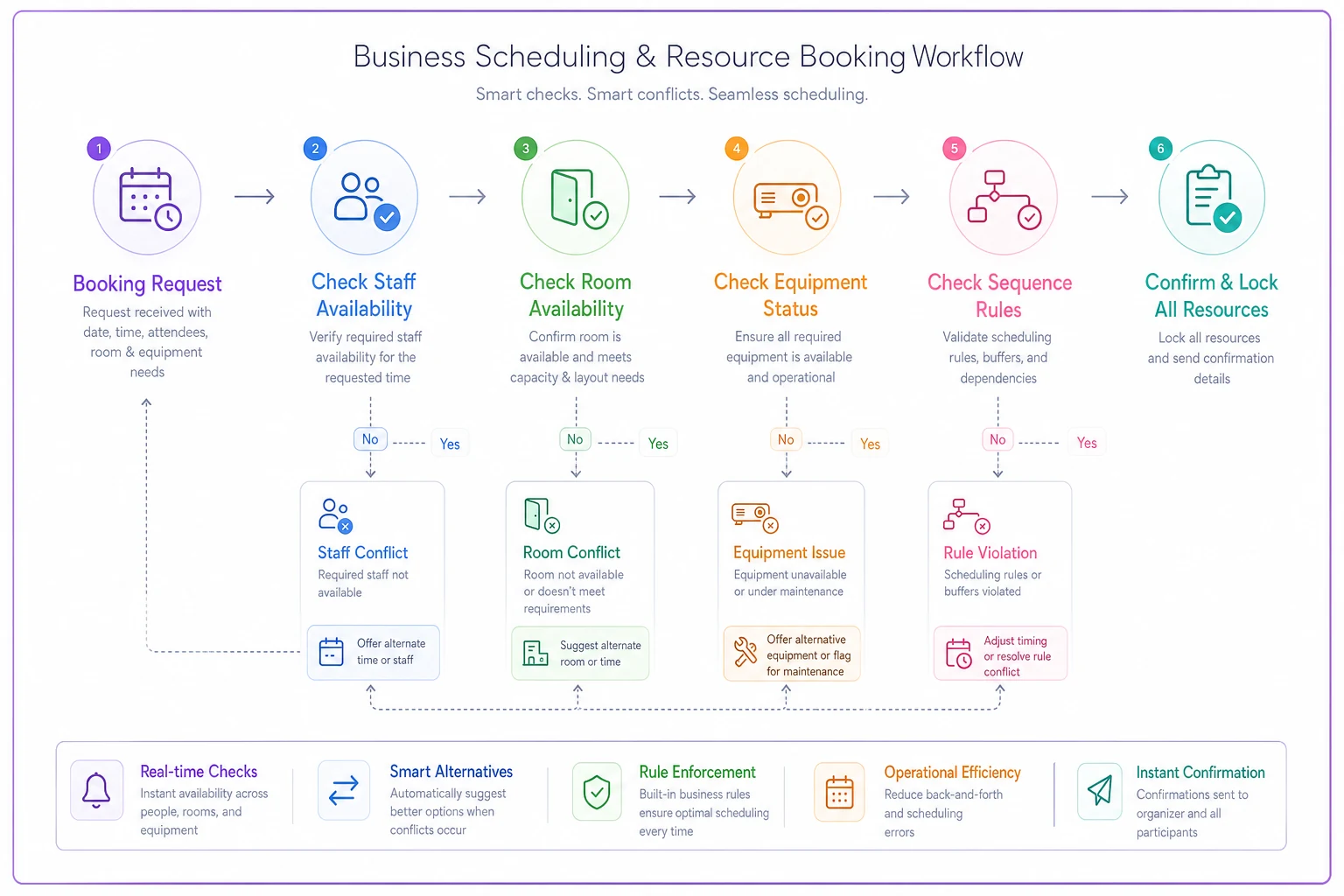
It sounds like a lot of steps, but this is exactly what's running through a good scheduler's head every time someone calls to book. The problem is doing it manually across dozens of appointments per day.
Creating booking rules that actually work
Generic rules like "30 minutes between appointments" don't cut it when you're managing multiple resource types. You need rules that reflect actual operational constraints.
For a dental practice, the rules might look like this:
-
Equipment-based rules - Hygiene appointments in rooms 1–3 only (equipped with ultrasonic scalers) - X-rays require 15-minute machine warm-up if it's the first appointment of the day - Surgical procedures need room 4 (specialized lighting and suction)
-
Staff-based rules - Dentist consultations can overlap with hygienist cleanings - Complex procedures require dentist and assistant together - New patient exams need an extra 20 minutes for paperwork
-
Sequence rules - Cleaning before dentist examination - X-rays before consultation for new patients - No invasive procedures after 4pm (recovery observation time)
The challenge is encoding these rules into your actual scheduling system, not just hoping everyone remembers them. Manual scheduling means someone has to check every rule for every appointment. Miss one and you've got an angry patient and idle equipment.
Here's a simple way to organize and document your booking rules by resource type:
| Rule Type | Resource Affected | Constraint | Notes |
|---|---|---|---|
| Equipment warm-up | X-ray machine | +15min if first booking of day | Front desk must flag AM appointments |
| Room assignment | Rooms 1–3 | Hygiene only | Room 4 reserved for surgical |
| Staff pairing | Dentist + assistant | Required for complex procedures | Can't book one without the other |
| Sequence | Cleaning → Exam | Cleaning must precede examination | Cannot be reversed |
| Buffer | All invasive procedures | No bookings after 4pm | Recovery observation required |
Getting these written down and enforced consistently is half the battle.
Handling schedule changes without cascade failures
This is where multi-resource scheduling gets really ugly. Someone cancels a 2pm appointment. Seems simple enough to fill that slot — except that appointment had blocked three different resources that other services could have used.
A photography studio deals with this constantly. A client cancels their portrait session, which had reserved the photographer, the main studio space, two lighting setups, and the makeup artist for the first hour only. Now you've got four resources with different availability windows. The makeup artist was only needed for that first hour and is already booked elsewhere for the second. The studio is free but the photographer has a consultation during part of that same window.
Smart operations build cascade rules into how they handle cancellations:
-
When a multi-resource appointment cancels with more than 48 hours notice, automatically release all resources back to available inventory and notify waitlist clients who need those specific combinations.
-
For same-day cancellations, check whether partial resources can still be used. Maybe you can't fill the full portrait session, but you could fit in a headshot that only needs the photographer and basic lighting.
-
Build buffer time into high-demand resources. If your MRI machine is booked solid, 15-minute buffers between appointments give you flexibility when things shift.
The businesses that handle cancellations well aren't just reacting — they've thought through these scenarios ahead of time and have a process ready to go.
Measuring scheduling efficiency with resource utilization
Most businesses track appointments per day or revenue per service. With multi-resource scheduling, you need deeper visibility into how efficiently each resource type is actually being used.
Staff utilization — Not just hours worked, but hours generating revenue. A therapist might be present for 8 hours but only performing treatments for 5 due to poor schedule coordination.
Room utilization — The percentage of available room-hours actually used. If treatment room 2 sits empty 40% of the time while clients wait for room 1, you've got a resource allocation problem.
Equipment utilization — Expensive equipment should run at roughly 70–85% capacity during operating hours. Lower means wasted capital. Higher risks breakdowns and delays.
A small dental practice was convinced they needed to add another operatory. Their scheduling data told a different story. Room utilization was only sitting at around 60%, but it felt maxed out because of scheduling conflicts — long procedures were getting booked during prime time while quick cleanings got pushed to slower periods. Reorganizing their booking rules increased capacity by roughly 25% without adding any rooms or staff.
Track these numbers monthly. They'll tell you more about your actual capacity than any gut feeling will.
Preventing bottlenecks in your highest-demand resources
Every business has bottleneck resources — the ones that cap your total capacity. In a medical imaging center, it's the MRI machine. In a salon, it might be the only stylist who does wedding updos. In a fitness studio, it's the reformer machines.
These resources need special treatment.
Reserve bottleneck resources for highest-value services first. If your ultrasound machine is the limiting factor, don't let routine check-ups block time slots that complex diagnostic cases need.
When you identify a bottleneck, map its peak usage hours and protect a small percentage of that time for triage or emergency bookings.
Build your schedule backward from bottleneck availability. If your color specialist only works Tuesday through Thursday, structure other appointments around maximizing their productivity during those three days.
Create overflow protocols for when bottlenecks hit capacity. Can you partner with another business for equipment access? Cross-train staff to reduce specialist dependencies? Extend hours for high-demand resources only?
The mistake most businesses make is treating all resources as equally important. They're not. Protect your bottlenecks and the rest of the schedule gets easier to manage.
Moving from reactive to predictive scheduling
The real shift happens when you stop just filling slots and start looking at patterns — what resource combinations get booked together, when demand spikes, which combinations create the most problems.
Resource clustering — Certain combinations get booked together frequently. Customers who book service A often want service B right after. Build package slots that pre-allocate both resource sets.
Demand timing — Some resources follow predictable patterns. Physical therapy equipment gets heavy use after typical work hours. Schedule maintenance during predictable slow periods.
Conflict patterns — Track which resource combinations create the most rebooking issues. If appointments requiring both the laser and the aesthetician constantly conflict, designate specific days for those combination services.
This kind of pattern recognition is hard to do manually when you're running a busy practice. It's also the thing that separates businesses that feel constantly overwhelmed by scheduling from ones that seem to run smoothly without much drama.
Technology's role in multi-resource coordination
Manual scheduling with multiple resources is nearly impossible to optimize at any real scale. Even small businesses with around 10 appointments per day and 3 resource types face thousands of possible scheduling combinations. Add constraints, preferences, and dependencies, and human schedulers simply can't calculate optimal arrangements reliably.
This is where AI-powered operational software becomes genuinely useful. Modern scheduling platforms can track all resource types simultaneously, enforce complex booking rules automatically, and adjust schedules in real-time as changes happen.
-
Real-time resource tracking across all categories — staff, rooms, equipment, consumables. The system needs to know not just what's booked but what's available, what's under maintenance, and what's approaching capacity limits.
-
Automatic conflict detection that catches problems before they happen. When someone tries to book, the system checks all resource dependencies instantly rather than relying on someone to remember the rules.
-
Dynamic optimization that continuously improves resource utilization. As appointments book and cancel, the system can flag moves that open up high-value time slots or reduce gaps.
-
Intelligent waitlist management that matches cancelled resources with waiting customers who need those specific combinations.
Platforms built around these capabilities can reduce scheduling errors significantly while improving resource utilization — and for a service business doing solid monthly revenue, that efficiency gain often translates to meaningful additional capacity without adding headcount or equipment.
Setting up for long-term scheduling success
Getting multi-resource scheduling right isn't a one-time project. Resource needs evolve as the business grows. New services require different combinations. Staff skills develop. Equipment gets upgraded or replaced.
Build review cycles into your operations:
-
Monthly Check resource utilization rates and identify emerging bottlenecks
-
Quarterly Review booking rules and update for new patterns
-
Annually Reassess your entire resource classification system
Document everything. When the person who "just knows how the schedule works" goes on vacation, your operation shouldn't grind to a halt. Every resource requirement, booking rule, and conflict pattern should be written down somewhere accessible.
Train your team on why resource scheduling matters. When staff understand that double-booking the laser machine means cancelling three downstream appointments, they're more careful about making changes.
Wrapping up
Multi-resource appointment scheduling isn't about fancier calendars or more complicated spreadsheets. It's about understanding the hidden relationships between your resources and building systems that respect those dependencies.
Most service businesses lose real money every month from poor resource coordination — not because their team is incompetent, but because human brains aren't built to juggle dozens of simultaneous constraints. The operations that handle this well are the ones that acknowledge the complexity and build systems around it.
Whether you're running a medical practice, salon, fitness studio, or any service business with shared resources, the core approach stays the same: map your resources, identify the conflicts, create booking rules that reflect reality, and use the right tools to handle the complexity that humans naturally can't track in their heads.
Your customers don't care about your scheduling challenges. They just want their appointment to go smoothly — and getting multi-resource scheduling right means they never have to know how much is happening behind the scenes.
Ready to optimize your scheduling and operations?
Join thousands of businesses using Schedily to save time, improve coordination, and enhance operational efficiency.