


Managing resources across multiple locations feels like conducting an orchestra where each section plays from a different sheet of music. Corporate wants standardized processes. Local managers want flexibility to handle their unique situations. Staff get caught in the middle, following contradictory rules depending on who's asking.
Most multi-location businesses swing between two extremes. Either they lock everything down with rigid corporate policies that ignore local realities, or they give locations so much freedom that the whole operation becomes inconsistent and impossible to optimize. Neither works once you hit three or more locations.
The real challenge isn't choosing between centralized control and local autonomy — it's building a framework that gets you both. There's a clear pattern to what actually works: governance matrices that define exactly which decisions happen where, paired with operational software that enforces the framework without burying people in bureaucracy.
Why traditional resource allocation breaks at multiple sites
The breakdown usually starts small. Your flagship location runs fine with 12 technicians handling around 280 appointments weekly. You open a second site 30 miles away. Suddenly you're dealing with staff calling in sick at one location while the other has idle capacity. Customers at the busy site are waiting two weeks while the slow site has same-day availability.
You try fixing it with spreadsheets and daily check-ins. Managers start texting each other about borrowing staff. Someone creates a shared calendar. Within months, you've got three different scheduling systems, nobody knows who's actually available where, and your best technicians are spending half their time driving between sites.
The complexity multiplies with each new location. By the time you hit five sites, you're dealing with:
-
Different labor markets with varying wage expectations
-
Sites with seasonal demand patterns that don't align
-
Equipment that can't move between locations
-
Specialized staff who only work certain sites
-
Local regulations that affect scheduling differently
-
Customer expectations shaped by local competition
Fully centralized systems become too rigid to adapt to local conditions. Fully decentralized systems create chaos that makes optimization impossible. Neither handles this well.
The governance matrix: defining decision boundaries
The foundation of any working multi-location resource allocation framework is a governance matrix that explicitly defines which decisions happen at which level. This isn't about creating bureaucracy — it's about eliminating the daily confusion over who decides what.
Eliminate scheduling conflicts and missed meetings.
Schedily helps you organize and manage all appointments and team availability effortlessly.
- Unified appointment and resource management
- Automated notifications & reminders
- Team calendar synchronization
No credit card required
Here's what a practical governance matrix looks like for a home services company with six locations:
Corporate-Level Decisions (Non-Negotiable)
-
Minimum staffing ratios per service type
-
Overtime approval thresholds
-
Cross-location transfer policies
-
Base wage structures
-
Core operating hours
-
Safety and certification requirements
-
Customer service standards
Regional-Level Decisions (Within Parameters)
-
Staff sharing between nearby locations
-
Shift swapping approval within region
-
Regional capacity rebalancing
-
Training schedule coordination
-
Regional performance bonus pools
Local-Level Decisions (Full Autonomy)
-
Daily staff assignments
-
Break scheduling
-
Same-day schedule adjustments
-
Individual performance management
-
Local customer accommodation
-
Equipment allocation within site
The key is being specific. Don't just say "scheduling is local" — define exactly which aspects of scheduling. Can a local manager extend hours for a big customer? Can they approve overtime to handle unexpected demand? Can they send staff home early on a slow day? These seem like small details until they become the source of daily conflict.
Exception handling: when to break your own rules
Every framework needs escape hatches. The question is how to handle exceptions without undermining the whole system. Most businesses either have no exception process at all — creating rigidity — or treat every exception as a one-off negotiation, which creates inconsistency.
A working exception framework has three components:
Triggering Events
-
Staff availability drops below 60% at any location
-
Same-day appointment requests exceed capacity by 40%
-
Equipment failure affects three or more scheduled appointments
-
Weather event impacts two or more locations simultaneously
Escalation Thresholds
-
Under $500 impact
Local manager decides
-
$500–$2,000 impact
Regional manager approval
-
Over $2,000 impact
Corporate approval required
-
Multiple locations affected
Automatic escalation
Documentation Requirements
-
Triggering event (dropdown selection)
-
Action taken (brief description)
-
Financial impact (estimated)
-
Alternative options considered (checkbox list)
-
Outcome measurement (follow-up required)
The goal isn't to prevent exceptions — it's to handle them consistently and learn from patterns. When the same exception keeps happening, that's a signal to adjust the base framework.
Forecast-to-shift templates: translating predictions into schedules
Demand forecasting is worthless if you can't translate it into actual shift assignments. Most multi-location businesses have decent forecasting but terrible execution — they know they'll need 47 technician-hours next Tuesday but can't figure out who should work where.
Forecast-to-shift templates bridge this gap by creating standard patterns for different demand scenarios. Instead of rebuilding the schedule from scratch each week, managers select from pre-built templates and make minor adjustments.
Template Components
-
Demand tier (high/medium/low)
-
Day type (weekday/weekend/holiday)
-
Staffing distribution by role
-
Shift timing patterns
-
Cross-location coverage rules
-
Buffer capacity requirements
A "High-Demand Weekday" template for a multi-location dental practice might specify:
-
2 hygienists per location for morning shifts
-
1 floater hygienist covering 2 locations
-
Dentists staggered across locations by 30 minutes
-
Administrative staff concentrated at the busiest location
-
15% buffer capacity held for urgent cases
Adjustment Protocols
-
Can reduce staffing by one person if demand drops 20% below forecast
-
Can add overtime shifts if demand exceeds forecast by 25%
-
Must maintain minimum coverage ratios regardless of demand
-
Can borrow staff from nearby locations with four hours' notice
The templates work because they eliminate most scheduling decisions while still leaving room for edge cases. Managers spend time on exceptions rather than recreating standard patterns week after week.
Rebalancing triggers: when to move resources between sites
Resource imbalances between locations are inevitable. The real question is when a small imbalance actually justifies the disruption of moving resources. Too sensitive, and you're constantly shuffling staff. Too tolerant, and locations suffer unnecessarily.
Effective rebalancing triggers consider both the magnitude and duration of imbalances:
Immediate Rebalancing (Same Day)
-
One location over 95% capacity while another is under 70%
-
Staff shortage affecting customer commitments
-
Equipment failure with available backup at another site
-
Unexpected demand spike exceeding 30% of forecast
Next-Day Rebalancing
-
Persistent 20% capacity differential for two or more days
-
Scheduled staff absence without local coverage
-
Preventable overtime at one location while others have availability
Weekly Rebalancing Review
-
Average utilization variance exceeding 15% between locations
-
Overtime costs concentrated at specific locations
-
Customer wait times diverging significantly
-
Staff requesting permanent transfers
The framework should also define who can initiate rebalancing. Local managers might flag issues but lack authority to pull resources from other sites. Regional managers might have the authority but need visibility into the full picture first.
Technology considerations for multi-location frameworks
Manual coordination across locations doesn't scale. By the time you hit four or more sites, you need operational software that can enforce governance rules while giving managers real-time visibility.
Most scheduling software is either too rigid — forcing all locations into identical processes — or too flexible, letting each location drift completely. Multi-location frameworks need platforms that understand hierarchy and governance.
Core Platform Capabilities
| Capability |
|---|
| Hierarchical permissions matching your governance matrix |
| Real-time capacity visibility across all locations |
| Automated rebalancing suggestions based on your triggers |
| Exception logging and pattern analysis |
| Forecast integration with shift template selection |
| Mobile access for field staff and traveling managers |
AI-Enhanced Coordination
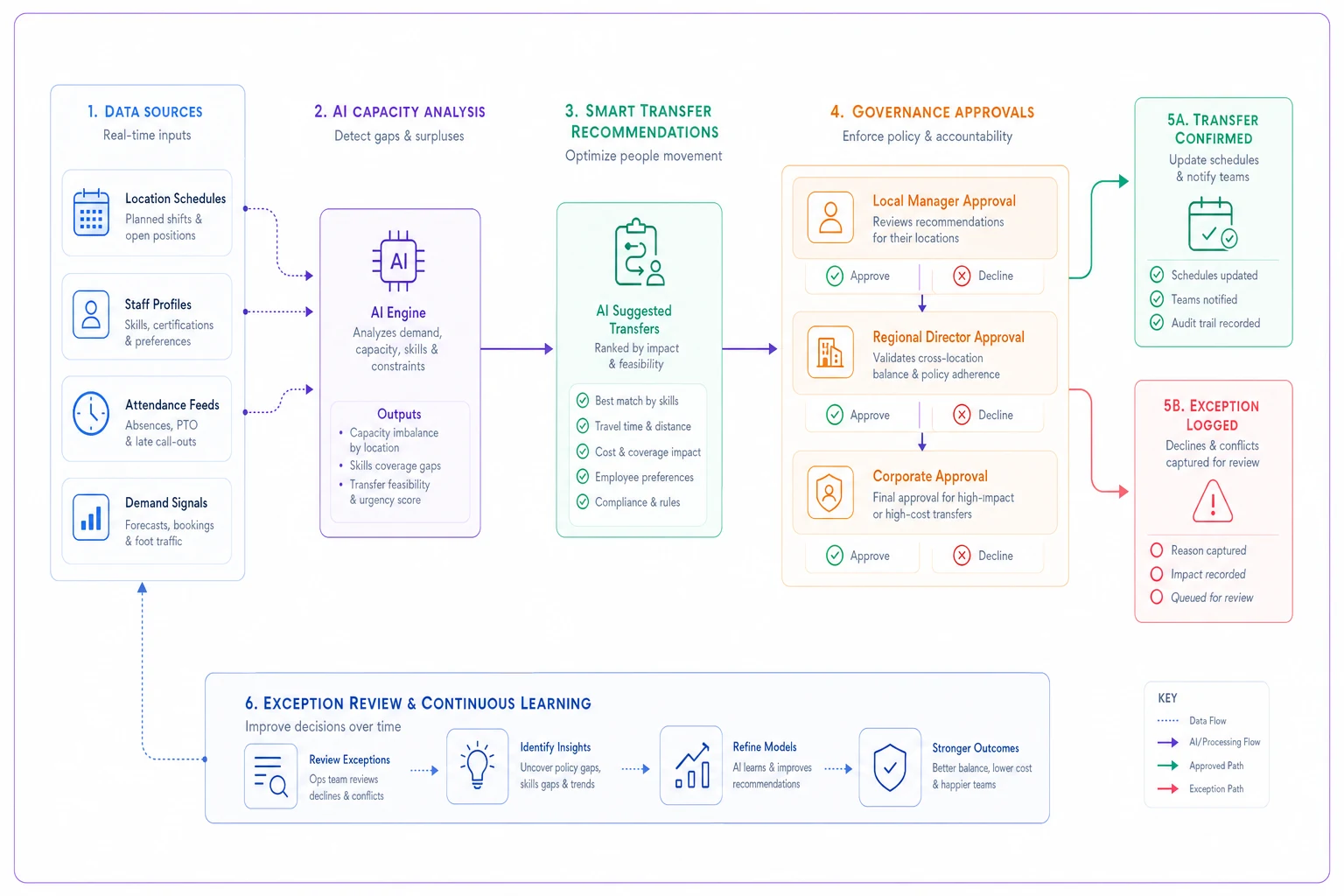
Modern AI automation can shift multi-location coordination from reactive firefighting to something closer to proactive optimization. Instead of managers texting each other about borrowing staff, the system identifies imbalances and suggests specific transfers based on travel time, staff skills, and historical performance.
When demand spikes at one location, the right platform can instantly surface available qualified staff at nearby sites, estimate the impact of transfers, and propose reassignments — all while respecting governance rules. It's not about replacing human judgment, it's about giving managers better information faster so they're not making decisions blind.
Integration Architecture
Multi-location frameworks require careful integration planning:
-
Payroll systems must handle cross-location time tracking
-
Customer systems need unified views across locations
-
Inventory management must support transfer tracking
-
Financial reporting needs both location-level and consolidated views
Integration complexity is exactly why many businesses try to force all locations onto identical systems. But that creates its own problems when locations have legitimate differences in tools and workflows.
This diagram shows the typical workflow from detection to recommendation to approval in an AI-enhanced coordination system.
It's not about replacing human judgment, it's about giving managers better information faster so they're not making decisions blind.
Real scenario: 5-location HVAC company transformation
A commercial HVAC company with five locations across two states is a good example of how these frameworks play out. They had 73 technicians total, handling roughly 1,100 service calls monthly, but were bleeding money on overtime while customers faced 10-day waits for non-emergency service.
Their original structure was pure chaos. Each location scheduled independently. Technicians were technically assigned to home locations but constantly borrowed through informal arrangements. Nobody tracked cross-location hours properly. Overtime decisions happened on a case-by-case basis, usually based on whoever complained loudest.
The transformation started with a clear governance matrix. Corporate set minimum coverage requirements and overtime thresholds. Regional managers — each covering two or three locations — handled capacity rebalancing and shared resource pools. Local managers kept daily scheduling and customer service decisions.
They built forecast-to-shift templates around three main patterns: emergency season (summer), maintenance season (spring and fall), and slow season (winter). Each template defined base staffing by location with adjustment rules for demand variance.
Rebalancing triggers were set at a 25% utilization differential between locations within the same region, or when overtime at one location exceeded 10 hours while another had availability. The system flagged imbalances automatically, but managers made the final transfer calls.
Within four months, overtime costs dropped around 30% while average response time fell from 10 days to 6 days for standard service. The framework didn't eliminate all problems, but it made them visible and manageable. Local managers stopped fighting about borrowed resources because the rules were clear. Regional managers could optimize capacity without micromanaging daily operations.
Common implementation mistakes
Starting Too Complex
The biggest failure pattern is trying to implement a complete framework all at once. Businesses create 50-page governance documents nobody reads, build elaborate templates that don't match reality, and set up triggers that fire constantly without clear action plans.
Ignoring Change Management
Frameworks fail when people don't follow them. Local managers who've run their sites independently for years won't suddenly embrace corporate governance. Corporate teams used to controlling everything won't easily delegate.
Over-Automating Too Soon
Technology amplifies good processes but can't fix bad ones. Businesses often jump straight to expensive software before defining their governance model, creating automated chaos instead of automated efficiency.
Define the framework manually first. Run it with spreadsheets and meetings for at least one full business cycle. Only automate once you understand which rules actually work versus which just sound good in theory.
Measuring framework effectiveness
A working multi-location resource allocation framework should improve measurable outcomes within 90 days. Track these indicators:
-
Utilization Variance The gap between highest and lowest utilization across locations should narrow. You'll never achieve perfect balance, but variance exceeding 20% consistently signals framework problems.
-
Overtime Distribution Overtime should distribute relatively evenly across locations and people. Concentrated overtime at the same sites week after week suggests poor rebalancing or incorrect templates.
-
Response Time Consistency Customer experience should be reasonably consistent across locations. If one site offers same-day service while another has week-long waits, the framework isn't working.
-
Exception Frequency Exceptions should decrease over time as templates and triggers improve. Rising exception rates indicate the base framework doesn't match operational reality.
-
Manager Time Allocation Track how much time managers spend on scheduling and coordination. A working framework should reduce this meaningfully, freeing managers for customer service and staff development.
A working framework should reduce manager time spent on coordination and show measurable improvements across these indicators within a short timeframe.
Who shouldn't implement this framework
Fewer than three locations.
Two-location businesses can usually coordinate through direct communication. The overhead isn't worth it until complexity exceeds what humans can coordinate informally.
Truly independent locations.
If sites serve completely different markets with no shared resources or customers, treat them as separate businesses rather than forcing artificial coordination.
Organizations that lack basic operational discipline.
Frameworks require consistent execution. Fix foundational process problems before adding governance complexity on top.
Businesses in rapid pivot mode.
Frameworks assume relative stability. If you're changing business models, testing new markets, or in hypergrowth, stay flexible rather than locking in structures that may not fit in six months.
Building your implementation roadmap
Weeks 1–2: Current State Assessment Document how decisions actually happen today. Who decides scheduling? How do locations share resources? What breaks most often? Don't design solutions yet — just understand reality.
Weeks 3–4: Governance Matrix Design Define decision boundaries for your top 10 operational decisions. Start simple — you can add detail later. Get buy-in from regional and local managers on proposed boundaries before finalizing anything.
Weeks 5–8: Template Development Create forecast-to-shift templates for your most common scenarios. Test them against historical data. Would they have prevented last month's problems?
Weeks 9–12: Pilot Implementation Run the framework in one region or service line. Track exceptions carefully. Adjust templates and triggers based on what actually happens versus what you expected.
Weeks 13–16: Full Rollout Expand to all locations with lessons from the pilot. Maintain exception tracking. Plan for quarterly reviews to refine the framework as operations evolve.
Multi-location resource allocation isn't about choosing between corporate control and local autonomy. The businesses that thrive with multiple sites build frameworks that deliver both — clear governance that eliminates confusion while preserving flexibility for local adaptation.
Governance matrices, exception protocols, forecast templates, and rebalancing triggers work together to create predictability without rigidity. Add operational software that enforces rules while providing visibility, and coordination shifts from daily crisis management to something closer to strategic optimization.
The transformation won't be perfect. You'll still have days when one location is slammed and another sits idle. You'll still have managers who push boundaries and staff who find workarounds. But you'll have a structure for handling those situations consistently, learning from the patterns, and gradually improving outcomes.
More practically, your managers get their time back. Instead of spending hours each day negotiating resource sharing and untangling scheduling conflicts, they can focus on customers, staff development, and actually running the business. That's when multiple locations stop feeling like a burden and start functioning like a real competitive advantage.
Ready to optimize your scheduling and operations?
Join thousands of businesses using Schedily to save time, improve coordination, and enhance operational efficiency.