

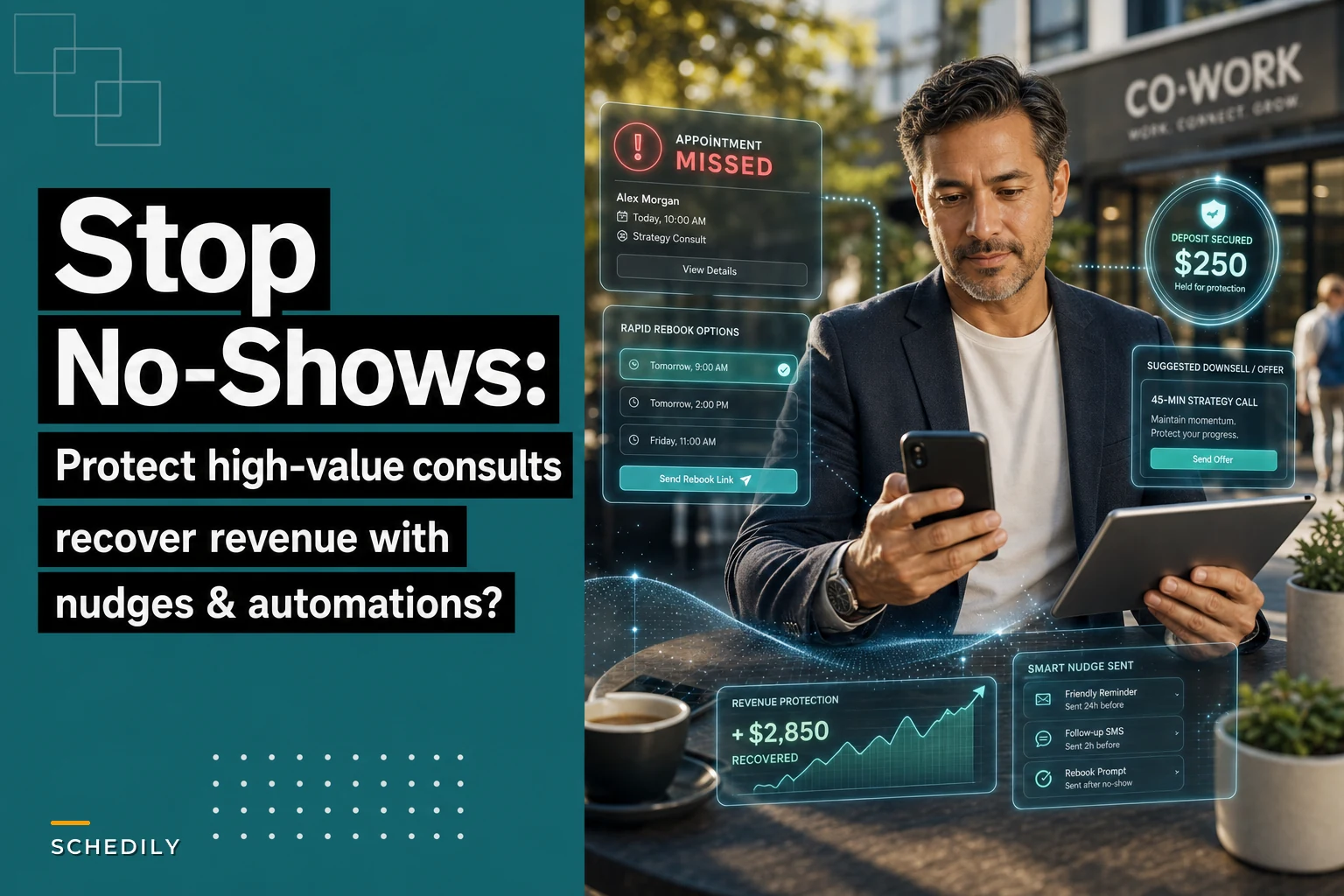

No-shows for high-value consults aren't just annoying — they're expensive. A single missed strategy session worth $2,500 might feel like bad luck, but when you're losing three or four of these a month, you're watching somewhere around $100k evaporate annually without much to show for it.
Most businesses treat no-shows like bad weather. They send a confirmation email 24 hours before, hope for the best, then scramble when someone ghosts. That carefully blocked three-hour window for a comprehensive business audit sits empty while other prospects wait weeks for availability. The slot is gone. The revenue doesn't come back.
What separates businesses with 90%+ show rates from those stuck in the low 70s isn't better clients. It's systematic prevention built on how people actually behave — and a recovery sequence that captures revenue even when prevention fails.
Why traditional confirmations don't work for premium appointments
Standard reminders work fine for routine stuff. Send a text the day before a haircut, most people show up. High-value consults run on different dynamics.
When someone books a $3,000 strategic planning session six weeks out, their commitment peaks at booking then slowly erodes. By week four, that initial urgency has faded. New priorities showed up. The problem they wanted solved either got partially addressed through some DIY attempt or just feels less pressing than it did when they hit "confirm." The appointment becomes a vague future obligation.
Generic reminder texts make this worse. "Don't forget your consultation tomorrow at 2pm" reminds them about the time commitment without reinforcing why they booked at all. For someone already questioning whether they need the service, that message becomes a quiet prompt to cancel.
The financial psychology shifts too. Booking a high-ticket service often creates immediate buyer's remorse. Without real nurturing between booking and appointment, that remorse quietly builds. They start wondering whether they actually need professional help, whether the cost makes sense, whether they should try handling it themselves first.
There's also preparation anxiety. Unlike showing up for a dental cleaning, high-value consults often require mental preparation, document gathering, or internal conversations. When a reminder lands and they haven't done any of that, canceling feels easier than showing up empty-handed.
The problem isn't that reminders are bad — it's that they focus on logistics rather than commitment and value. For premium appointments, confirmations must deepen investment, not just restate time and place.
The behavioral science of commitment escalation
Getting someone to show up for a premium appointment means progressively deepening their psychological investment before they arrive. Each touchpoint should make canceling slightly harder than following through.
Eliminate scheduling conflicts and missed meetings.
Schedily helps you organize and manage all appointments and team availability effortlessly.
- Unified appointment and resource management
- Automated notifications & reminders
- Team calendar synchronization
No credit card required
The commitment ladder starts at booking. Instead of just capturing contact info, have them answer two or three questions about their specific situation — "What's your biggest operational challenge right now?" or "What would success look like after our session?" These give you useful context while creating early psychological buy-in.
Three days after booking, send something that looks like a helpful resource but actually deepens commitment. "Based on what you shared about your inventory challenges, I put together a quick assessment worksheet. Take 10 minutes with it before our session — it'll help us skip straight to solutions rather than spending the first hour on discovery." Now they've invested time preparing, which makes cancellation feel wasteful.
Two weeks before, introduce personal connection through a brief video. Not a template — something actually specific: "Hey Sarah, I went through your intake form and I'm genuinely looking forward to our session on the 15th. Your challenge with seasonal demand fluctuations is almost exactly what we worked through with another retailer last month. Can't wait to share what worked for them." This turns an abstract appointment into a commitment to a real person.
One week out, shift from reminders to value reinforcement. Share a relevant case study or insight tied to their situation. "Thought this might be useful before we talk — another consultancy with similar growth challenges meaningfully improved their close rates after implementing the framework we'll discuss." You're not reminding them about a time slot. You're building anticipation for outcomes.
The 48-hour message introduces loss aversion, even without a deposit structure. "I've blocked our full three-hour session and started preparing preliminary recommendations based on your intake. If plans have changed, please let me know by tomorrow so I can offer the spot to someone on our waitlist." They're not just missing an appointment — they're taking someone else's opportunity.
BOOKING └─ Intake questions (2–3 specific prompts) └─ Day 3: Prep worksheet with value framing └─ Week 2: Personalized video message └─ Week 3: Value story + case study └─ 72 hrs: Commitment confirmation + waitlist mention └─ 24 hrs: Logistics + bonus insight └─ Day of: Momentum message
Each step compounds the psychological investment. By the time the appointment arrives, canceling feels like giving something up rather than opting out of something optional.
Deposit structures that protect revenue without killing conversions
Requiring deposits seems obvious until you watch conversion rates drop. The question isn't whether to require them — it's how to structure them so they create commitment without creating enough friction to stop people from booking.
Split deposits work better than full prepayment for services over $1,000. Charge around 30% at booking to create commitment, then automate the remaining balance 72 hours before the appointment. This reduces initial friction while maintaining protection. The second charge also functions as a pre-appointment signal — people notice when money moves.
For services above $5,000, consider credit hold structures instead of immediate charges. Place a hold for the full amount at booking but don't capture it until 24 hours before. It proves ability to pay without triggering immediate buyer's remorse. Banks show the pending charge, which creates psychological commitment without the finality of full payment.
Refundable deposits with conditions typically outperform non-refundable ones for conversion while maintaining similar show rates. "Your deposit is fully refundable if you reschedule with 72 hours notice or complete our pre-session preparation checklist." It feels fair while still creating behavioral friction around casual cancellation.
Frame deposits as "session preparation fees" or "resource allocation deposits" rather than penalties.
| Deposit Structure | Best For | Conversion Impact | Show Rate Impact |
|---|---|---|---|
| 30% split deposit | $1,000–$5,000 services | Low friction | High |
| Credit hold (full amount) | $5,000+ services | Moderate friction | Very high |
| Refundable with conditions | Any price point | Lowest friction | Moderate–high |
| Non-refundable flat fee | High-demand, waitlisted | Higher friction | Highest |
| Behavior-based waiver | Established client base | Near-zero friction | High |
The structure you choose should reflect both your price point and how far out appointments typically get booked. A credit hold makes sense for a $7,000 advisory retainer booked six weeks out. It's overkill for a $900 session booked this week.
The messaging matters more than the amount. Frame deposits as "session preparation fees" or "resource allocation deposits" rather than penalties. Explain what it covers: "This reserves your consultant's preparation time, includes pre-session analysis, and guarantees your preferred slot." People resist penalties but understand value exchange.
For established businesses, offer deposit waivers tied to specific behaviors. Complete a detailed intake form? Deposit waived. Refer another prospect? Deposit reduced. Watch a preparation video? Early-bird pricing. These alternatives maintain commitment through effort rather than money.
Confirmation sequences that reinforce value progressively
Confirmations should escalate in intensity as the appointment approaches, each one making the value more concrete and immediate.
The two-week confirmation introduces specificity. Don't just confirm the time — confirm the agenda. "For our January 15th session, we'll cover: 1) Reviewing your current funnel metrics, 2) Identifying your primary conversion bottlenecks, 3) Building your 90-day optimization roadmap. Let me know if you'd like to adjust our focus areas."
One week out, share preparatory material that creates sunk cost. "I've attached our Strategic Planning Workbook. Completing Section 1 before our session will save a meaningful chunk of discovery time, letting us focus on solutions from the start. Most clients find the exercise worth doing even independent of the consultation." They invest time, which builds commitment beyond money alone.
The 72-hour confirmation shifts to logistics and social proof. "Looking forward to Tuesday! We'll meet in Conference Room A (building map attached). Quick tip: our most productive engagement last month involved a CEO who brought their operations lead to take notes. Feel free to bring a key team member if it makes sense."
24 hours before, pair confirmation with immediate value. "Tomorrow's session is confirmed. While preparing, I noticed your competitor just launched something similar to what you're planning — I'll share my take on their approach and how to differentiate. See you at 2pm!" This creates real urgency, not manufactured urgency. Missing the appointment means missing something actually useful.
The morning-of message should create momentum, not pressure. "Today at 2pm! I have your materials ready and kept some buffer time in case we need to go deep on implementation. Text this number if you hit delays — we can shift by 30 minutes if needed." Reduces anxiety while maintaining commitment.
Automated recovery flows that capture lost revenue
Even solid prevention fails sometimes. The difference between writing off a no-show and recovering some of the revenue comes down to how quickly and how smartly you respond.
The moment they don't show triggers the recovery sequence. Not frustration — concern: "Hey Sarah, wanted to make sure everything's okay — you're usually so punctual. I'll hold the line for another 10 minutes in case you're stuck in traffic. Text me at [number] if you need anything."
Fifteen minutes in, shift to rescheduling with real urgency. "Looks like today didn't work out. I can fit you in tomorrow at 2pm or Thursday at 10am before my schedule fills. Which works? Reply in the next couple hours to grab one of those — otherwise we're looking at late February."
No response within two hours? Trigger the value-loss sequence. "Sarah, I spent time reviewing your situation and flagged three quick wins that could save you real money monthly — but the fix is simpler than you'd expect. Here's a short video covering the highest-impact one. If you want to discuss implementation, I'm holding Thursday at 10am for you until 6pm tonight."
Day two introduces subtle peer pressure without feeling manipulative. "Had a cancellation open up for Friday at 3pm. Before I open it to my waitlist, wanted to check if you'd like it. Let me know by noon?"
Day seven, offer a downgrade. "Schedules get complicated — totally get it. Instead of our full session, would a 30-minute focused call make more sense? We pick your biggest challenge, I give you one clear path forward. Tuesday or Wednesday work?"
Day fourteen is the last touch. "Final check-in before I close your file. Your initial deposit covers a 20-minute consultation or can transfer to our self-guided program. Otherwise, I'll process the cancellation per our agreement. Which would you prefer?"
This kind of sequence recovers a meaningful share of no-shows at some revenue level versus near-zero with traditional approaches.
Message templates that convert without sounding desperate
Initial booking confirmation: "Perfect! I've reserved [date/time] for your Strategic Growth Session. I'm already reviewing the challenges you mentioned and seeing some clear opportunities. Check your email for prep materials — they'll help us hit the ground running. Looking forward to digging into [specific challenge they mentioned]."
Week-before value reinforcement: "Hi [Name], excited about our session next week. Yesterday I helped another [industry] business uncover significant monthly savings using a framework we'll cover in your consultation. Already outlining how it applies to your situation — Tuesday can't come fast enough."
48-hour commitment confirmation: "Hi [Name], confirming Thursday at 2pm. I've prepared materials specific to your [challenge] and kept extra time in case we need it. If anything's changed, please let me know by tomorrow morning so I can offer the spot to someone on my waitlist. Otherwise, see you Thursday."
No-show immediate recovery: "Hey [Name], missed you at 2pm — hope everything's okay? I'll hold your materials for 24 hours. Can fit you in tomorrow at 3pm or Friday at 10am. Which works? Text me at [number] if easier."
Value-focused re-engagement: "[Name], I spent some time looking at your situation and found something worth sharing. Your [specific issue] is likely costing more than you'd expect monthly, and the fix is more straightforward than it sounds. Want to jump on a quick call? I have 20 minutes tomorrow at 4pm."
None of these guilt. None pressure. They focus on value, specificity, and forward momentum.
Timing cadences optimized for different consultation types
Different service types need different touch patterns. The cadence should match both the service value and how clients in that category typically behave.
For $5,000+ strategy sessions booked 4-6 weeks out:
-
Day 1
Booking confirmation with prep materials
-
Day 3
Personalized video message from consultant
-
Week 2
Value-reinforcement case study
-
Week 3
Agenda confirmation and adjustment opportunity
-
Week 4
Logistics and team invitation
-
72 hours
Commitment confirmation with waitlist mention
-
24 hours
Final confirmation with bonus insight
-
Day of
Momentum message 2 hours before
For $1,000–3,000 consultations booked 2-3 weeks out:
-
Immediate
Confirmation with intake form
-
Day 3
Prep worksheet with time-saving framing
-
Week before
Value story and anticipation builder
-
72 hours
Deposit charge notice (if applicable)
-
24 hours
Logistics and value teaser
-
Morning of
Simple confirmation with text option
For quick-turn sales calls booked within a week:
-
Immediate
Calendar invite with embedded video
-
Next day
One valuable insight related to their situation
-
48 hours before
Brief confirmation request
-
Morning of
Text reminder with easy reschedule option
Each touchpoint should feel useful, not like nagging. If someone goes quiet through all messages, pause outreach for 48 hours then trigger recovery sequences rather than continuing to hammer them.
Sample automation logic for different scenarios
Basic no-show recovery flow:
TRIGGER: Appointment time passes with no attendance WAIT: 5 minutes ACTION: Send immediate recovery message IF responds within 2 hours: → Offer immediate reschedule options → Book first available slot → Reset confirmation sequence IF no response in 2 hours: → Wait until next morning → Send value-loss message with video → Include 2 reschedule options IF no response in 48 hours: → Trigger downgrade offer sequence → Notify salesperson for manual follow-up IF no response in 7 days: → Process cancellation per policy → Add to re-engagement campaign for 90 days
Quick visual of the recovery and deposit flows can make implementation clearer.
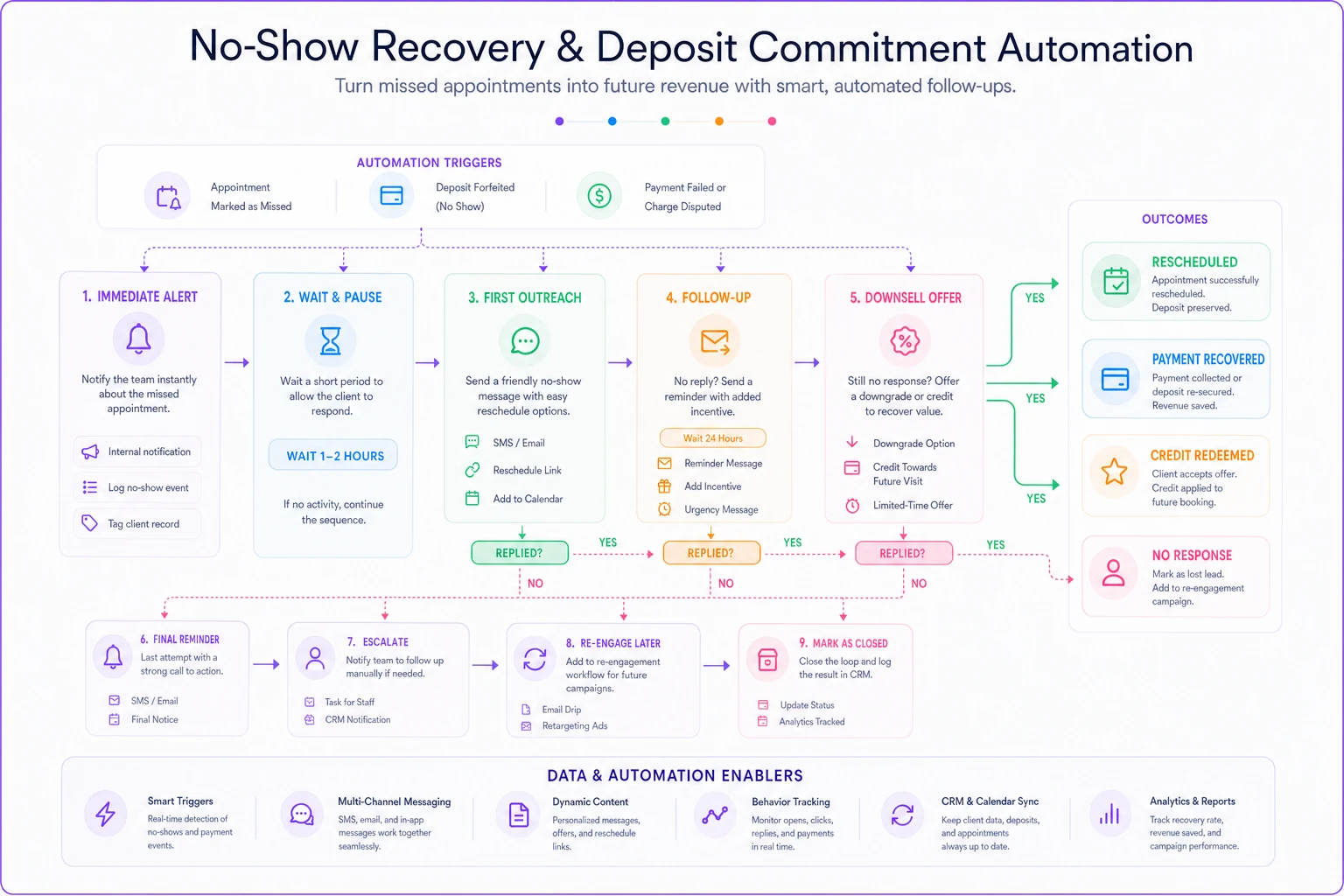
Deposit-based commitment flow: TRIGGER: High-value appointment booked ACTION: Send booking confirmation WAIT: 5 minutes ACTION: Charge initial deposit (30%) IF payment succeeds: → Send prep materials → Schedule video message for day 3 → Add to nurture sequence IF payment fails: → Wait 4 hours → Retry payment → Send payment update request IF payment still fails after 24 hours: → Cancel appointment → Notify sales for follow-up AT 72 hours before appointment: → Charge remaining balance → Send commitment confirmation IF payment fails: → Send immediate notification → Hold appointment for 4 hours → Require payment update to maintain booking
Progressive commitment escalation: TRIGGER: Booking confirmed DAY 1: Send intake form IF completed within 48 hours: → Send personalized video → Add high-engagement tag IF not completed by day 5: → Send reminder with value frame → Include form deadline IF not completed by day 7: → Trigger risk flag → Send "at risk" notification to consultant → Increase confirmation touchpoints by 2x
The key is branching logic that responds to actual engagement levels. Someone who completes every prep step needs fewer touches than someone who hasn't opened your intake form.
Measuring what works and killing what doesn't
Tracking the right metrics tells you which parts of your prevention system actually move the needle versus which ones just make you feel productive.
Show rate by lead source reveals whether certain channels attract less reliable prospects. If paid social leads show at 60% while referrals show at 90%+, you need channel-specific sequences. Paid leads might need more education touches; referrals might not need as many confirmations.
| Metric | What It Tells You | What To Do With It |
|---|---|---|
| Show rate by lead source | Which channels send reliable prospects | Build channel-specific sequences |
| Message open/engagement rate | Which touchpoints actually land | Cut low performers, double down on winners |
| Recovery rate by attempt # | Where your sequence loses steam | Trim attempts beyond diminishing returns |
| Show rate by deposit structure | Whether amount or psychology drives commitment | Optimize structure, not just dollar amount |
| Show rate by booking lead time | How far out is too far out | Adjust scheduling windows and sequence intensity |
Time-to-book impact often gets completely ignored. Appointments booked for next week might show at 90% while those booked six weeks out track closer to 70%. That data should directly influence your scheduling strategies and sequence design.
When automated prevention makes sense (and when it doesn't)
Not every business needs an elaborate prevention system. For companies doing a handful of consultations monthly at a few hundred dollars each, the setup overhead might easily exceed recovered revenue. But certain patterns make automation genuinely worth it.
You need automated prevention when consultations are your primary revenue driver. If you're running 40–50+ monthly sessions worth $2,000+ each, even a modest improvement in show rates represents real annual impact that's hard to ignore.
Long booking windows demand automation. If prospects typically book 3+ weeks out, manual follow-up becomes impossible at scale. Your team can't personally nurture a growing pipeline of future appointments while managing current operations.
High idle cost situations require protection. If no-shows mean paying consultants to sit idle or losing expensive room bookings, prevention becomes operational necessity rather than optimization.
Businesses with limited appointment slots need maximum efficiency. If you can only handle a set number of strategic sessions monthly and carry a waitlist, every no-show is revenue you can't recover by just adding more appointments.
That said, prevention automation might be overkill if you primarily do low-ticket, high-volume services where manual rebooking is easy. Or if your clients are enterprise accounts with procurement processes that naturally ensure attendance. Or if you're still early in figuring out what you're selling — focus on delivering value before optimizing attendance rates.
The revenue impact compounds over time
Systematic no-show prevention isn't just about recovering individual appointments. The compounding effects change how the whole operation runs.
Predictable attendance enables actual capacity planning. When show rates improve meaningfully, you can book more appointments without overcommitting resources. That same consultant availability suddenly delivers more revenue without adding hours.
Higher show rates improve team morale too. Consultants prepare seriously for sessions, and no-shows sting. When prevention systems work consistently, your team stays energized rather than frustrated by wasted preparation time.
Better attendance data enables pricing confidence. When you understand what actually drives commitment, you can test higher pricing without guessing. That $2,000 consultation might comfortably command $2,500 with the right commitment structure supporting it.
Strong prevention systems become quiet competitive advantages. While competitors lose a significant slice of booked revenue to no-shows, you're capturing nearly all of it. That efficiency allows better margins, more investment in service quality, and ultimately better outcomes for clients.
The operational software managing these sequences runs continuously in the background — catching at-risk appointments before they become no-shows, recovering revenue from the ones that slip through, and improving with every interaction. Instead of hoping clients show up, you're systematically ensuring they do, turning what used to be lost revenue into predictable income through smarter automation and a real understanding of how people commit.
The operational software managing these sequences runs continuously in the background — catching at-risk appointments before they become no-shows, recovering revenue from the ones that slip through, and improving with every interaction. Instead of hoping clients show up, you're systematically ensuring they do, turning what used to be lost revenue into predictable income through smarter automation and a real understanding of how people commit.
Ready to optimize your scheduling and operations?
Join thousands of businesses using Schedily to save time, improve coordination, and enhance operational efficiency.