



Most scheduling chaos doesn't come from bad software. It comes from decisions that live inside people's heads. One receptionist knows that cardiology consults need a 30-minute buffer. The weekend dispatcher doesn't. One account manager always collects a deposit before booking strategy sessions; another forgets half the time. The rules exist — they're just undocumented, inconsistent, and impossible to enforce at scale.
A scheduling policy matrix fixes that. It's a single structured document that answers, for every type of appointment: who can book it, what conditions must be met, what happens on handoff, when to escalate, and how success gets measured. This post gives you the actual matrix structure, a CSV template you can copy, three industry fill-ins, and the enforcement logic to make it stick across teams and integrations.
If you've already built out the high-level customer-journey mapping covered in the company-wide scheduling system blueprint, this is the operational layer that sits underneath it. The blueprint tells you what the journey looks like. The matrix tells your team exactly what to do at each point.
Why a matrix beats a policy document
Most operations teams write scheduling policy as prose. A 12-page PDF titled "Booking Procedures" that nobody opens after week one.
The problem with prose is that it forces humans to interpret. And interpretation is exactly where consistency dies. When a front-desk person is on the phone with an irritated customer, they're not scrolling to page 7 to check the buffer rule for new-patient intakes. They're guessing.
A matrix works differently because it's lookup-based. One row per appointment type, columns for each decision. The person — or the system — finds the row, reads across, and acts. No interpretation required. This is also why a matrix translates directly into integration logic, because each column maps to a field or rule in your scheduling platform in a way that prose never does cleanly.
What you see consistently across appointment-driven businesses is that the companies with the fewest scheduling disputes aren't the ones with the strictest rules. They're the ones whose rules are retrievable in under five seconds. That's the whole game.
The core columns every matrix needs
Before the industry examples, here's the column structure. These are the fields that actually drive behavior. You can add more, but don't ship a matrix missing any of these:
Eliminate scheduling conflicts and missed meetings.
Schedily helps you organize and manage all appointments and team availability effortlessly.
- Unified appointment and resource management
- Automated notifications & reminders
- Team calendar synchronization
No credit card required
| Column | What it defines | Example value |
|---|---|---|
| Appointment type | The specific service being booked | New-patient intake |
| Journey stage | Where this sits in the customer lifecycle | First contact |
| Who can book | Roles permitted to create this booking | Front desk, online self-serve |
| Preconditions | What must be true before confirming | Insurance verified, intake form sent |
| Buffer / duration | Time reserved including prep/cleanup | 45 min + 15 min buffer |
| Deposit / payment rule | Money collected at booking | None / $50 hold / full prepay |
| Handoff trigger | What signals the booking moves to another team | Confirmed → clinical team |
| Handoff acknowledgement | Required confirmation language/action | "Received, chart prepped" within 2 hrs |
| Escalation threshold | When this becomes an exception | No ack after 4 hrs |
| Escalation owner | Who gets pinged | Office manager |
| KPI tied to it | The metric this row is judged on | Intake-to-visit no-show rate |
Eleven columns feels like a lot until you realize each one is a question your team is already answering ad hoc, just inconsistently. The matrix forces those answers into writing once.
One pattern worth flagging: teams almost always skip the handoff acknowledgement column because it feels redundant. It isn't. The absence of a defined acknowledgement is the single most common reason bookings fall into a gap between two teams. More on that below.
Mapping journey stages to scheduling rules
The mistake most teams make is trying to write rules per appointment type first. That's backwards. Rules should be anchored to the journey stage, because that's what determines risk, urgency, and who owns the interaction.
-
List your journey stages, not your services. Keep it to 4–6. Something like: first contact → qualified → booked → in-progress → completed → follow-up. Don't overthink it.
-
For each stage, define the risk. First contact has conversion risk (losing the lead). In-progress has operational risk (resource conflicts, overruns). Follow-up has retention risk. The risk tells you what the rule should protect.
-
Attach appointment types to stages. A single service often spans two stages — a consult is "booked" then "in-progress." That's fine. Each gets its own row.
-
Write the precondition from the risk. If the risk is no-shows at the "booked" stage for high-value appointments, the precondition becomes a deposit or card-on-file. The risk drives the rule, not the other way around.
-
Define the handoff trigger and acknowledgement together. Never write one without the other. A trigger with no required acknowledgement is just hope.
-
Set the escalation threshold as a time or condition, never a feeling. "Escalate if the clinical team hasn't acknowledged within 4 business hours" — not "escalate if it seems stuck."
-
Assign exactly one KPI per row. If a row doesn't map to a metric, you can't tell whether the rule works. Rows with no KPI tend to be rules nobody enforces.
The reason this ordering matters: when rules come from stages and stages come from risk, the matrix stays stable even as you add new services. You're not rewriting policy every time marketing launches a new package — you're just slotting it into an existing stage.
Sample handoff acknowledgement language
This is the part most teams underbuild, so here's concrete language you can lift directly. The goal is that a handoff isn't "done" until the receiving team says so in a specific, logged way.
Weak (don't use):
-
"I'll let the team know."
-
Forwarding an email with no required response.
Strong (use these):
-
Front desk → clinical
"Chart prepped and reviewed for [patient], [date/time]. Flags: [none / allergy / prior no-show]. — [initials], [timestamp]"
-
Sales → delivery (professional services)
"Engagement confirmed for [client]. Scope doc attached, resources reserved: [names]. Kickoff locked. — [initials]"
-
Dispatch → field tech
"Job [#] assigned. Parts confirmed on truck, access instructions attached, ETA window sent to customer. Acknowledge receipt. — [initials]"
The pattern is always the same: what was received, what was verified, what's flagged, who confirmed, when. That last part — the timestamp and initials — is what makes the escalation threshold enforceable. Without a logged acknowledgement, you literally cannot measure whether the 4-hour rule was breached.
Escalation thresholds that don't backfire
The common failure with escalation rules is setting them too tight, which trains everyone to ignore them. If every slightly-late handoff fires an alert, the office manager mutes the channel by Thursday.
-
Tie thresholds to business hours, not clock hours. "4 hours" at 4:45 PM is different from 4 hours at 9 AM. Define thresholds in business hours or your night bookings will all escalate falsely at opening.
-
Use two tiers. Tier 1 is a nudge — an automated reminder to whoever owns that step. Tier 2 is an actual escalation to a manager. Jumping straight to the manager burns goodwill fast.
-
Escalate the step, not the person. The threshold is about an unacknowledged handoff, not about blaming whoever's name is attached. Keep the language about the booking's state.
-
Cap escalation volume. If more than roughly 10% of a given row's bookings are escalating, the problem isn't the staff — it's the threshold or the upstream rule. That's a signal to revise the matrix, not to discipline the team.
That last point is the one teams miss most. A high escalation rate on a single row is diagnostic. It usually means the precondition is unrealistic — "insurance verified before booking" when verification takes two days, for example — and the rule needs loosening or re-sequencing.
KPI definitions (one per row, defined precisely)
Vague KPIs are worse than none, because people game them without realizing. Here are tight definitions you can attach to matrix rows:
-
Handoff acknowledgement rate % of bookings with a logged acknowledgement within the defined threshold. Denominator is all handoffs for that row, including the ones that escalated.
-
Precondition compliance % of confirmed bookings where every precondition was actually met at confirmation time. Audited by sampling, not self-reported.
-
Stage-to-stage conversion % of bookings that move from one stage to the next without cancellation. Catches friction that hides between teams.
-
Escalation rate % of that row's bookings hitting Tier 2. Target is low but non-zero — zero usually means people aren't using the system honestly.
-
No-show / overrun rate depending on the stage, either missed appointments or appointments exceeding their reserved duration and buffer.
These are defined with explicit numerators and denominators on purpose. "No-show rate" means nothing until you specify whether reschedules count, whether same-day cancellations count, and what the denominator is. Write that down in the matrix or your dashboards will quietly disagree with each other.
The CSV template
Copy this into a spreadsheet or save as .csv. Each row is one appointment-type-at-a-stage. Fill in your real values.
| appointment_type | journey_stage | who_can_book | preconditions | buffer_duration | payment_rule | handoff_trigger | handoff_acknowledgement | escalation_threshold | escalation_owner | kpi |
|---|---|---|---|---|---|---|---|---|---|---|
| New-patient intake | Booked | Front desk; online | Insurance verified; intake form sent | 45m+15m buffer | None | Confirmed → clinical | Chart prepped note within 2 business hrs | No ack 4 business hrs | Office manager | Handoff ack rate |
| Strategy consult | Booked | Account mgr | Signed SOW; deposit on file | 60m+0 | $500 deposit | Booked → delivery | Resources reserved note | No kickoff lock 1 business day | Delivery lead | Stage conversion |
| HVAC install | In-progress | Dispatch | Parts confirmed; access details | 180m+30m travel | Prepay 25% | Dispatch → tech | Receipt ack + ETA sent | No tech ack 2 business hrs | Field supervisor | Overrun rate |
Keep every row this granular. The temptation is to collapse "all consults" into one row — resist it. A new-patient consult and a returning-patient consult have different preconditions, and collapsing them is exactly how undocumented exceptions creep back in.
Three industry fill-ins
Healthcare clinic
The highest-risk row is almost always new-patient intake at the booked stage. Preconditions here aren't optional — insurance verification and a completed intake form directly affect whether the visit even happens. A realistic pattern: a mid-size clinic running around 300–350 appointments a month was losing a meaningful chunk to intakes that reached the chair without verified coverage, forcing reschedules at the worst possible moment.
The matrix fix: precondition = "coverage verified + form received," handoff acknowledgement = clinical team confirms chart prep, escalation = any unacknowledged intake 4 business hours out. After formalizing that single row, the gap between "booked" and "actually seen" tightened noticeably, and the front desk stopped absorbing blame for a problem that was really a missing-acknowledgement problem.
Professional services firm
Risk concentrates here at the booked → delivery handoff. The classic failure: sales closes an engagement, the delivery team doesn't find out until the client emails asking where the kickoff deck is. No one dropped the ball on purpose — there was just no required acknowledgement.
The matrix row makes the handoff explicit: trigger is "SOW signed + deposit on file," acknowledgement is "resources reserved and kickoff locked," escalation fires if delivery hasn't locked a kickoff within one business day. The KPI is stage-to-stage conversion, which surfaces exactly how often signed engagements stall in the gap between teams. Firms that track this usually discover the stall rate is higher than anyone guessed.
Field service company
Field service lives and dies on the in-progress stage because the cost of a failed handoff is a truck roll. The precondition that matters most is parts confirmation and site access details — both have to be true before dispatch confirms, or the tech arrives and can't complete the job.
The acknowledgement here is doubly important: the tech confirms receipt and the customer ETA window goes out. Escalation threshold is tight — two business hours of silence on an assigned job — because unlike a clinic, you can't quietly reschedule; a crew is already mobilizing. The KPI is overrun rate, which catches jobs blowing past their reserved duration and quietly wrecking the rest of the day's routing.
Enforcing the matrix across teams and integrations
A matrix that lives in a spreadsheet nobody references is just a nicer-looking policy PDF. Enforcement is where it earns its keep, and there are three layers:
Here's a quick visual of the enforcement workflow.
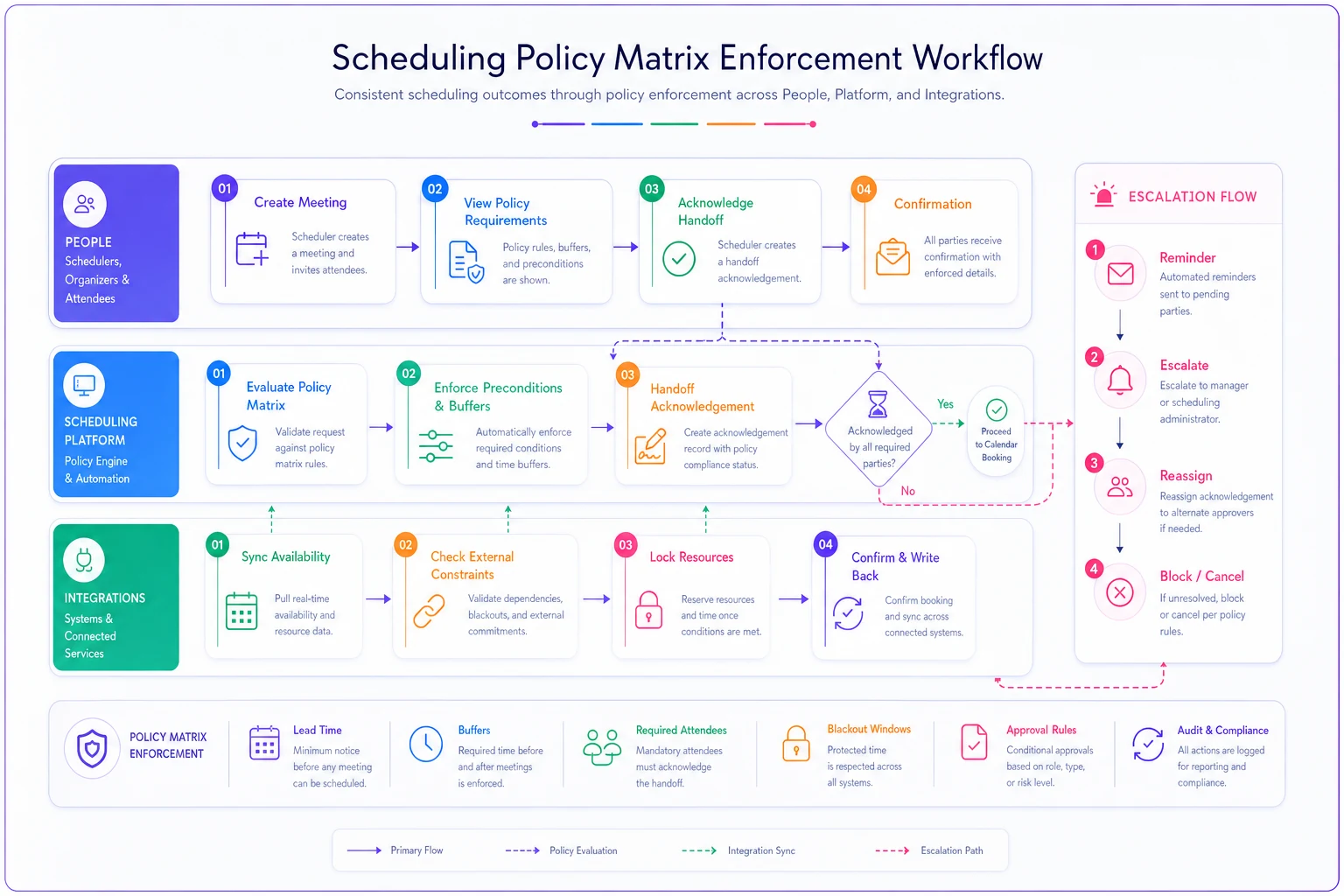
Layer 1 — People. Each column becomes a line in the relevant role's SOP. The front desk SOP references the "who can book" and "preconditions" columns directly. Managers audit "precondition compliance" by sampling somewhere around 15–20 bookings a week rather than trusting self-reports.
Layer 2 — The scheduling platform. This is where the matrix stops being a document and becomes behavior. The columns map to configuration: preconditions become required fields that block confirmation, buffers become enforced durations, payment rules become booking-time captures, escalation thresholds become automated alerts. The goal is that the system refuses to create a booking that violates the matrix — because any rule that depends purely on human memory will eventually be forgotten under pressure.
Layer 3 — Integrations. When bookings sync across calendars, CRMs, and dispatch tools, the handoff acknowledgement has to survive the jump. The acknowledgement note and timestamp should write back to whatever system of record owns the KPI. If your acknowledgement lives only in a Slack message, you can't report on it, and an unreportable rule is an unenforceable one.
Log handoff acknowledgements in the system of record so KPIs are measurable and automations can act on them.
This is the practical reason to run the matrix inside an operational scheduling platform rather than a spreadsheet: the columns you defined become live rules and automated nudges, so compliance stops depending on whether a tired dispatcher remembered the policy at 6 PM. The matrix is the specification; the platform is what makes it self-enforcing.
When this is worth doing — and when it isn't
Build the full matrix when: you have multiple teams touching a booking, more than a handful of appointment types, or any handoff between the person who books and the person who delivers. That's where the undocumented-exception problem compounds.
Keep it lightweight when: you're a solo operator or a single small team where everyone sees every booking. A three-column version — type, precondition, buffer — is plenty. Forcing full escalation tiers on a two-person shop just creates overhead nobody uses.
Don't bother with escalation thresholds at all if your booking volume is low enough that a manager already sees every exception naturally. Escalation logic solves a scale problem. Below that scale, it's ceremony.
A short real scenario
A field-service company handling roughly 40–50 jobs a week kept getting hit by techs arriving without the right parts. The dispatch team swore they were confirming parts; the techs swore they weren't being told. Classic he-said-she-said, and somewhere around one in six jobs was turning into a partial or a repeat visit.
The fix wasn't new software or more staff. It was one matrix row with a hard precondition (parts confirmed before dispatch confirms) and a required acknowledgement (tech confirms receipt, customer ETA sent) with a two-hour escalation. Within a couple of months the repeat-visit rate on that job type dropped to something closer to one in fifteen. Nobody got yelled at. The rule just made the gap visible and closed it.
That's the whole point of a matrix. It doesn't make your team smarter or more careful — it makes the right action the easy, obvious, retrievable one, and it makes the wrong action impossible to do silently. Start with your three riskiest appointment types, fill in those rows completely, wire the acknowledgements so they're logged, and expand from there. The rows you write first should always be the ones where a dropped handoff costs you the most.
Ready to optimize your scheduling and operations?
Join thousands of businesses using Schedily to save time, improve coordination, and enhance operational efficiency.