

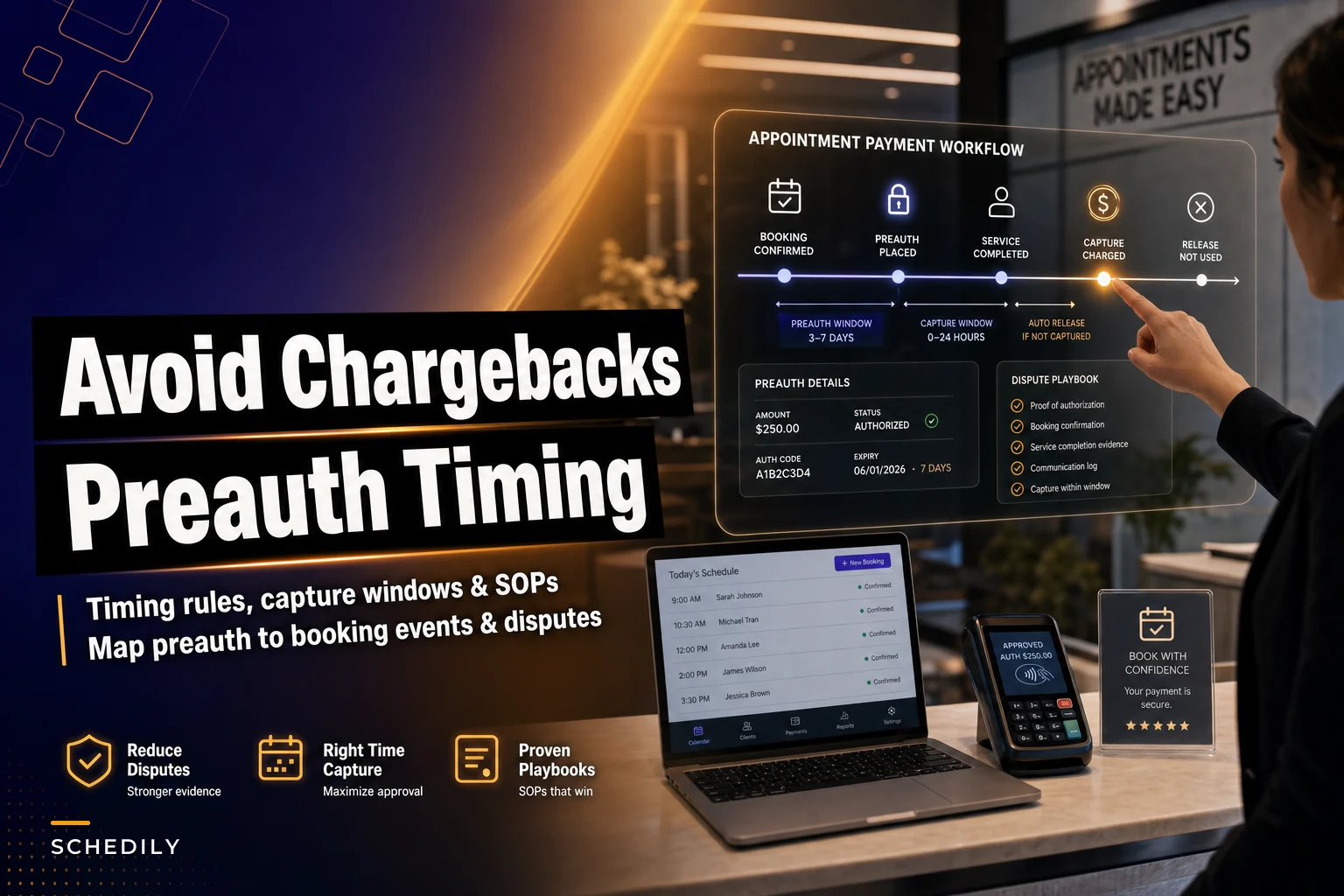

Your payment processor just released $4,800 in held funds back to a customer who no-showed their luxury spa package last Tuesday. The appointment happened, your team delivered the service, but because you captured the payment 8 days after the preauthorization instead of the required 7, the money vanished. Meanwhile, another business across town lost a $1,200 dispute because they couldn't produce documentation linking their cancellation policy to the customer's booking confirmation.
These aren't edge cases. They're predictable failures that happen when appointment payment preauthorization workflows don't align with actual booking patterns and cancellation policies.
The preauthorization timing trap that catches most service businesses
Most appointment-based businesses handle preauthorizations backwards. They set uniform hold periods across all service types, thinking consistency equals simplicity. A home renovation contractor holds funds for 30 days whether it's a $500 consultation or a $15,000 kitchen remodel. A medical practice preauthorizes everything for 7 days regardless of whether the appointment is tomorrow or three weeks out.
This creates two problems that compound each other. First, preauthorizations expire before appointments happen, forcing awkward re-authorization calls that damage customer trust. Second, when appointments do occur, teams scramble to capture payments before authorization windows close, leading to missed captures and revenue loss.
The real issue runs deeper than timing. Payment lifecycles need to match appointment lifecycles. A teeth cleaning scheduled 6 weeks out has different preauthorization needs than an emergency plumbing call booked for that same afternoon. Yet most businesses treat them identically in their payment systems.
Consider what happens at a typical veterinary clinic. They preauthorize a card for $350 when someone books a surgery consultation three weeks ahead. By the time the appointment arrives, that preauthorization has expired. The front desk tries to re-run the card at check-in, but now the customer's credit limit is lower, or they've switched cards, or they feel uncomfortable with multiple holds on their statement. What started as a simple booking becomes a payment negotiation at the worst possible moment.
Why standard capture windows fail during real operations
Payment processors give you windows — typically 7 days for most preauthorizations, sometimes up to 31 days for certain industries. But these windows assume perfect operational execution. They assume your team captures payments immediately after service delivery, that appointments happen when scheduled, that cancellations get processed instantly.
Eliminate scheduling conflicts and missed meetings.
Schedily helps you organize and manage all appointments and team availability effortlessly.
- Unified appointment and resource management
- Automated notifications & reminders
- Team calendar synchronization
No credit card required
Real operations look nothing like this. A landscaping company completes a job Friday afternoon. The crew leader forgets to mark it complete in the system. The office manager doesn't review completed jobs until Tuesday. By Wednesday, when they try to capture payment, the 7-day window from the original booking preauthorization has passed. A $2,400 job becomes an accounts receivable headache instead of captured revenue.
The window problem multiplies with appointment modifications. A customer books a home inspection for next Monday, then reschedules to the following Thursday. The original preauthorization expires Tuesday. Unless someone manually tracks that the appointment moved and creates a new authorization, you're left trying to collect payment after the fact.
Even successful captures face timing challenges. A dental office might complete a root canal at 2 PM, but the final billing amount depends on insurance verification that doesn't complete until 5 PM. Do they capture the estimated amount immediately and risk overcharging? Wait for exact amounts and risk missing the window? Most practices end up doing neither consistently, creating a patchwork of partial captures, adjustments, and payment disputes.
The expensive dispute vulnerability nobody talks about
A customer claims they cancelled their personal training session 48 hours in advance. Your cancellation policy requires 72 hours notice. You charge their preauthorized card. They dispute the charge with their credit card company.
Now you need to prove not just that they cancelled late, but that they explicitly agreed to your 72-hour policy when booking. Can you produce that evidence? Can you show the timestamp of their cancellation? Can you demonstrate they received and acknowledged your policy?
Most businesses lose these disputes by default — not because they're wrong, but because their documentation systems weren't built for dispute defense. The personal trainer knows the client cancelled Monday morning for a Wednesday session. But the booking system only shows "cancelled," not when. The cancellation policy exists on the website, but there's no record the client saw it during booking. The preauthorization happened, but there's nothing linking it to the specific appointment terms.
A massage therapy studio lost around $18,000 in disputes over six months. Not because they did anything wrong operationally — they had clear policies, confirmed appointments, and delivered services. They lost because their payment capture happened in Stripe, their bookings lived in Calendly, their policies were posted on their website, and cancellation confirmations went through email. When disputes arrived, assembling proof across four systems took hours per case, and the evidence almost always had gaps that favored the customer.
Building preauthorization rules that match appointment reality
Effective payment preauthorization starts with mapping your actual appointment patterns, not following generic processor guidelines. Different appointment types need different authorization strategies based on three factors: booking lead time, service value, and modification probability.
For appointments booked within 7 days, standard preauthorization works fine. Authorize when booked, capture when complete. But this only covers roughly 30% of appointments for most service businesses.
Appointments booked 8-30 days out need staged authorization. Don't preauthorize at booking — you'll create expired holds. Set authorization to trigger 5 days before the appointment instead. This keeps the hold fresh while giving customers time to update payment methods if needed. A home cleaning service using this approach reduced failed captures by around 60% just by aligning authorization timing with actual appointment dates.
High-value appointments beyond 30 days need deposit structures, not preauthorizations. Charge a non-refundable deposit at booking (usually 20-30% of service value), then authorize the balance 5 days before. This protects revenue while avoiding the complexity of managing long-duration holds.
Here's a practical framework based on appointment value and timing:
| Booking Window | Under $500 | $500-$2000 | Over $2000 |
|---|---|---|---|
| 0-7 days | Immediate preauth | Immediate preauth | 30% deposit + preauth balance |
| 8-30 days | Preauth at T-5 days | 20% deposit + preauth at T-5 | 30% deposit + preauth at T-5 |
| 30+ days | Preauth at T-5 days | 25% deposit + preauth at T-5 | 40% deposit + staged payments |
The modification probability factor requires tracking your actual reschedule rates by service type. Services with reschedule rates above 25% need shorter authorization windows to avoid multiple expired holds. A mobile auto detailing service found that their premium packages had a 40% reschedule rate, usually weather-related. They switched to authorizing just 48 hours before appointments for those services, which eliminated most re-authorization friction.
Track reschedule rates by service type to set authorization windows that minimize re-authorizations.
Aligning authorization timing with booking behavior reduces friction and failed captures.
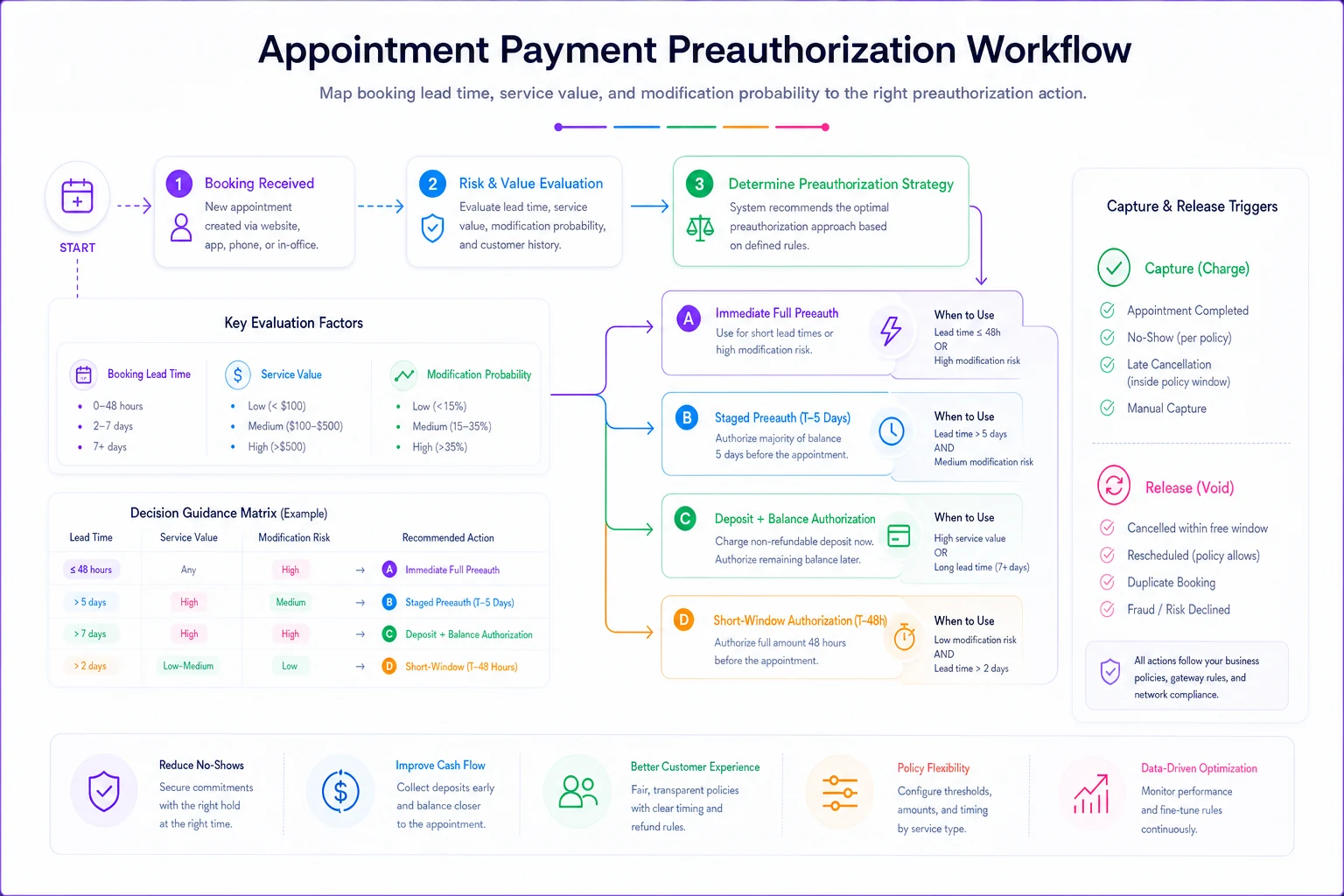
The diagram shows how different booking windows and values route to deposits, preauths, and capture timing.
Automated release rules that prevent accidental captures
The worst payment mistake happens in reverse — capturing funds you shouldn't have. A customer cancels appropriately, but your system captures their preauthorization anyway. Now you're processing refunds, dealing with angry customers, and potentially triggering disputes that damage your merchant account standing.
Auto-release rules need multiple triggers working together. The obvious one: release holds when appointments are cancelled with proper notice. But this assumes your cancellation system talks to your payment system in real-time, which rarely happens cleanly.
-
Appointments cancelled with proper notice
immediate release
-
No-shows not marked within 4 hours
hold for policy review
-
Appointments incomplete after 24 hours
automatic release
-
Rescheduled appointments
release original, create new authorization
-
Disputed appointments
immediate release pending review
Make release the default action unless explicitly overridden. This reverses the typical pattern where holds stay active until someone remembers to release them.
A dental practice reduced accidental captures by around 90% with this rule set.
The documentation system that wins disputes before they start
Winning payment disputes requires proving a chain of agreement from booking through service delivery. Most businesses can't do this because their documentation exists in fragments across multiple systems. The fix isn't complex — it's about creating linked documentation at each transaction point.
Start with the booking confirmation. This document needs to include:
-
Service details and pricing
-
Cancellation policy with specific terms
-
Payment authorization amount and capture terms
-
Timestamp and IP address of acceptance
-
Link to full terms of service
What most businesses miss: you need to prove the customer actually received and opened this confirmation. Send it via email with read receipts enabled. Send a text with the critical terms. Record both sends in your CRM. When a dispute arrives months later, you can show multiple confirmation channels.
For the appointment itself, document everything:
-
Check-in time and method (in-person, virtual, automated)
-
Service start and end times
-
Any modifications to the original booking
-
Completion confirmation from service provider
-
Customer satisfaction check (even a simple "service complete" acknowledgment)
A home organizing company built this documentation flow and saw their dispute win rate jump from around 15% to 70%. They didn't change their actual service or policies — they just started documenting what was already happening in a way that payment processors could verify.
The real power comes from linking these documents. Your booking confirmation should reference a confirmation number that appears on the service record, which links to the payment capture, which references the original authorization. This creates an evidence chain that's extremely difficult for customers to dispute successfully.
Reconciliation SOPs that catch revenue leakage daily
Payment reconciliation for appointment businesses isn't just matching deposits to invoices. It's tracking the entire lifecycle from preauthorization to capture to settlement, catching failures at each stage before they become permanent revenue loss.
Daily reconciliation needs three checkpoints:
Morning: Yesterday's Captures Pull all appointments completed yesterday. Match against payment captures. Flag any completed appointments without captures. Flag any captures without completed appointments. This catches the most common failure — services delivered but not billed — within the capture window.
Afternoon: Expiring Authorizations List all authorizations expiring in the next 48 hours. Match against upcoming appointments. For appointments still scheduled, verify they'll happen before authorization expires. For appointments that won't happen in time, decide: release, extend, or capture per your policies.
End of Day: Failed Payments Review all failed capture attempts. Separate into categories: expired authorizations, insufficient funds, wrong card info, processor errors. Each category needs different remediation. Expired authorizations need rebilling. Insufficient funds need payment plans. Wrong card info needs customer contact.
-
Appointments without valid authorizations
-
Authorizations without matching appointments
-
Authorizations that will expire before appointments
-
Appointments that have moved but authorizations haven't
A property management company using this daily rhythm recovered around $31,000 in previously lost revenue over four months. Not one big problem — hundreds of small gaps that added up to significant leakage.
Weekly reconciliation goes deeper. Match your authorization ledger against your appointment schedule for the next month. Monthly reconciliation examines patterns. Track your authorization-to-capture rate by service type, team member, day of week, and booking channel.
The cancellation policy integration everyone forgets
Your cancellation policy and payment capture rules need perfect alignment, but most businesses develop them separately. The policy says "24 hours notice required," but the payment system is configured for 48-hour holds. Or the policy allows free cancellation for first-time customers, but the payment system treats all customers identically.
Map every cancellation scenario to a specific payment action:
Cancellation with proper notice:
-
Release preauthorization immediately
-
Send confirmation of release to customer
-
Log cancellation reason for pattern analysis
Late cancellation (policy violation):
-
Capture cancellation fee per policy
-
Release remaining authorization
-
Document policy reference and cancellation timestamp
-
Send receipt explaining charge
No-show:
-
Hold authorization for review period (usually 24 hours)
-
Attempt customer contact for explanation
-
Capture full amount or cancellation fee based on response
-
Document attempt at contact and outcome
Provider-initiated cancellation:
-
Release all authorizations immediately
-
Send apology with confirmation of release
-
Offer priority rebooking if appropriate
-
Track for service recovery follow-up
The complexity multiplies with partial cancellations. A party planning service books multiple vendors for an event. One vendor cancels, but others remain. Do you release the entire authorization and re-authorize for the remaining amount? Capture the cancelled portion as a fee while maintaining holds for active services? Each decision needs clear rules that your payment system can execute consistently.
Template package for dispute-proof operations
Most dispute losses are preventable with the right templates and operational documents. Here's a practical structure that's helped many businesses strengthen their payment operations:
Booking Confirmation Template: Subject: Appointment Confirmed - [Service] on [Date] - Confirmation #[Number] Your appointment for [specific service] is confirmed for [date] at [time]. Location: [full address or virtual meeting link] Service Provider: [name] Estimated Duration: [time] Service Price: $[amount] Payment Authorization: We've authorized $[amount] on your card ending in [last 4 digits]. This amount will be captured after your appointment is completed successfully. Cancellation Policy:
-
Cancel 48+ hours before appointment
Full refund
-
Cancel 24-48 hours before
50% cancellation fee
-
Cancel less than 24 hours
Full charge
-
No-show
Full charge
To modify or cancel this appointment: [specific link or phone number] This appointment is governed by our full terms of service: [link] By booking this appointment, you've agreed to these terms.
Dispute Response Template: [Adapt based on dispute reason, but always include:]
-
Transaction Details
- Authorization Date: [date] - Service Date: [date] - Capture Date: [date] - Amount: $[amount] - Service Provided: [specific description]
-
Evidence of Agreement
- Booking confirmation sent: [date/time] via [channel] - Policy acknowledgment: [screenshot or log] - Service completion: [documentation]
-
Supporting Documentation
- Attachment 1: Booking confirmation email - Attachment 2: Policy acknowledgment - Attachment 3: Service completion record - Attachment 4: Communication history
-
[Specific rebuttal to dispute reason]
Payment Reconciliation Checklist: Daily Tasks:
-
[ ] Match yesterday's appointments to captures
-
[ ] Review authorizations expiring in 48 hours
-
[ ] Process failed payment reports
-
[ ] Update customer payment methods for failures
-
[ ] Document any manual overrides
Weekly Tasks:
-
[ ] Audit next month's appointments for valid authorizations
-
[ ] Review dispute queue and prepare responses
-
[ ] Analyze authorization failure patterns
-
[ ] Update automatic rules based on patterns
-
[ ] Train team on any new payment procedures
These templates give your team a consistent starting point for dispute responses, booking confirmations, and daily operational checks.
When manual payment handling becomes unsustainable
Around 200 appointments per month is roughly where manual payment lifecycle management starts breaking down. Not because your team isn't capable, but because the complexity multiplies fast. Each appointment might have 5-10 payment events — authorization, modification, capture, settlement, reconciliation. At 200 appointments, that's potentially 2,000 payment decisions monthly that need consistent execution.
This is where operational inefficiencies compound into serious revenue impact. Teams spend hours daily just managing payment authorizations, missing the capture windows that actually generate revenue. The answer isn't hiring more payment processors — it's building systematic workflows that handle standard cases automatically while flagging exceptions for human review.
Modern operational platforms now integrate appointment scheduling directly with payment processing, creating unified workflows that eliminate most manual handoffs. When a customer books, the system automatically determines the right preauthorization strategy based on appointment type, timing, and value. When appointments complete, captures happen instantly. When cancellations occur, the appropriate payment action triggers based on your actual policies, not generic rules.
For businesses managing complex appointment payment preauthorization across multiple service types, locations, or providers, AI-powered operational software can map your specific policies to automated workflows. Instead of training staff on dozens of payment scenarios, you configure rules once and let the system handle standard cases while surfacing exceptions that actually need human judgment.
The businesses that win in appointment-based services aren't necessarily the ones with the best service or the best marketing. They're the ones with the tightest operations — where every authorized dollar gets captured, every dispute gets won, and every payment reconciles correctly. Building these systems manually is possible but increasingly difficult as transaction volumes grow and customer payment expectations evolve.
Your payment lifecycle directly impacts customer experience and cash flow. The templates and SOPs here give you the foundation.
Making them operational reality — whether through manual diligence or systematic automation — is what separates businesses that scale profitably from ones that leak revenue at every step.
Ready to optimize your scheduling and operations?
Join thousands of businesses using Schedily to save time, improve coordination, and enhance operational efficiency.