



The Conference Board's August reading came in slightly lower again, with consumer confidence edging down in August 2026 according to Reuters. It wasn't a dramatic collapse — it rarely is. But for appointment-driven businesses, small shifts in how confident people feel about their finances show up fast, and not always in ways that look like "fewer bookings" on the surface.
If you run scheduling, staffing, or revenue for a business where people book time with you, this is worth paying attention to. Not because the number itself is alarming, but because the behavior underneath it tends to distort your calendar, your no-show rates, and your per-hour economics over the next 8–12 weeks in ways that are easy to miss until the damage is done.
Below are the operational moves that actually hold up when demand gets softer.
What Actually Shifts (It's Not Just "Fewer Appointments")
The first instinct is to assume booking volume drops across the board. That's usually wrong. What tends to happen is more subtle:
-
Downgrades, not cancellations. People still come in, but they book the $60 service instead of the $110 one, or skip the add-ons.
-
Longer decision lag. The gap between "I should book this" and actually booking stretches out. Your lead time distribution shifts.
-
Softer commitment. No-show and same-day cancellation risk creeps up, especially on discretionary or higher-ticket slots.
-
Rescheduling churn. Instead of canceling outright, people push appointments — which quietly eats your capacity through the back door.
The second Conference Board release, summarized on PR Newswire, noted that expectations about future conditions softened more than the view of the present. That's the tell. When people feel okay about now but nervous about later, they don't stop spending — they get more cautious about committing ahead of time. For a booking calendar, that translates directly into shorter lead times and looser commitments.
The Underlying Problem: Your Calendar Was Built for Confident Customers
Most scheduling setups get this wrong in a softening environment. They're optimized to fill the calendar, not to protect the value of each slot.
Eliminate scheduling conflicts and missed meetings.
Schedily helps you organize and manage all appointments and team availability effortlessly.
- Unified appointment and resource management
- Automated notifications & reminders
- Team calendar synchronization
No credit card required
When demand is strong, filling is the whole game. Every open slot feels like a loss, so you take whatever books. But when confidence dips and people downgrade or hesitate, a calendar packed with low-value, high-cancellation-risk bookings can actually earn less than a slightly emptier one built around your better slots.
That distinction — filling versus protecting yield — is the core operational shift. And most teams don't make it until they've already watched a month of margin leak out through downgrades and last-minute holes they couldn't backfill.
This is where thinking in terms of revenue per available hour matters more than raw booking counts. We broke this down in more detail in optimizing appointment economics with RevPAH and capacity pricing — worth revisiting now, because a soft-demand period is exactly when per-hour thinking beats per-booking thinking.
The 7 Moves
1. Re-tier your slots before you touch prices
Don't reprice yet. First, sort your inventory. Which time slots and service types actually carry your margin? In most appointment businesses, a minority of slots and services drive the bulk of profit — mid-week peak hours, higher-skill providers, premium services.
Put firmer rules on the small set of mid-week peak slots first — they usually carry most of your margin.
Once you know your tiers, protect the high-value ones differently: firmer deposit rules, tighter cancellation windows, priority for repeat clients. The low-tier slots can stay flexible to capture whatever demand exists.
Applying one blanket policy across the whole calendar is a common mistake. When demand softens, uniform policies quietly punish your best inventory.
2. Tighten deposit and cancellation rules — but only where risk lives
Softer commitment means your no-show exposure goes up, but adding friction everywhere suppresses the bookings you still want. Target it.
| Booking type | Cancellation risk | Recommended rule |
|---|---|---|
| First-time, high-ticket | High | Deposit + 48hr window |
| Prime-time discretionary | Medium-high | Card on file + reminder cadence |
| Repeat client, routine | Low | Keep frictionless |
| Off-peak, low-value | Low-medium | Flexible, easy rebook |
Higher-ticket consults, first-time clients, and prime-time slots are where a modest deposit or card-on-file requirement earns its keep. Repeat clients booking a routine service? Leave them alone. Adding a deposit wall to a loyal customer's $50 recurring appointment is how you turn a soft month into a lost regular.
3. Shorten your forecasting window
If you're still building staffing plans off a rolling 6-week demand model, you're forecasting with stale assumptions. When lead times compress, your near-term signal gets noisier and your far-out signal gets less reliable.
Move to a tighter cadence — reforecast weekly, watch the 10–14 day booking window closely, and treat anything beyond that as a soft estimate. The goal isn't precision. It's not over-committing labor to a demand curve that's shifting under you.
4. Flex staffing toward your actual demand shape
Softer demand rarely spreads evenly. Certain days, certain providers, certain services hold up while others thin out.
-
Trimming coverage on the two slowest days rather than shaving everyone's hours evenly
-
Cross-training so one person can cover two service types during thin periods
-
Keeping a small on-call float for days that still spike
The operations that handle soft periods well aren't always cutting the most hours — they're cutting the right hours and leaving their strong slots fully staffed.
5. Fight downgrades with structure, not discounts
The reflex when people trade down is to discount the premium service to pull them back up. Usually a mistake. You end up training your best customers to wait for lower prices and compress margin on the exact services that carry you.
Restructure the offer instead. Bundle the add-on into the base service at a modest bump rather than pricing it separately. Offer value-adds that cost you little but read as premium. Give repeat clients a reason to stay at their usual tier — priority booking, a locked-in rate — rather than a straight price cut.
6. Rework your reminder and rebook flow
When cancellation and reschedule churn goes up, the difference between a lost slot and a recovered one is how fast you know it opened and how fast you can fill it.
A practical workflow that holds up:
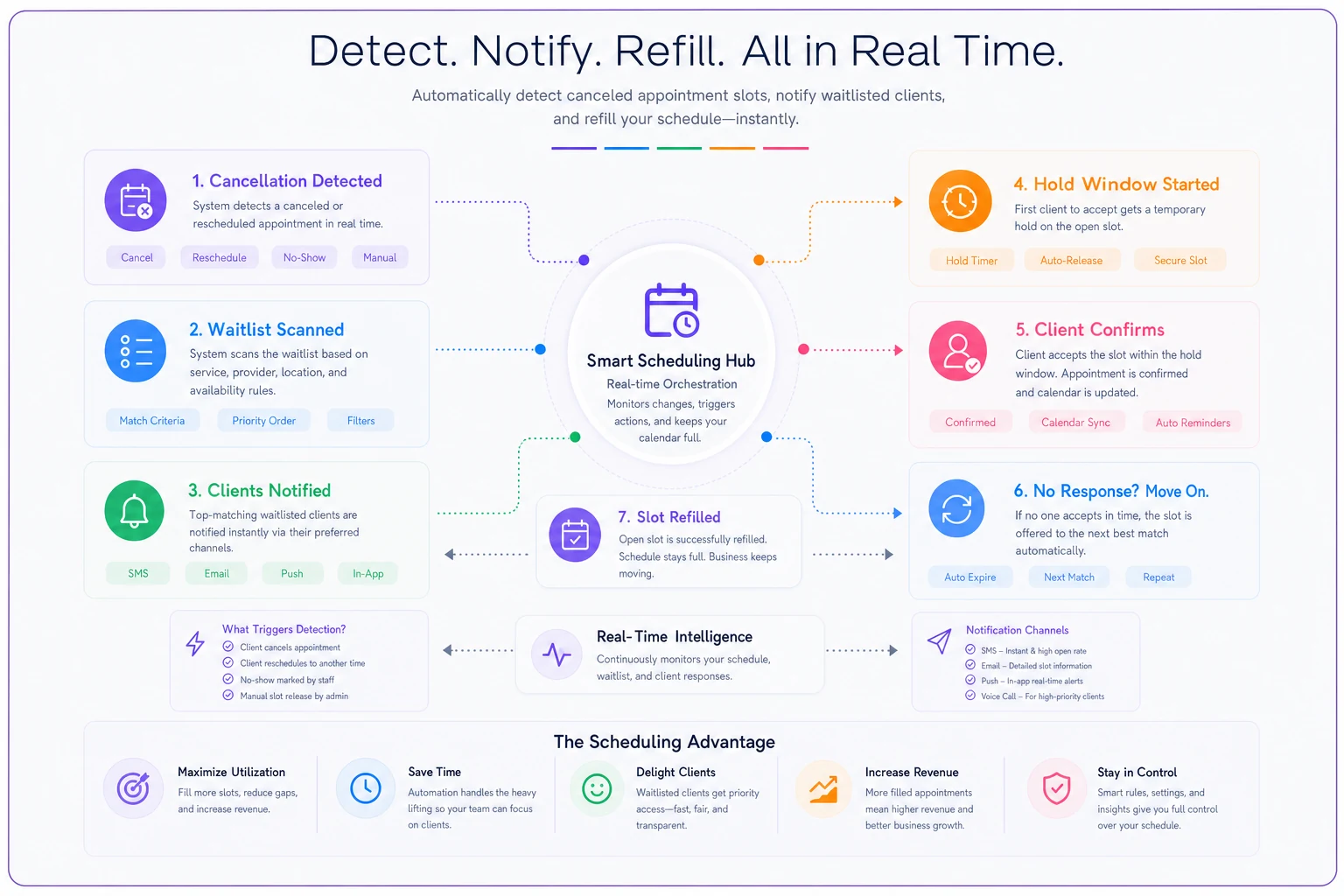
-
Confirmation at booking, with the cancellation policy stated plainly — not buried.
-
Reminder at 48 hours, timed so a cancellation still leaves room to backfill.
-
Instant open-slot detection the moment a cancellation hits, so the slot goes back into availability immediately.
-
A short waitlist trigger — notify people who wanted that time window.
-
A same-day fill offer to nearby or flexible clients for slots still open inside 24 hours.
The gap most businesses have isn't steps 1 or 2. It's steps 3 through 5 — the recovery half. A canceled appointment sits invisible for hours because nobody's watching the calendar in real time, and by the time it's noticed, the window to refill is gone.
Scheduling software that flags openings and triggers waitlist notifications automatically earns its cost here, especially when your front desk is stretched thin. Not because automation is inherently better, but because recovery is time-sensitive and manual monitoring consistently loses to the clock.
7. Watch your leading indicators, not just revenue
Revenue reports lag. By the time a soft month shows up in the numbers, the behavior started weeks earlier. Track the signals that move first:
-
Average booking lead time (shortening = softer commitment)
-
Mix of high-tier vs. low-tier bookings (downgrade trend)
-
Same-day cancellation rate
-
Reschedule frequency
-
Backfill rate on canceled slots
A quick weekly look at these tells you what's happening before your P&L does.
A Real Scenario
A mid-sized wellness and massage studio running two locations — roughly 320–360 appointments a month combined — noticed something odd through late summer: booking count held nearly flat, but revenue slipped around 9%. The calendar looked fine.
When they broke it down, two things were happening. Clients were dropping 90-minute sessions for 60-minute ones, and same-day cancellations on their premium therapists had crept up from a handful a week to closer to a dozen — slots that almost never got refilled because nobody caught them in time.
They didn't cut prices. They tiered their slots, put a card-on-file rule on prime-time and first-time bookings only, and set up automatic open-slot alerts with a short waitlist. Over the following six or seven weeks, backfill on canceled premium slots went from almost nothing to filling roughly half of them, and the downgrade drift slowed once they bundled the add-on into the base session instead of pricing it separately. Revenue didn't rocket back — it recovered most of the gap — but more importantly the calendar stopped leaking quietly.
The lesson wasn't "do more marketing." It was that their operation was built to fill, not to protect yield, and a small demand shift exposed it.
When These Moves Make Sense — And When They Don't
When to act now: You're seeing lead times shorten, downgrade drift, or rising same-day cancellations. Even without a revenue hit yet, these are early signals worth getting ahead of.
When to hold off: If your bookings are genuinely stable and your mix hasn't shifted, don't add friction preemptively. Deposit rules and tightened windows have a real cost — they suppress some good demand — and there's no reason to pay it before you need to.
Who should be careful: Businesses running heavily on new-client acquisition. If most of your volume is first-timers, blanket deposit requirements can choke your top of funnel. Tier carefully and lean on softer commitment mechanisms — reminders, card-on-file — before going to hard deposits.
The Real Takeaway
A slight dip in consumer confidence isn't a reason to panic, and it's definitely not a reason to slash prices. It's a signal to change how you think about your calendar — from filling seats to protecting the value of each hour you have available.
The businesses that struggle in soft periods are usually running a strong-demand playbook against weak-demand behavior. Same policies, same flat staffing, same fill-everything reflex. The ones that come through relatively intact make small, targeted adjustments early: they know which slots carry them, they protect those, they recover cancellations faster, and they watch the leading signals instead of waiting for the P&L to confirm what already happened.
None of that requires a big strategic overhaul. Most of it is just tightening the operational habits you already have — before a soft month turns into a soft quarter.
None of that requires a big strategic overhaul. Most of it is just tightening the operational habits you already have — before a soft month turns into a soft quarter.
Ready to optimize your scheduling and operations?
Join thousands of businesses using Schedily to save time, improve coordination, and enhance operational efficiency.