


Most appointment-driven businesses price their time like it's a fixed cost. A haircut is $60. A dental cleaning is $140. A consult is $250. Same price at 9am Tuesday as 5pm Friday, same price during your slowest February week as your fully-booked December.
Hotels stopped doing this decades ago. Airlines too. They figured out that an empty seat or an empty room is worth exactly nothing the moment the plane leaves or the night passes — so the price should move based on how full you are and how far out the booking sits. Appointment businesses have the exact same economics. A stylist's 2pm slot that goes unfilled is dead revenue. It doesn't roll over. It's gone.
The problem is that borrowing "dynamic pricing" from hotels usually gets butchered into surge pricing that annoys customers and confuses staff. What actually works is translating the underlying metrics — RevPAH and fill elasticity — into concrete operational rules: deposit tiers, pricing windows, rollback triggers, and staffing calls your front desk can follow without a data science degree. That's what appointment yield management really is when you strip the buzzwords off it.
RevPAH is the number your P&L is missing
RevPAH means Revenue Per Available Hour. Not revenue per booked hour — revenue per available hour, including the empty ones. That distinction is the whole game.
Here's why it matters. A clinic can look busy and still be leaking money. If a provider works an 8-hour day and books 6 hours at $180 each, gross is $1,080. Feels fine. But RevPAH is $1,080 ÷ 8 = $135. Two empty hours dragged the real number down by 25%. Most owners never calculate this because their reports show "revenue" and "utilization" as separate figures, and separately they both look acceptable.
When you combine them into one number, the decisions get obvious. You stop asking "are we busy?" and start asking "what is each hour on the calendar actually earning, on average, across every chair/room/provider?"
A few patterns worth knowing once you start tracking this:
-
Utilization can be high while RevPAH is low. This happens when you fill slow slots with discounted or low-margin services just to keep people busy. The chair is occupied; the hour is underperforming.
-
RevPAH exposes your worst time blocks, not your worst services. You'll usually find a specific window — say Tuesday and Wednesday mid-mornings — that's structurally underfilled every single week.
-
Averaging across providers hides the real spread. Your top provider might run a RevPAH double your newest hire. That's a coaching, pricing, and scheduling signal all at once.
The mistake almost everyone makes is measuring RevPAH monthly and calling it a day. Monthly averages smooth out exactly the volatility you're trying to price against. You want it by day-of-week and by time block, because that's the level where you actually make decisions.
Fill elasticity: how much your calendar responds to price
Elasticity is the second half. Fill elasticity is simply: how much does demand for a slot change when you change the price?
Eliminate scheduling conflicts and missed meetings.
Schedily helps you organize and manage all appointments and team availability effortlessly.
- Unified appointment and resource management
- Automated notifications & reminders
- Team calendar synchronization
No credit card required
Some slots are stiff. Saturday morning fills no matter what you charge — people want their weekend appointment and they'll pay. Raising that price 10% barely dents demand. Other slots are springy. That dead Tuesday 11am might sit empty at full price but fill instantly at 15% off. The springy slots are where discounting actually earns money; the stiff slots are where you're leaving money on the table by not charging more.
In real operations, this usually shows up as a lopsided week. Fridays and Saturdays are jammed and you're turning people away. Tuesday through Thursday mornings are ghost towns. Flat pricing treats all of them identically, which is why the imbalance never fixes itself. You're effectively subsidizing your slow slots by underpricing your busy ones.
A lot of service business owners intuitively know their peak times but have never quantified how springy the off-peak slots are. They assume "nobody wants Tuesday morning" when the truth is "nobody wants Tuesday morning at full price." A modest, rule-based nudge changes that.
You don't need a regression model to estimate elasticity. Run a controlled test: drop the price on one recurring dead block for three weeks, hold everything else constant, and watch the fill rate. If fill jumps a lot, that slot is elastic and worth a standing discount. If it barely moves, the problem isn't price — it's demand, and you should be cutting capacity there instead.
Building the decision matrix
Concepts don't run a business. Rules do. The point of RevPAH and elasticity is to feed a matrix your team can actually execute. Here's the core structure that translates the theory into daily operations.
| Slot condition | RevPAH signal | Elasticity | Operational rule |
|---|---|---|---|
| High demand, filling early | Above target | Stiff | Raise price 8–15%, require deposit, no discounts |
| Filling on schedule | At target | Moderate | Hold price, standard deposit |
| Empty inside 72 hrs | Below target | Springy | Trigger discount window, drop deposit friction |
| Chronically empty every week | Well below | Springy but low ceiling | Cut capacity or reassign staff, don't just discount |
| Empty inside 24 hrs | Salvage mode | Very springy | Last-minute rate to waitlist/app notifications |
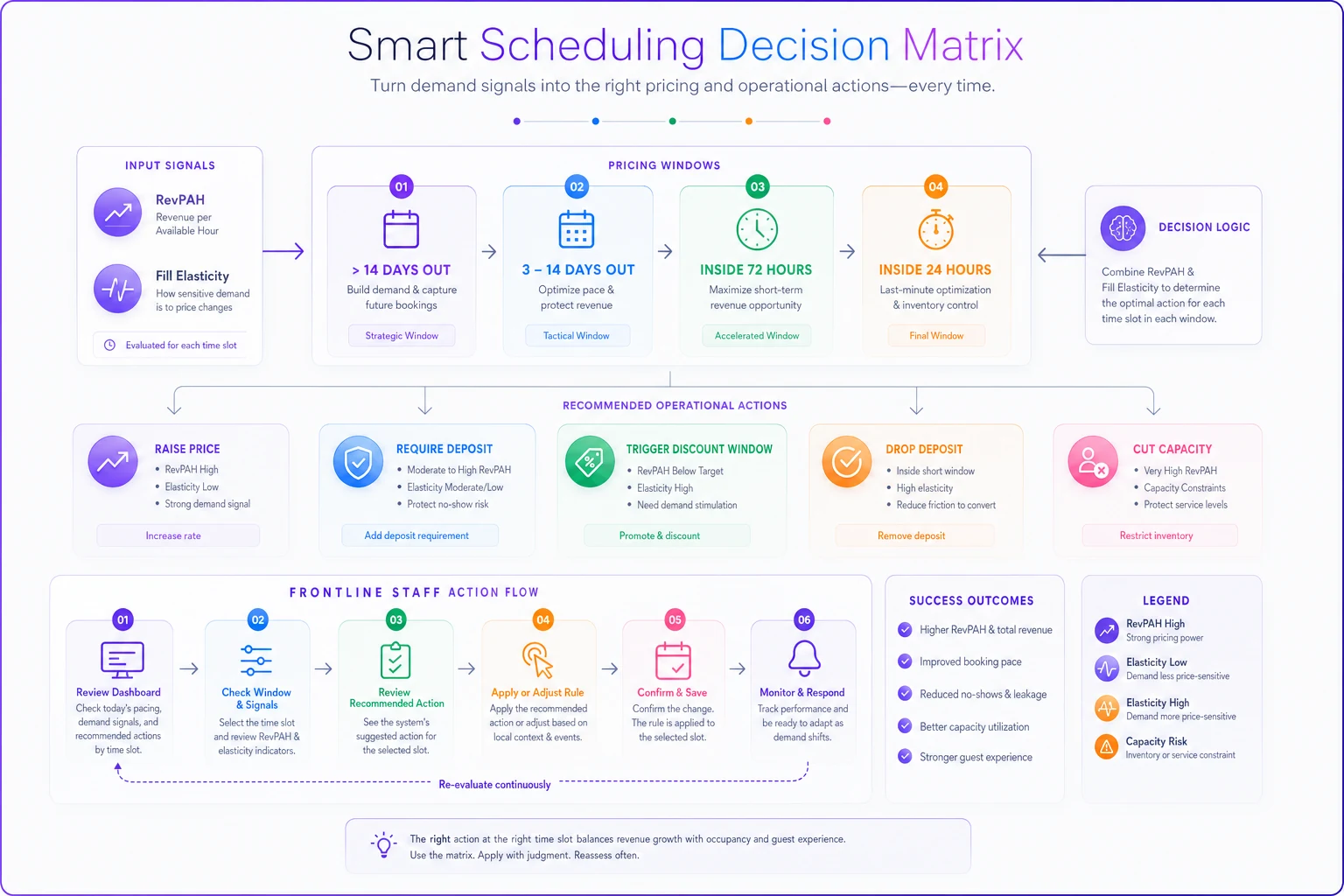
The column that matters operationally is the last one. Every slot state should map to a single, unambiguous action — not a judgment call your front desk has to relitigate every day.
Keep deposit tiers simple: two or three levels linked to the pricing bucket so staff can apply them quickly.
Deposit and priority rules move with price, not separately. When you raise the price on a stiff peak slot, that's also when you should require a bigger deposit — those are your highest-value bookings and the ones most painful to lose to a no-show. When you discount a springy slot, you want less friction — a smaller deposit or none — because you're trying to convert marginal demand, and a deposit wall kills conversion on price-sensitive bookings. Getting the deposit logic tied cleanly to the pricing logic is where a lot of this lives, and it's worth grounding in real policy-first governance for pricing, deposits, and cancellations so the rules are consistent and defensible rather than improvised at the desk.
Dynamic pricing windows should be bounded, not continuous. Don't let prices float freely. Define discrete windows — "more than 14 days out," "3–14 days out," "inside 72 hours," "inside 24 hours" — and set a rule for each. Continuous pricing feels sophisticated but it makes your prices look erratic and it's impossible for staff to explain to a customer. Windows are legible.
Rollback triggers: the part everyone skips
You build a nice dynamic pricing setup, it works for a month, and then a competitor opens down the street, or a holiday shifts demand, and your rules are now pricing against a reality that no longer exists. Without a rollback trigger, you keep discounting slots that would've filled anyway, or you keep charging premiums on slots that have gone soft.
A rollback trigger is a predefined condition that reverts a pricing rule to baseline. You decide in advance what "this isn't working" looks like, so you're not making emotional pricing calls mid-week.
-
Fill-rate collapse. If a normally-stiff peak slot drops below, say, 70% fill for two consecutive weeks, roll the premium back to baseline — demand has shifted and you're now suppressing it.
-
Discount overshoot. If a discounted slot hits 100% fill three weeks running, you discounted too hard. Step the price back up until you find the level that fills it without giving away margin.
-
Margin floor breach. If dynamic discounting ever pushes an hour's effective RevPAH below your break-even, hard stop. No slot should be priced below the cost to staff it.
-
Complaint threshold. If price-related complaints or cancellations cross a set count in a period, pause the aggressive rules and review. Reputation damage doesn't show up in RevPAH until it's too late.
The discipline here is deciding the triggers before you launch, when you're calm and thinking clearly — not in the middle of a bad week when you're tempted to panic-discount everything.
Wiring the experiment: how to test without wrecking your calendar
You can't A/B test pricing the way a software team tests a button color — your inventory is tiny and every slot is real revenue. But you can run disciplined experiments if you're structured about it.
The clean approach is time-block isolation. Pick one recurring block, change one variable, hold everything else steady, and measure across enough weeks to beat the noise.
-
Baseline for 3–4 weeks. Record RevPAH and fill rate for the target block at current pricing. This is your control.
-
Change one lever. Adjust price, or deposit requirement, or the discount window — never more than one at a time, or you won't know what caused the change.
-
Hold for 3–4 weeks. Resist the urge to tweak mid-test. Short samples on low-volume slots lie constantly.
-
Compare RevPAH, not fill. A slot can fill more and earn less if you discounted too deep. RevPAH is the scoreboard; fill rate is a secondary signal.
-
Keep or roll back. If RevPAH improved and complaints held steady, standardize the rule. If not, revert and try a different lever.
One thing that trips people up: they change price and start sending waitlist notifications at the same time, then can't tell whether the price or the outreach moved the needle. Isolate. Boring, but it's the only way to learn anything real from a small calendar.
Where staffing collides with all of this
Yield management isn't only a pricing exercise. The moment you know which slots are structurally weak and which are structurally strong, you're also looking at a staffing map. There's no point running elaborate discounts on Tuesday mornings if the smarter move is to simply not staff Tuesday mornings at full strength and shift that labor to Saturday.
This is where RevPAH earns its keep beyond pricing. If a time block's RevPAH stays below break-even no matter what you charge, the answer isn't a better discount — it's fewer providers on the floor during that block. Conversely, if a peak block is turning away demand at premium prices, you have a clear, dollar-justified case to add hours or a float provider.
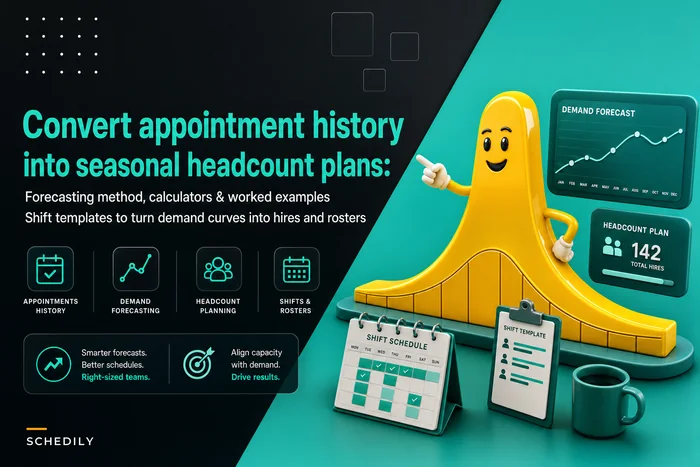
The strongest operations line their pricing windows up with their staffing model so the two reinforce each other instead of fighting. That connection runs straight through demand forecasting — if you're building schedules off gut feel, the pricing rules won't have anything solid to sit on. Doing this well means turning appointment history into seasonal headcount plans so your staffing anticipates the same demand curve your pricing responds to.
And none of the peak-slot premium math works if your highest-value slots keep evaporating to no-shows. When you're charging more for stiff, high-demand appointments, protecting those bookings matters more than ever — which is why deposit rules and no-show prevention with behavioral nudges and recovery flows belong in the same conversation as pricing, not in a separate silo.
A real scenario
Consider a three-chair aesthetics studio doing roughly 330–360 appointments a month. Flat pricing across the board. On paper, utilization looked healthy at around 78%, and the owner assumed things were basically optimized.
Once they broke revenue down into RevPAH by time block, the picture changed. Weekend and evening blocks were running RevPAH around $155/hour and turning clients away. Tuesday through Thursday mornings were sitting closer to $60/hour — chairs occupied maybe half the time, and often with the lowest-ticket services because those were the only ones that booked in advance for those slots.
They ran the matrix. Peak evening and weekend slots got an ~12% price bump plus a firmer deposit. Slow weekday mornings got a standing off-peak rate and the deposit dropped to almost nothing to reduce booking friction. They set a rollback trigger on the peak premium — if weekend fill dipped below 70% for two weeks, revert.
Over the following couple of months, the weekend premium held with barely any drop in fill, and the weekday mornings went from roughly half-empty to mostly booked. Blended RevPAH moved from the mid-$120s to somewhere around $140–$145/hour. On their volume, that worked out to somewhere in the range of an extra $3k–$4k a month, without adding a single chair or hour of labor. Same capacity, priced against reality instead of habit.
The part the owner didn't expect: the weekday morning fill let them justify moving one provider's hours toward the weekend, which relieved the turn-away problem on the high-RevPAH blocks. Pricing and staffing ended up solving each other.
When this makes sense — and when it doesn't
Yield management pays off most when you have variable demand across time and perishable capacity. If your calendar swings hard between packed and empty depending on day and hour, you're the ideal candidate. Salons, clinics, studios, consultants, inspection and home-service businesses with clear peak/off-peak patterns — all good fits.
When it's a bad idea: if your demand is genuinely flat all week, dynamic pricing adds complexity for almost no gain. You'll spend more effort maintaining rules than you recover in revenue. Same if your average ticket is very low — the margin you'd capture per slot doesn't justify the operational overhead.
Who should hold off: businesses that can't reliably measure fill rate and revenue by time block. If your data is scattered across a paper book, a spreadsheet, and three staff members' memories, fix the measurement first. Dynamic pricing built on bad data just makes wrong decisions faster. And if your no-show and cancellation rates are wild and unmanaged, stabilize those before you start charging premiums — you'll just be raising the price of appointments that don't show up.
One last thing: don't let the pricing get so clever that your front desk can't explain it. If a client asks "why is this more than last time?" and the answer is a shrug, you've built something too complicated to run. The whole point of translating RevPAH and elasticity into a matrix is that the thinking is sophisticated but the execution is simple — a clear rule for each slot state, a clear trigger for when to back off, and a staffing plan that moves with the demand.
Bringing it together
Appointment yield management isn't about squeezing customers or turning your calendar into an airline booking screen. It's about noticing that not every hour on your schedule is worth the same, and pricing and staffing accordingly. RevPAH tells you what each hour actually earns. Fill elasticity tells you which slots will respond to a price change and which won't. The decision matrix turns both into rules anyone on your team can follow, and rollback triggers keep those rules honest when the market shifts.
Do this well and you don't need more capacity to earn more — you need the capacity you already have to be priced against reality, staffed against demand, and protected against the no-shows that quietly erode your best slots. That's the whole system, and once the pieces are wired to each other instead of managed separately, the calendar starts working for the P&L instead of just filling up.
Ready to optimize your scheduling and operations?
Join thousands of businesses using Schedily to save time, improve coordination, and enhance operational efficiency.