


Most businesses treat their appointment cancellation policy like a speed limit sign—posted once, forgotten immediately. What gets missed is that rigid, one-size-fits-all policies quietly leak revenue while frustrating both high-value clients and the frontline staff who have to enforce them.
The damage is gradual, which is why it goes unnoticed for so long. Premium clients spending $8,000 a year get the same 24-hour cancellation window as someone booking their first $50 service. Your team manually processes refund decisions without any clear guidelines. Revenue per available hour slowly drops because nobody connects cancellation patterns to pricing structures.
Across appointment-driven businesses—medical practices, home services, consulting firms—the pattern is remarkably consistent. Companies treating policies as static rules instead of operational levers underperform on revenue metrics, often by more than owners expect.
The hidden complexity of modern appointment economics
Appointment businesses run on a different economic model than retail or subscriptions. Every unfilled slot is permanent revenue loss. You can't sell yesterday's 2pm appointment today.
That time-perishability creates operational challenges that standard business frameworks completely miss. A dental practice with 4 hygienists working 8-hour days has exactly 32 revenue-generating hours daily. When a patient cancels their cleaning with 2 hours notice, that slot is economically dead unless the practice has real rebooking systems in place.
-
Discovery calls at $0 (lead generation)
-
Standard consultations at $300/hour
-
Premium strategy sessions at $750/hour
-
Executive advisory at $1,500/hour
Each tier probably warrants different cancellation windows, deposit structures, and rebooking priorities. Yet most firms apply blanket 48-hour policies across everything, leaving money on the table and creating friction where there shouldn't be any.
What makes this genuinely tricky is how interconnected these decisions are. Your cancellation window affects your deposit requirements. Your deposit requirements influence your refund rules. Your refund rules impact rebooking success. Your rebooking rates determine actual revenue per available hour. Pull one lever and everything else shifts.
Why flat cancellation policies guarantee operational failure
Traditional cancellation policies fail because they ignore business reality.
Eliminate scheduling conflicts and missed meetings.
Schedily helps you organize and manage all appointments and team availability effortlessly.
- Unified appointment and resource management
- Automated notifications & reminders
- Team calendar synchronization
No credit card required
Take a home services company charging $150 for standard maintenance visits. They require 24-hour cancellation notice and keep a 50% deposit for late cancellations. Sounds reasonable—until you look at the data:
-
68% of cancellations happen within 8 hours of appointment time
-
Average rebooking success rate is 12% for same-day slots
-
Customer lifetime value ranges from $400 to $12,000
The company loses tens of thousands annually from that mismatch. High-value customers who rarely cancel get penalized the same as chronic no-shows. The ops team spends hours each week on manual refund decisions. Nobody tracks how cancellation patterns correlate with service types or customer segments.
The deeper problem is governance structure. Most businesses manage policies through scattered documents, verbal agreements, and inconsistent enforcement. The owner makes refund exceptions based on gut feel. Managers override policies to keep important clients happy. Front desk staff follow different rules depending on who trained them.
This creates a predictable spiral. Customers learn policies are negotiable, so they push back. Staff lose confidence in enforcement and default to whatever avoids confrontation. Revenue leaks accelerate while morale drops.
Building proper KPI frameworks helps surface these patterns, but fixing them requires rethinking how policies function as operational tools in the first place.
Building tiered governance that actually works
Effective appointment cancellation policy governance starts with accepting that different services, customers, and situations need different rules. A governance-first framework creates clear decision paths while keeping operational flexibility intact.
Start by mapping your service ecosystem. For each service type, identify:
-
Direct revenue per appointment
-
Preparation and setup costs
-
Rebooking probability
-
Customer acquisition cost for that service tier
-
Lifetime value patterns
A physical therapy clinic might find their evaluation appointments generate $180 directly but lead to $2,400 in follow-up treatments. Meanwhile, single massage sessions average $90 with minimal downstream revenue. Those two services need fundamentally different cancellation structures—yet most clinics treat them identically.
Next, build customer tiers from behavioral data—not just spending history. Track:
-
Cancellation frequency
-
Advance booking patterns
-
No-show history
-
Revenue consistency
-
Referral generation
The useful part comes when you connect these tiers to specific policy parameters. Instead of blanket rules, you build a decision matrix:
| Customer Tier | Service Level | Deposit % | Cancellation Window | Refund Rules |
|---|---|---|---|---|
| Platinum (top 10%) | Premium | 25% | 12 hours | Full refund, priority rebook |
| Gold (next 20%) | Premium | 40% | 24 hours | 75% refund, standard rebook |
| Silver (middle 40%) | Standard | 50% | 48 hours | 50% refund credit |
| Bronze (bottom 30%) | Standard | 75% | 72 hours | No refund, credit only |
This isn't about punishing lower-tier customers. It's about aligning policies with operational reality. Chronic cancelers require larger deposits to offset rebooking challenges. Premium clients who rarely cancel deserve flexibility that reflects their actual value to the business.
Connecting deposits, refunds, and revenue targets
Deposit structures directly impact appointment fill rates and cash flow, yet most businesses set them arbitrarily—25% because it sounds reasonable, 50% because competitors do it, 100% because they got burned once.
Smart deposit governance ties amounts to actual operational metrics. Calculate your true cost per unfilled appointment:
-
Lost revenue from the slot
-
Administrative time for rebooking attempts
-
Overhead allocation for that time block
-
Opportunity cost of turning away other bookings
A mobile grooming operation discovered their actual cost per cancelled appointment was around $127—not the $75 service price. That included van depreciation, fuel, groomer wages, and missed opportunities. Their previous $25 deposit covered maybe 20% of real losses. Nobody had done the math before.
Higher deposits do create booking friction, though. The solution is scaling deposits based on risk rather than applying a flat number:
Low-risk indicators (reduce deposit):
-
Established customer with clean history
-
Booking far in advance
-
Multiple services in a single appointment
-
Referral from a trusted source
High-risk indicators (increase deposit):
-
First-time customer
-
Last-minute booking
-
History of cancellations
-
Booking during peak demand periods
Tier A Refund (premium customers, legitimate emergencies):
-
100% refund to original payment method
-
Automatic rebooking offer with priority scheduling
-
Waived deposits on next 2 appointments
Tier B Refund (good customers, valid reasons):
-
75% refund as account credit
-
Standard rebooking at same rate
-
Maintained deposit requirements
Tier C Refund (pattern cancelers, weak reasons):
-
50% credit toward future services
-
Rebooking at current rates
-
Increased deposit on future bookings
No Refund (chronic issues, no-shows):
-
Deposit retained
-
Required prepayment for future services
-
Possible service restrictions
Your refund matrix should mirror this complexity. Graduated refund paths work better than simple yes/no decisions:
Automated decision trees eliminate enforcement friction
Manual policy enforcement kills consistency and burns out your team. Every refund decision becomes a negotiation. Every cancellation requires multiple touchpoints. Staff spend more time managing exceptions than actually serving customers.
Automation changes this—not through rigid computer rules, but by encoding your governance framework into smart decision paths.
Map your cancellation scenarios into branching logic:
-
Check customer tier status
-
Verify service type and value
-
Calculate hours until appointment
-
Review cancellation history
-
Apply appropriate policy pathway
-
Execute refund/credit/rebooking sequence
-
Update customer profile and metrics
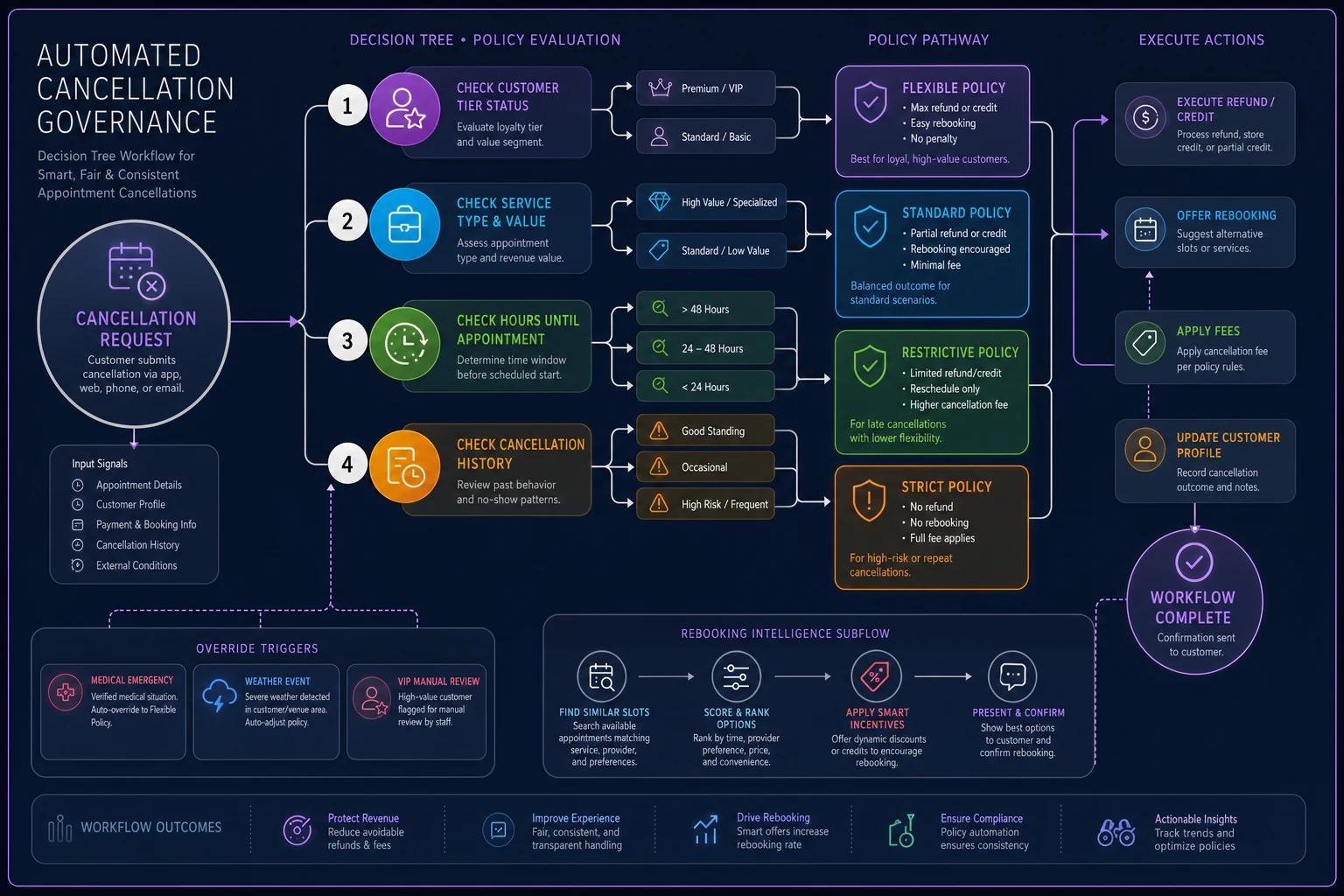
A wellness center that implemented this saw refund processing time drop from 45 minutes to around 3 minutes per case. Policy consistency climbed from 61% to 94%. Customer satisfaction actually improved because expectations became clear upfront rather than being negotiated after the fact.
Build flexibility into the automation, though. Set override triggers for edge cases:
-
Medical emergencies bypass standard windows
-
Weather events trigger mass policy adjustments
-
VIP clients route to manual review
-
Unusual patterns flag for investigation
Your automation should also handle rebooking intelligence. When someone cancels, the system should immediately identify similar available slots, calculate what discount makes sense for a quick fill, send targeted offers to waitlisted clients, and track acceptance rates over time.
Proper escalation rules ensure exceptional situations get human attention while routine cases flow automatically.
RevPAH optimization through policy calibration
Revenue per Available Hour is the north star metric for appointment businesses, yet few operators connect it to their cancellation policies. This disconnect creates a cycle where poor policies degrade RevPAH, which triggers desperate discounting, which attracts worse customers, which increases cancellations.
Break it by treating policies as RevPAH optimization levers.
A spa that tested different cancellation windows found some genuinely counterintuitive results:
-
72-hour window
91% fill rate, $127 RevPAH
-
48-hour window
88% fill rate, $134 RevPAH
-
24-hour window
83% fill rate, $139 RevPAH
-
12-hour window
76% fill rate, $118 RevPAH
The sweet spot landed at 24 hours—balancing fill rate with rebooking opportunity. But it varied by service. Massages optimal at 24 hours, facials at 48, package treatments at 72. That granularity matters more than most operators realize.
Deposit Level Calibration — Higher deposits reduce bookings but improve show rates. One operation's actual numbers:
-
0% deposit
160 bookings, 72% show rate = 115 completed
-
25% deposit
145 bookings, 84% show rate = 122 completed
-
50% deposit
128 bookings, 93% show rate = 119 completed
-
75% deposit
97 bookings, 97% show rate = 94 completed
The data pointed to 25% deposits maximizing completed appointments while keeping booking friction manageable.
Auto-Rebook Intelligence — Smart rebooking can recover 30–60% of cancelled revenue, but success requires careful matching on service compatibility, customer preferences, travel time feasibility, and price elasticity.
One home services company built rebooking tiers:
-
Same service, same provider, same day
15% discount
-
Same service, different provider, same day
25% discount
-
Similar service, any provider, same day
35% discount
-
Any service, any provider, within 48 hours
45% discount
That graduated approach filled 43% of cancelled slots versus their previous 11%. The jump surprised even them.
Service level agreements demand different cancellation structures
SLAs add another dimension to all of this. When you guarantee response times or service windows, your policies need to protect those commitments while staying commercially viable.
Different SLA tiers need different governance:
Platinum SLA (4-hour response, same-day service):
-
Non-cancellable once confirmed
-
100% prepayment required
-
Automatic penalties for provider-side cancellation
-
Premium rebooking priority if issues arise
Gold SLA (24-hour response, 48-hour service):
-
6-hour cancellation window
-
75% deposit requirement
-
50% penalty for late cancellation
-
Standard rebooking within original SLA window
Standard SLA (72-hour response, 1-week service):
-
24-hour cancellation window
-
40% deposit requirement
-
Graduated penalty structure
-
Best-effort rebooking
The framework extends to provider-side cancellations too. If your business cancels on a Platinum SLA customer, automatic compensation should kick in—maybe a 125% refund plus priority rebooking. That protects your reputation while acknowledging the disruption.
SLA-based policies also enable premium pricing. Customers willingly pay significantly more for guaranteed service windows with protective cancellation terms. A commercial cleaning service increased revenue 28% by introducing SLA tiers with corresponding policy structures.
Implementation roadmap for governance transformation
Overhauling cancellation governance requires careful sequencing. Sudden policy changes alienate customers and confuse staff. Phase it over 60–90 days:
Phase 1: Data Collection (Weeks 1–2)
-
Audit current cancellation patterns
-
Calculate true cost per cancellation
-
Identify customer segments
-
Map service interdependencies
-
Establish baseline metrics
Phase 2: Framework Design (Weeks 3–4)
-
Create service tier definitions
-
Build customer segmentation rules
-
Design deposit/refund matrices
-
Develop decision trees
-
Draft policy documentation
Phase 3: System Configuration (Weeks 5–6)
-
Set up automated workflows
-
Configure customer communication templates
-
Build reporting dashboards
-
Create override procedures
-
Test edge cases
Phase 4: Soft Launch (Weeks 7–8)
-
Roll out to new customers only
-
Train team on new framework
-
Monitor early results
-
Gather feedback
-
Refine processes
Phase 5: Full Migration (Weeks 9–12)
-
Communicate changes to existing customers
-
Implement grandfather periods where appropriate
-
Activate full automation
-
Track performance metrics
-
Optimize based on data
Soft-launch changes to new customers first to limit disruption and surface issues before full migration.
A veterinary hospital that followed this approach saw cancellations drop 31% and staff spent noticeably less time on policy management each week. The phased rollout also prevented the client backlash they'd been genuinely worried about—which almost never happens when you just flip policies overnight.
Measuring governance effectiveness
Your governance framework is only as good as its results. Track these indicators:
Policy Consistency Score: Percentage of cancellations handled according to the framework versus exceptions. Target 85–90%—perfect consistency often signals rules that are too rigid.
Revenue Recovery Rate: Revenue retained through deposits, rebookings, and credits divided by total cancelled appointment value. Strong frameworks achieve 40–55% recovery.
Operational Efficiency: Hours spent on cancellation management per 100 appointments. Good governance gets this below 2 hours.
Customer Satisfaction Delta: Comparison of satisfaction scores between customers who cancelled versus those who didn't. The gap should be minimal with well-designed policies.
Lifetime Value Protection: Average LTV of customers who experience cancellation policies versus those who don't. Well-designed governance maintains or improves LTV.
Build monthly governance reviews into your operational rhythm. Look for patterns like specific services with excessive cancellations, customer tiers misaligned with actual behavior, deposit levels creating booking friction, refund rules generating complaints, and automation gaps requiring manual intervention.
The compound effect of systematic governance
Most businesses treat cancellation policies as necessary evils—administrative overhead that protects against bad customers. That defensive mindset practically guarantees mediocre results.
Operators who do this well recognize policies as strategic tools that shape customer behavior, optimize resource utilization, and drive profitability. They invest in governance frameworks that adapt to business evolution rather than constrain growth.
The compound effect shows up after 6–12 months. Customer quality improves as policies naturally filter out chronic cancellers. Team confidence builds with clear, consistent rules. Revenue per available hour climbs. Operational complexity decreases even as the business scales.
A multi-location massage franchise that implemented tiered governance across 8 locations tracked their year-one results:
-
Cancellation rate reduced from 18% to 11%
-
RevPAH increased across all locations
-
Customer acquisition cost dropped 23%
-
Staff turnover decreased 35%
-
Franchisee satisfaction improved noticeably
These weren't independent improvements that happened simultaneously by coincidence. They came from a single governance transformation that aligned policies with operational reality.
Businesses still running flat cancellation policies are fighting yesterday's problems with yesterday's tools. Modern appointment operations need governance that accounts for the complex interplay between customer behavior, service economics, and operational constraints.
Stop treating policies as rules carved in stone. Build dynamic governance frameworks that evolve with your business, protect your revenue, and actually improve customer relationships.
The investment in proper appointment cancellation policy governance pays for itself within months while setting your operation up for sustainable scale.
Ready to optimize your scheduling and operations?
Join thousands of businesses using Schedily to save time, improve coordination, and enhance operational efficiency.