
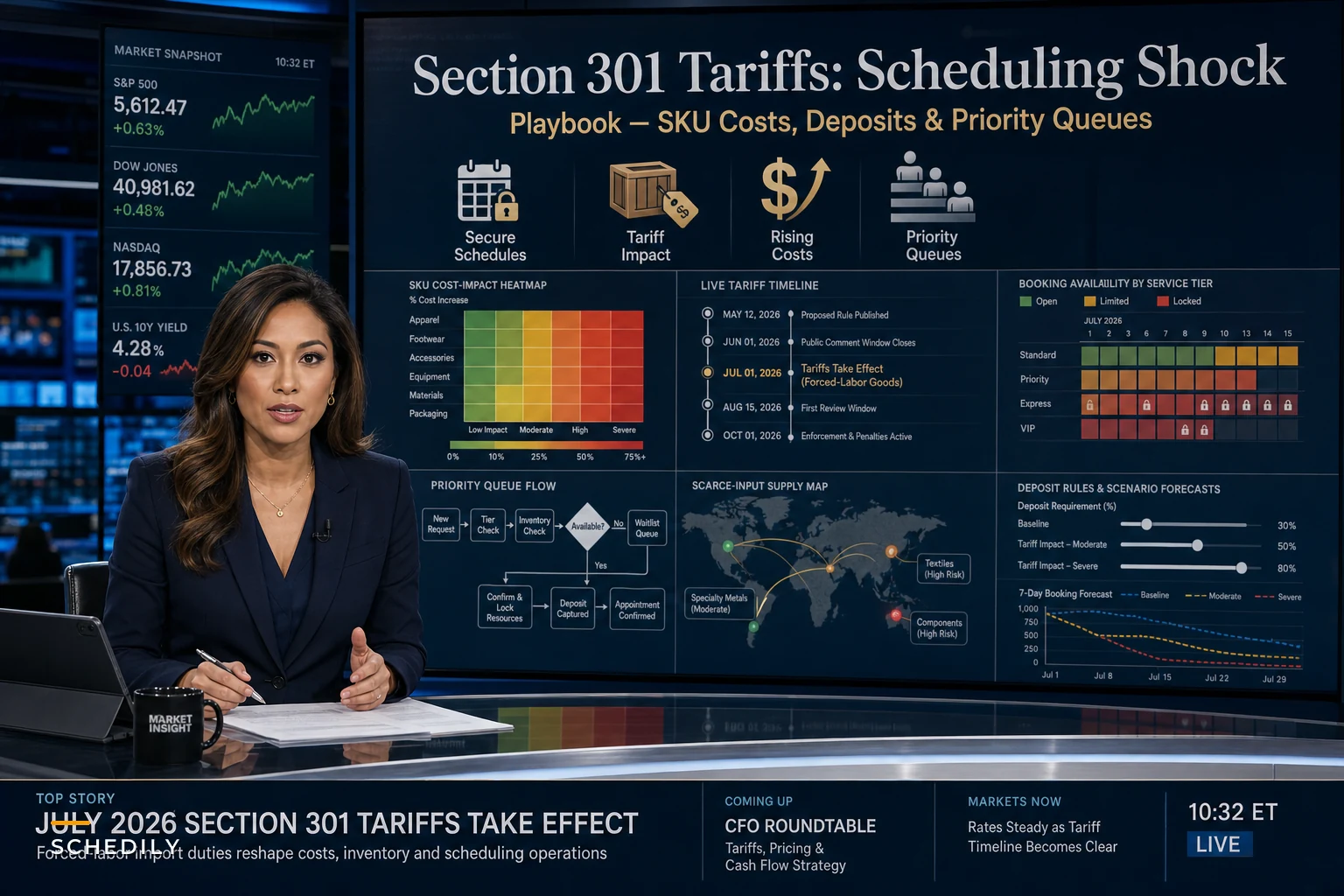

The Section 301 tariffs that kicked in last week just added 10–12.5% to landed costs across 60 economies. If you run an auto shop, equipment rental business, medical practice, or any appointment-driven service that depends on imported supplies, you're about to find out how fragile your scheduling system really is.
Most operations teams treat tariffs as a procurement problem. They're not. When your distributor calls next Tuesday saying those replacement parts now have a six-week lead time instead of ten days, your entire appointment book becomes fiction. The dentist down the street just learned this when their composite resin supplier announced allocation limits. Hygienist appointments are fine — restorative work is getting pushed to September.
What makes forced-labor tariffs different from normal supply disruptions is the scope. This isn't one supplier having a rough quarter. It's entire product categories getting more expensive and slower to arrive simultaneously. The operational cascade moves fast: higher input costs force deposit changes, uncertain availability forces scheduling buffers, and suddenly your standard processes don't hold up anymore.
The hidden scheduling bomb: when supply uncertainty meets customer commitments
Every appointment-driven business makes an implicit promise — we'll have what we need when you show up. That promise just got expensive.
Take equipment rental operations. A landscape contractor books a skid steer for next month. Under normal conditions, you'd schedule maintenance three days before the rental starts. But now your hydraulic fluid costs 11% more and your supplier is warning about "potential delays" on filters. Do you pull the equipment from the schedule preemptively? Order triple the normal stock? Raise deposits to cover the uncertainty?
When input costs spike suddenly, three things tend to break at once.
Your margin calculations go wrong overnight. That HVAC tune-up priced at $189 assumed around $47 in parts and consumables. Add 12% to those costs and you're either eating the difference or surprising customers with surcharges. Neither is a great outcome.
Capacity planning falls apart. If you can't guarantee parts availability, you can't guarantee appointment slots. Shops that normally run eight bays are starting to only schedule six when critical supplies get low.
Cancellation economics flip. Pre-tariff, a last-minute cancellation meant lost labor. Post-tariff, that same cancellation might save you from eating higher material costs on a low-margin service. Some shops are quietly relieved when certain appointments cancel now — which is a strange position to be in.
Deposit structures that actually protect operations (not just cash flow)
The most common mistake businesses make during supply shocks is raising deposits uniformly. A flat 25% increase across all services feels logical but creates operational chaos underneath.
Eliminate scheduling conflicts and missed meetings.
Schedily helps you organize and manage all appointments and team availability effortlessly.
- Unified appointment and resource management
- Automated notifications & reminders
- Team calendar synchronization
No credit card required
| Service Type | Pre-Tariff Deposit | Current Deposit | Supply Risk Factor |
|---|---|---|---|
| Diagnostic only | $50 | $50 | None |
| Routine maintenance | $100 | $125 | Low (domestic fluids) |
| Brake work | $200 | $300 | Medium (mixed sourcing) |
| Transmission rebuild | $500 | $850 | High (imported parts) |
| Custom performance | $750 | $1,200 | Very high (specialty imports) |
Deposits scale with actual supply risk rather than service value alone. That protects against the real problem: committing to appointments you may not be able to fulfill.
Deposits alone don't solve the scheduling puzzle though. You also need conditional booking rules that account for inventory reality. One auto glass shop implemented what they call "inventory-linked scheduling" — their booking system checks real-time glass availability before confirming appointments. No inventory, no booking, regardless of whether the customer is willing to leave a deposit.
Use inventory-linked scheduling to prevent taking deposits for services you can't actually perform.
Deposits that scale with risk protect operations rather than just cash flow and reduce the odds of committing to work you can't finish.
The appointment mix problem nobody talks about
Supply constraints force a brutal calculation: not all appointments are worth keeping right now. When materials cost more and arrive slower, your appointment mix becomes something you actually have to manage.
A medical aesthetics practice ran into this after their dermal filler costs jumped 11%.
Three obvious options:
-
raise prices and lose price-sensitive clients
-
absorb the costs and hurt margins
-
restructure toward higher-margin services
They went with something more nuanced — dynamic service availability based on supply levels. When filler inventory runs low, the booking system reduces available slots for basic injection appointments while keeping full availability for combination treatments that include higher-margin laser services. Same number of clients monthly, but the service mix shifted toward what actually makes sense given current costs.
Equipment rental businesses face the same math differently. When replacement parts get scarce, some are shifting rental priorities — longer-term contractor jobs get preference over short weekend rentals, not because one customer matters more, but because the operational risk of a breakdown during a three-day job is more manageable than during extended use.
Building the three-layer scheduling hedge
Getting through tariff-driven supply shocks requires what I'd call three-layer scheduling architecture. Each layer handles a different failure mode.
`` [WORKFLOW GRAPH: Three-Layer Scheduling Hedge Flow]
Layer 1: Inventory Hard Stop → Check real-time stock → Block booking if unavailable
Layer 2: Supply Velocity Check → Calculate burn rate vs. resupply timeline → Throttle appointment availability
Layer 3: Substitution Protocol → Match alternatives to patient/customer profile → Confirm and book
``
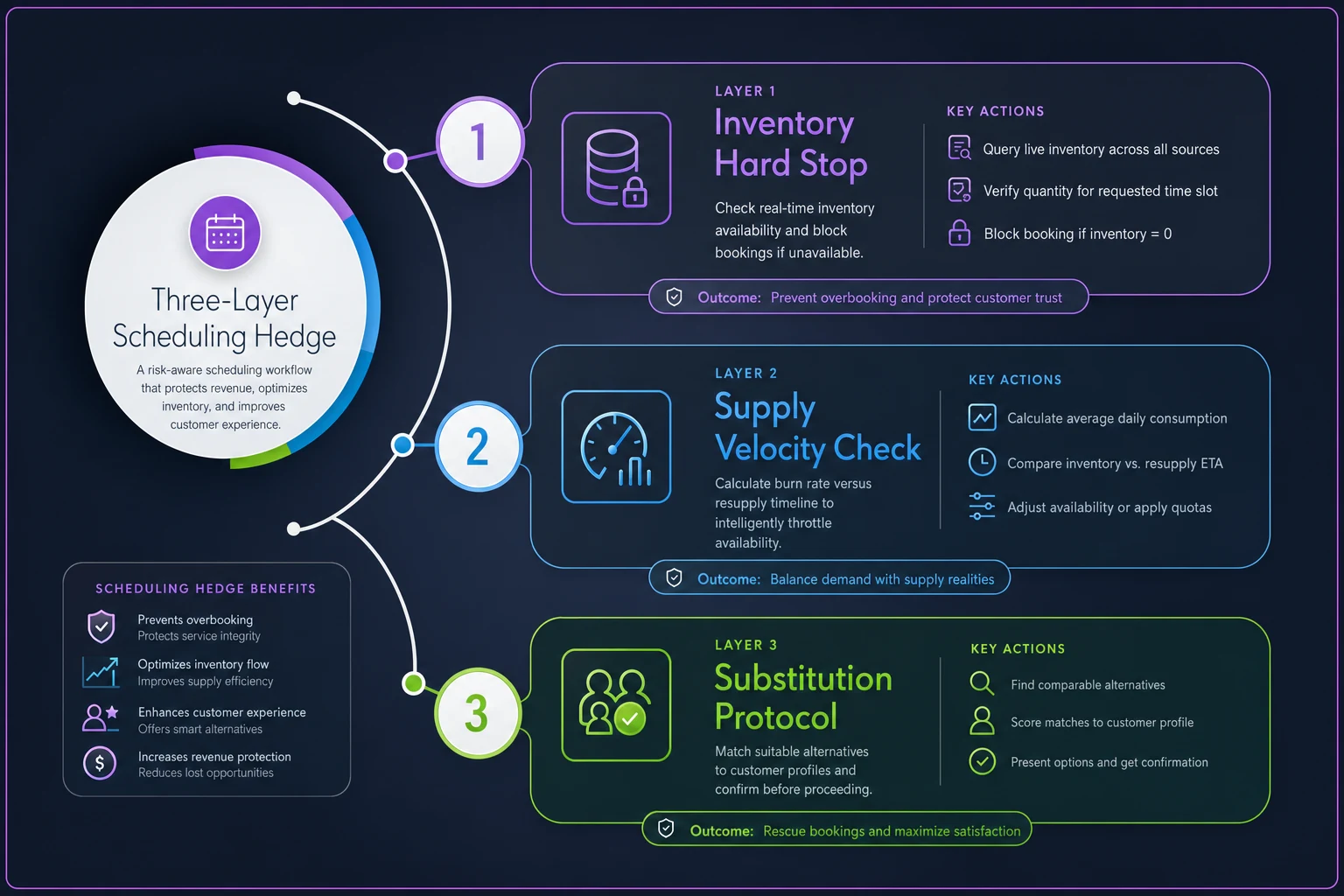
This diagram maps the three layers and how they interact.
-
Layer one handles immediate availability. Hard stops based on actual counted inventory, not projections or historical patterns. When a specific dental implant isn't in stock, the system shouldn't allow implant procedure bookings. Full stop.
-
Layer two manages supply velocity — and this is where most businesses fall short. They track what they have but not how fast they're burning through it. A veterinary clinic might have 200 surgical sutures in stock, which looks fine on paper. But if resupply now takes eight weeks instead of two, that inventory evaporates fast. Scheduling systems need to calculate burn rate and automatically throttle appointment availability when resupply timelines stretch out.
-
Layer three creates operational flexibility through substitution protocols built before you actually need them. The medical equipment rental company that normally provides one specific CPAP model now maintains approved substitution lists. When the primary model is unavailable, staff know exactly which alternatives work for which patient profiles. No scrambling, no confused customers, no day-of cancellations.
A pest control company dealing with chemical supply delays built something similar. They created service bundling rules that automatically combine treatments when specific chemicals run low — instead of two separate visits, customers get pushed toward combination services that use available inventory more efficiently. It's not a perfect fix, but it keeps the schedule from falling apart.
Pricing conversations that preserve relationships and margins
Nobody enjoys telling customers that prices went up because of something completely outside anyone's control. But avoiding the conversation tends to make things worse.
One commercial kitchen equipment maintenance company absorbed three months of higher parts costs before finally implementing surcharges. Customer reaction was significantly worse than it would have been with early transparency. Clients felt deceived even though the company was trying to protect them. That kind of trust damage is hard to undo.
A better approach separates temporary adjustments from permanent increases. A medical supply rental business restructured their quotes to show:
-
Base service cost (unchanged)
-
Current supply adjustment (varies monthly)
-
Total current price
Customers can see the business isn't arbitrarily raising rates — it's responding to real market conditions. And that structure implies prices could also come down if things improve, which actually matters to people.
An HVAC service company took a different angle. They created "price protection appointments" — customers who book and leave deposits lock in current pricing for services scheduled within 60 days. Customers get certainty, the business gets cash flow help during uncertain times. A simple trade that works in both directions.
When traditional scheduling rules become operational liability
Standard scheduling assumes predictable supply chains. That assumption is under serious pressure right now.
First-come-first-served booking made sense when you could restock parts in 72 hours. Now you're potentially committing scarce resources to low-value appointments while higher-value work waits. A collision repair shop that prided itself on no-favoritism scheduling had to face this directly: when paint supplies are constrained, insurance jobs with guaranteed payment take priority. Not ideal, but it's operational reality.
Buffer time calculations need rethinking too. A mobile device repair service that used 15-minute buffers between appointments now uses dynamic buffering based on parts certainty. Routine screen replacements with in-stock parts keep standard buffers. Logic board repairs requiring imported chips get 45-minute buffers to handle potential complications.
Cancellation policies that once felt generous can now threaten operations. A dental lab that allowed free cancellations up to 24 hours before appointments can't sustain that when materials get ordered weeks in advance. They've shifted to sliding-scale cancellation fees based on material commitment — cancel two weeks out, no charge; cancel three days before and you're covering materials already allocated.
Resource pooling breaks down when supplies get scarce too. The multi-location medical practice that used to share inventory freely between offices now treats each location as its own inventory island. Central pooling sounds efficient until one location's shortage cascades into everyone's problem.
The automation advantage in supply-shocked scheduling
This is genuinely where AI-powered operational platforms earn their keep. Manual scheduling can't handle the complexity of inventory-linked availability, dynamic pricing adjustments, and real-time supply signals running at the same time.
An automotive service chain with around 47 locations found their spreadsheet-based scheduling couldn't track parts availability across suppliers, calculate optimal appointment mix based on margin and inventory, or automatically adjust booking rules when supply signals changed. Those things require systems that process multiple data streams at once.
Operational software with AI automation handles this by maintaining a living model of your constraints — not just what you have right now, but what you'll likely have based on supplier patterns and burn rates. The medical equipment rental operation mentioned earlier built their substitution protocols directly into their platform. When specific equipment isn't available, the system automatically suggests alternatives based on patient requirements, insurance coverage, and what's actually on hand. Staff don't need to remember complex decision trees.
For businesses still running appointments through basic calendar tools, the current supply environment makes the limitation pretty obvious. You can't manually track inventory levels, adjust pricing based on supply costs, and optimize appointment mix while also actually serving customers. Something gives.
Look beyond the tariff headlines
These forced-labor tariffs aren't going away soon. The White House announcement made clear this represents a long-term trade posture, not a temporary pressure campaign. That means appointment-driven businesses need permanent operational adaptations, not stopgap workarounds.
The operators who come out ahead won't be the ones who absorbed costs quietly or passed them through blindly. It'll be the ones who restructured operations to function well despite supply uncertainty — dental practices that shifted toward higher-margin procedures, repair shops that built inventory-linked scheduling, rental companies that built substitution protocols before they actually needed them.
Your scheduling system is about to become your most important operational asset. Not inventory management, not pricing strategy — scheduling. Because that's where all these pressures converge. Every appointment you book commits inventory, locks in pricing, and creates a customer expectation. Book wrong in this environment and you're either eating costs or losing customers.
The playbook is clear enough at this point: segment deposits by supply risk, build inventory-linked availability rules, shift appointment mix toward sustainable margins, and communicate pricing reality honestly. Manual scheduling processes can't carry this complexity — you need systems that handle multiple constraints simultaneously and adjust in real time.
Those tariffs that hit last week were just the beginning. The question isn't whether you'll need to adapt — it's whether you'll do it strategically or scramble when your next supplier shipment arrives with a 12% surprise attached.
The businesses that implement proper governance around their pricing and deposit structures while building supply-aware scheduling rules will come out of this in a stronger position. Those that don't will find out exactly how fragile their appointment operations really were.
Ready to optimize your scheduling and operations?
Join thousands of businesses using Schedily to save time, improve coordination, and enhance operational efficiency.