



The FTC dropped something in early July that most operations teams haven't picked up on yet. While everyone's been buried in summer scheduling chaos, the Federal Register published a proposed policy statement that could seriously change how businesses handle AI-powered scheduling decisions. The public comment deadline is July 31, 2026, but the operational implications are already worth your time.
What caught my attention wasn't AI bias — that's been on the radar for a while. The FTC is specifically targeting "suppression of accuracy," meaning when businesses intentionally or accidentally hide, steer, or manipulate AI outputs to appear more favorable. For appointment-driven businesses using AI to estimate service times, prioritize bookings, or route technicians, this creates a compliance dimension most ops teams simply aren't ready for.
Think about your current scheduling stack. How many systems use some form of AI or machine learning to make recommendations? Appointment duration estimates, capacity planning models, no-show predictions, routing algorithms — these all fall under the FTC's new scrutiny. And if you're using third-party scheduling software, you're still on the hook for accuracy and transparency.
The real problem isn't the technology. It's that most scheduling operations have zero visibility into how their AI makes decisions, no audit trails for algorithmic outputs, and no process for monitoring accuracy drift. Scheduling systems get built to optimize for efficiency and revenue, not regulatory transparency. That gap is about to get expensive.
Why appointment businesses are in a uniquely vulnerable spot
Appointment-driven businesses sit in a particularly tricky position here. Unlike e-commerce or content platforms where algorithmic decisions happen invisibly in the background, scheduling decisions create tangible customer expectations that stick around for days or weeks.
When your system tells a customer their HVAC repair will take 90 minutes, that's not just an estimate — it shapes their entire day. If your AI consistently underestimates service times to pack more appointments into the schedule, you're not just creating operational headaches. Under the FTC's interpretation, you might be engaging in deceptive practices by suppressing accurate time predictions.
It gets more complicated when you look at how modern scheduling systems actually work. Most platforms layer multiple AI models on top of each other. One predicts appointment duration from historical data, another calculates travel time, a third scores cancellation risk, maybe a fourth optimizes technician assignments. Each model introduces its own potential for accuracy suppression — whether intentional or not.
What's genuinely concerning is how many businesses have implemented "business rules" that override AI recommendations with zero documentation. HVAC companies that automatically add 15 minutes to every AI-generated time estimate because "the model always runs short." Medical practices that bump high-value procedures to the front of the queue regardless of what the algorithm suggests. These overrides might make operational sense, but under the FTC's framework, they could constitute accuracy suppression if they're not disclosed.
The regulatory risk compounds when you factor in customer communications. If your AI knows a Thursday afternoon slot has a 70% chance of running late based on that technician's history, but your system shows it as equally reliable as a Monday morning slot, that's exactly the kind of suppression the FTC is targeting.
Step 1: Map every AI touchpoint in your scheduling workflow
Before you can fix anything, you need to understand where AI actually touches your scheduling operations. This sounds straightforward but it's not — most businesses discover they're using far more algorithmic decision-making than they realized.
Eliminate scheduling conflicts and missed meetings.
Schedily helps you organize and manage all appointments and team availability effortlessly.
- Unified appointment and resource management
- Automated notifications & reminders
- Team calendar synchronization
No credit card required
Start with the obvious ones. Your core scheduling platform probably uses machine learning for time estimation, capacity planning, or resource allocation. But dig deeper. That Google Maps integration for travel time? Predictive algorithms. Your payment processor's fraud detection that occasionally blocks bookings? AI-powered. The chatbot handling appointment requests on your website? Definitely AI.
Build a simple spreadsheet with five columns: System Name, AI Function, Data Inputs, Output Type, and Customer Impact. For each system, document what the AI does and how its outputs affect the customer experience. A routing algorithm that assigns technicians might seem purely internal, but if it systematically sends newer techs to certain neighborhoods, that affects service quality and wait times in ways customers absolutely notice.
Pay attention to cascade effects. When your reminder system uses AI to determine optimal send times, and those reminders affect no-show rates, which feed into your capacity planning model, you've created a chain of algorithmic decisions that's nearly impossible to audit without documentation. Tracing those connections is exactly what the FTC's transparency focus requires.
Don't overlook seasonal adjustments and override rules. If your dental practice automatically shortens cleaning appointments in December to squeeze more patients in before insurance benefits expire, that's an accuracy modification that needs documentation. Same goes for weather-based adjustments, holiday scheduling logic, or any other systematic override of AI outputs.
When mapping, track third-party vendors as separate rows so you can assign responsibility for accuracy.
The mapping exercise usually surfaces an uncomfortable truth: scheduling operations are deeply dependent on AI decision-making, but very few businesses have any governance structure around these systems. Critical operational decisions have been handed off to black boxes, then more black boxes layered on top through undocumented business rules.
Step 2: Implement accuracy baselines and drift monitoring
Once you know where AI touches your scheduling, you need to define what "accurate" actually means for each system. This gets operationally complex fast, because accuracy in scheduling isn't binary — it exists on multiple dimensions that often conflict with each other.
Take appointment duration estimates. "Accurate" could mean matching actual service time within 10 minutes, predicting the median duration correctly, or minimizing total variance. Each definition drives different model behavior. If your AI optimizes for median accuracy, it might systematically underestimate long appointments while overestimating short ones. Under the FTC's framework, that could be seen as suppressing accuracy for specific customer segments.
| Scheduling Component | Primary Accuracy Metric | Secondary Metric | Compliance Risk if Skipped |
|---|---|---|---|
| Appointment duration estimates | Average error vs. actual time | Error distribution by service type | Systematic underestimation for certain jobs |
| Routing / travel time | On-time arrival rate | Variance by neighborhood or zip code | Bias toward or against specific areas |
| No-show predictions | Prediction vs. actual no-show rate | Accuracy by customer segment | Hidden bias against certain demographics |
| Capacity planning | Overbooking / underbooking rate | Drift during peak seasons | Consistently broken promises to customers |
| Technician assignment | Job completion rate per assignment | Expertise match accuracy | Systematic assignment of inferior resources |
Build measurement baselines for each AI component. For time estimates, track both average error and error distribution. You might find your system is 90% accurate overall but consistently wrong for specific service types or customer segments. For routing algorithms, measure not just efficiency but consistency — are certain areas systematically getting longer wait times or less experienced technicians?
The harder part is monitoring drift over time. AI models don't stay static. As your business changes and new data flows in, model performance shifts with it. A no-show prediction model trained on pre-2020 data might be completely off about current customer behavior. Without drift monitoring, you won't know when your "accurate" AI has quietly become systematically biased.
Set up weekly or monthly accuracy audits for critical scheduling decisions. Compare predictions to actual outcomes, but don't just look at averages — check the distribution tails. Are mistakes clustering around certain customer types, service categories, or time periods? Document what you find, because the FTC will want evidence you're actively monitoring for systematic issues.
One thing most ops teams miss: accuracy isn't just about the AI being right. It's about the AI being wrong in predictable, transparent ways. If your duration estimates are always 20% optimistic on Fridays, that's actually better from a compliance standpoint than random errors — as long as you disclose that pattern to customers and staff. Reuters reports the FTC is particularly concerned about hidden biases that consumers can't detect or adjust for.
Step 3: Design transparency controls without overwhelming operations
The FTC's emphasis on transparency creates a genuine operational challenge. How do you explain AI decisions to customers without turning every appointment confirmation into a technical document? The answer is layered transparency — different levels of detail for different stakeholders.
For customer-facing communications, focus on disclosure rather than explanation. Appointment confirmations can include simple language like: "Duration estimate based on historical service data for similar appointments. Actual time may vary." You don't need to explain the machine learning model, just acknowledge it exists and that it might be imperfect.
Build more detailed transparency into your internal tools. When staff view a schedule, they should understand why the AI made specific recommendations. Add hover-over tooltips or sidebar notes that explain key decisions: "This 2-hour block recommended based on: typical duration for water heater replacement (90 min) + travel time from previous appointment (20 min) + buffer for this technician's completion rate (10 min)." Staff need enough context to make smart override decisions.
Create an audit log capturing both AI decisions and human overrides. Every time someone manually adjusts an appointment duration, changes a routing recommendation, or overrides a scheduling suggestion, document why. When the scheduler adds 30 minutes to every estimate for a particular technician because "Dave always runs long," that's meaningful context for compliance purposes.
The trickier problem is real-time transparency during booking. If your online scheduling system uses AI to surface available slots, you need to balance transparency with a usable experience. An info icon next to appointment slots can reveal relevant factors without cluttering the interface: "This slot accounts for typical traffic patterns and technician availability." For slots with higher uncertainty, be upfront: "Note: Afternoon appointments may experience delays due to variable service times earlier in the day."
Step 4: Build override workflows that maintain compliance
Manual overrides are where this gets genuinely complicated. Every scheduling operation needs the flexibility to override AI recommendations — sometimes the model is just wrong, or there are factors it can't account for. But under the new FTC framework, these overrides can look like accuracy suppression if they're not handled properly.
Start by categorizing overrides. Some are operationally necessary: overriding a routing recommendation because a technician called in sick, extending an appointment because the customer requested additional services, blocking slots for emergency repairs. These overrides actually improve accuracy by incorporating real-time information the AI doesn't have. Document these as "accuracy enhancements."
The problematic ones are systematic overrides. If your team routinely shortens AI-recommended appointment durations for premium customers to fit more in, or consistently assigns experienced technicians to high-value accounts regardless of efficiency, you're potentially suppressing algorithmic accuracy for business reasons. Not necessarily wrong from an operations standpoint, but they need documentation and disclosure.
Here's a structured override process that builds in compliance checks:
-
Require a reason code when anyone overrides an AI recommendation. Options like "Customer request," "Equipment availability," "Staff expertise required," "Safety consideration," or "Business priority" create an audit trail and help surface patterns.
-
Flag recurring overrides for review. If the same override is happening multiple times per week, it shouldn't be a manual adjustment — it should become a documented system rule.
-
Build systematic patterns into explicit business rules. If you always add 20 minutes to appointments in certain zip codes due to parking, make that a transparent system rule, not a per-appointment manual adjustment.
-
Set override thresholds that trigger manager approval. Compressing a 90-minute AI recommendation to 60 minutes shouldn't happen silently. Require sign-off and documentation above certain thresholds.
-
Review override patterns monthly. Look for schedulers who consistently override in one direction — that's usually a sign of either a model problem or an undisclosed business practice.
-
Communicate significant systematic overrides to customers. If a business rule consistently affects service times or slot availability, that deserves mention in customer-facing materials.
The point isn't that overrides are the compliance problem. Hidden overrides that systematically bias outcomes without transparency are the problem. Make them visible, documented, and justified, and they become evidence of responsible AI governance rather than a liability.
Step 5: Update customer communications and SLAs
Your customer-facing communications need a refresh, but not in the "add lengthy disclaimers everywhere" sense. The goal is honest communication about how your scheduling works while keeping the customer experience intact.
Start with your service level agreements. Most SLAs promise things like "2-hour appointment windows" or "same-day service" without acknowledging these commitments rely on AI predictions that might be wrong. Add language that acknowledges automated scheduling while maintaining your service commitment: "We use advanced scheduling technology to optimize appointment times. While we commit to arriving within your scheduled window, actual service duration may vary based on job complexity."
Review your appointment confirmation templates. Frame times as intelligent estimates rather than absolute facts: "Based on similar services, we expect this appointment to take approximately 45–60 minutes. We'll notify you if we anticipate any significant changes." Simple reframing that acknowledges the probabilistic nature of AI scheduling while still providing useful information.
Be especially careful with automated messages. That text saying "Your technician will arrive in 15 minutes" might be based on GPS data and traffic algorithms — presenting it as certain fact could be problematic if those systems are systematically optimistic. A small qualifier helps: "Based on current location and traffic, your technician should arrive in approximately 15 minutes."
For online booking interfaces, consider progressive disclosure about how slots are generated. The main booking page shows simple availability. An "How we schedule" link explains the approach: "Available appointment times are determined by our scheduling system, which considers typical service durations, travel time, and technician expertise. We continuously refine these estimates based on actual service data."
Update cancellation policies to acknowledge AI involvement where relevant. If you charge different cancellation fees based on AI-predicted rebooking probability, disclose it. "Cancellation fees may vary based on appointment type and our ability to fill the slot, as determined by historical rebooking data." Transparency here actually helps justify variable fees while staying compliant.
If certain appointment types consistently run long — like initial consultations or diagnostic visits — acknowledge it upfront rather than hoping customers won't notice. "First-time diagnostic appointments often require extra time to thoroughly assess issues. We've scheduled a 90-minute block, though simple issues may be resolved faster." That's honest expectation-setting, and it's also evidence you're not suppressing what you know about systematic variations.
Step 6: Create ongoing governance and iteration processes
This isn't a one-time fix. The biggest mistake I keep seeing is businesses treating FTC AI accuracy compliance like a checkbox exercise rather than building it into how they operate day to day.
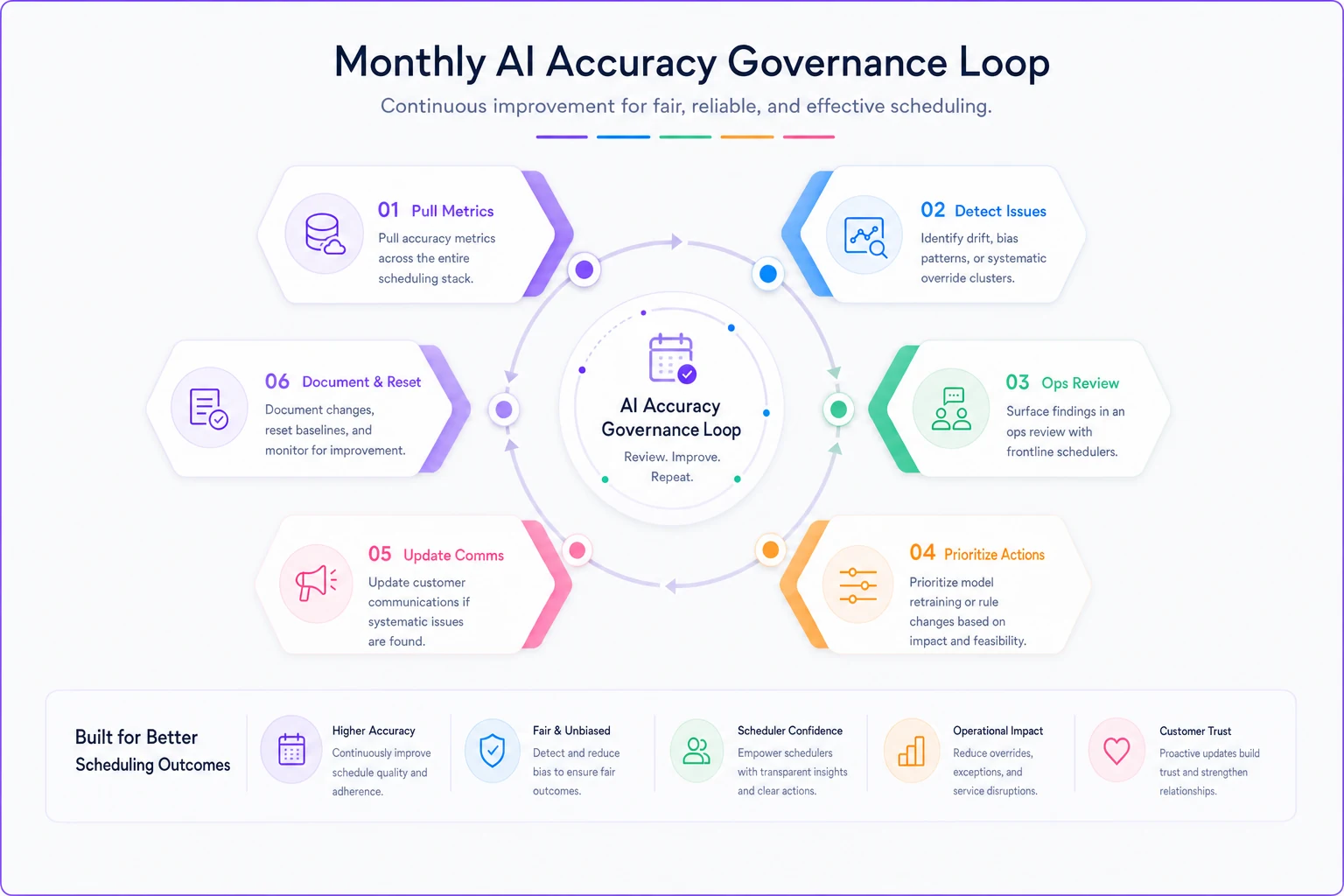
A simple monthly governance loop to check accuracy and updates.
Establish a monthly accuracy review. Frame it as operational intelligence, not a compliance session. Review accuracy metrics across your scheduling stack, identify drift or bias patterns, and discuss systematic overrides. Include frontline schedulers — they often know exactly where the AI gets things wrong but have never had a forum to share that knowledge.
Build a feedback loop between operations and AI refinement. When you identify systematic inaccuracies, fix them rather than just documenting them for compliance. If your AI consistently underestimates appointment times for older homes, retrain the model or add a property-age factor. This demonstrates genuine effort to improve accuracy, not just a willingness to accept and disclose errors.
Build what I'd call "accuracy release valves" into your scheduling system — mechanisms that prevent small inaccuracies from cascading into bigger problems. Automatically flag any day where more than 30% of appointments ran over estimate, triggering a same-day schedule review. Alert managers when a specific technician's appointments consistently deviate from AI predictions. These catches make the whole system more self-correcting over time.
Document your governance process in a simple playbook. How often do you review accuracy metrics? What triggers a model review or retrain? Who approves systematic overrides? How do you communicate significant changes to customers? This documentation becomes critical evidence of responsible AI governance if regulators ever come asking.
Connect accuracy governance to your broader operational KPI framework. Add accuracy metrics alongside traditional efficiency measures — track not just whether appointments run on time, but whether AI predictions are actually improving over time. This integration ensures compliance work improves operations rather than just adding overhead. Businesses that can demonstrate transparent, accurate AI-powered scheduling will build more customer trust than competitors hiding behind algorithmic black boxes.
The operational reality check
The FTC's focus on AI accuracy isn't going away. As appointment-driven businesses lean harder into AI-powered scheduling to manage complexity and scale, regulatory scrutiny will only intensify. The businesses that come out ahead won't be the ones that avoid AI or bury it under compliance bureaucracy — they'll be the ones that build transparent, well-governed operations from the start.
Over the next year or so, this means a few concrete things. You'll need budget for compliance infrastructure — not just legal review, but actual operational changes like audit logging, accuracy monitoring, and staff training. You may need to slow down AI adoption temporarily while governance structures catch up. That exciting new scheduling optimization tool might need to wait until you can properly monitor its accuracy. And vendor relationships need rethinking — every scheduling software provider becomes a compliance partner, and you need to understand how their AI works, not just what it does.
The silver lining is real: accuracy governance actually makes operations better. When you understand how your AI makes decisions and where it tends to fail, you build better workflows around it. When staff understand why the system makes certain recommendations, their overrides get smarter. When customers understand how estimates are generated, they come in with realistic expectations.
The businesses that struggle will be the ones treating this as a paperwork problem — adding disclaimers and audit logs without actually improving accuracy or transparency. The FTC isn't asking for perfect AI. They're asking for honest AI. That's an operational problem worth solving, not just for compliance, but because scheduling operations that are genuinely transparent tend to work better for everyone involved.
Start with the six steps here, but build accuracy and transparency into how you evaluate new scheduling tools, train staff, and communicate with customers. The regulatory landscape around AI is still forming, and businesses that get ahead of it now will have a meaningful advantage over those scrambling to catch up later.
Start with the six steps here, but build accuracy and transparency into how you evaluate new scheduling tools, train staff, and communicate with customers. The regulatory landscape around AI is still forming, and businesses that get ahead of it now will have a meaningful advantage over those scrambling to catch up later.
Ready to optimize your scheduling and operations?
Join thousands of businesses using Schedily to save time, improve coordination, and enhance operational efficiency.