

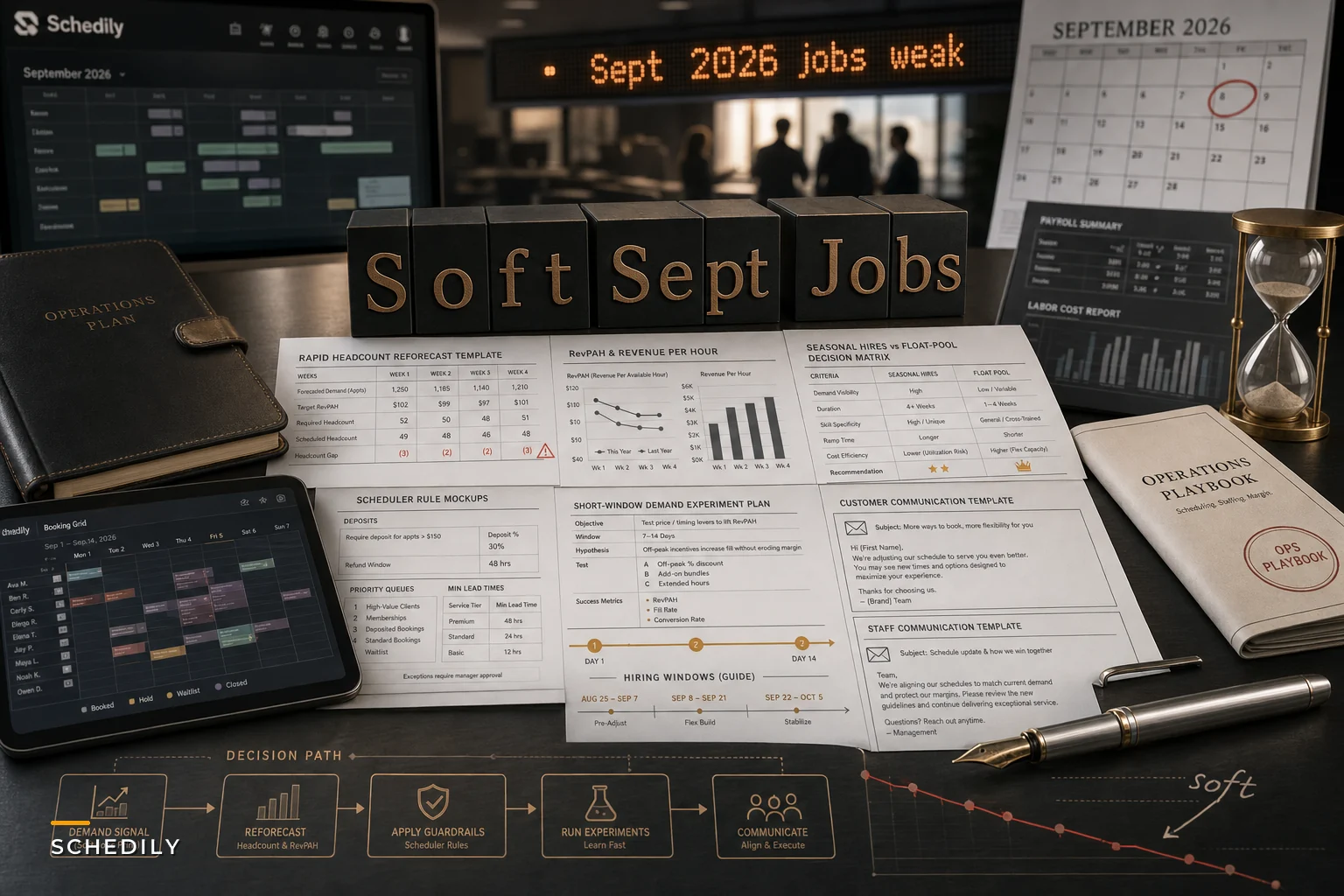

The September jobs number landed soft. Payrolls grew by roughly 29,000 — a fraction of what most forecasters expected — and unemployment nudged up to about 4.2%, while wage growth cooled to around 3.0% year over year. CNBC's coverage of the September release framed it as a market that "faltered," and Reuters noted the slowdown was sharp relative to expectations. The BLS release itself confirmed the details.
For anyone running appointment‑driven operations, the timing is what matters. This report drops right as you're locking holiday rosters, finalizing seasonal hiring targets, and committing to booking rules that'll govern your busiest weeks. A soft jobs report pulls you in two directions at once: hiring might get easier and cheaper, but softer demand could also mean you over‑hire into a quieter season. Both risks are real. Most teams only plan for one.
First, understand which way the pressure is actually pointing
A cooling labor market changes two variables at once, and most people react to only the one they're already primed for.
If you've spent the last two years struggling to fill shifts, your instinct will be relief — "finally, I can hire." If you've been nervous about demand, your instinct will be caution — "maybe I shouldn't commit to headcount." The soft September print gives ammunition to both instincts, which is exactly why rushing a single-direction decision is risky.
The pattern worth naming: easier hiring and softer demand usually arrive together, but not on the same schedule. Labor loosens a little ahead of consumer pullback in a lot of service categories. So you get a window where candidates are suddenly available and cheaper to land — right before bookings may thin out. Hire aggressively into that window without re‑checking demand signals and you build a cost base for volume that never shows up.
The fix isn't to freeze. It's to separate the two decisions and make each one deliberately.
Move 1: Reforecast seasonal targets against your own demand signal, not the headline
The jobs report tells you about labor supply. It tells you almost nothing about your holiday demand. A med‑spa in a strong local market and a mobile detailing business two towns over will face completely different realities even if they're reading the same BLS release.
Eliminate scheduling conflicts and missed meetings.
Schedily helps you organize and manage all appointments and team availability effortlessly.
- Unified appointment and resource management
- Automated notifications & reminders
- Team calendar synchronization
No credit card required
So before you touch your hiring plan, rebuild the demand side from your own booking history. Pull the last two or three holiday seasons and look at the shape of the curve — not just the totals. When did bookings actually accelerate? Which services carried the volume? Which weeks were quietly dead but overstaffed anyway?
This is the part most teams skip, and it's the part that actually protects margin. If you want a repeatable method for this, we broke down the full approach in turning appointment history into seasonal headcount plans — the forecasting logic and shift templates there pair directly with what the September data is signaling.
Quick gut check: if your reforecast shows demand flat or softening, a looser labor market is not a reason to hire more. It's a reason to hire smarter — more flexible, less fixed.
Move 2: Shift the hiring mix toward float and flex, not full seasonal headcount
When wage pressure eases, the temptation is to lock in permanent seasonal staff because they're suddenly affordable. Resist the urge to over‑commit fixed labor into an uncertain season.
-
Core shifts staffed by your reliable, permanent team
-
A float pool of cross‑trained part‑timers you can activate per week
-
A short on‑call tier for the two or three genuine peak weeks
The float pool is the hedge. In a softer market you can actually recruit a decent bench because candidates are more available — so you get staffing optionality without carrying the full cost if demand disappoints. The businesses that survive soft holidays aren't usually the ones with the biggest team; they're the ones whose team size can flex week to week without drama.
When full seasonal hiring still makes sense
-
Your reforecast shows demand genuinely holding or growing
-
The roles require training that makes week‑to‑week churn impractical
-
You have high‑margin services that are capacity‑constrained, not demand‑constrained
When it's a bad idea
-
Demand signal is flat or soft
-
The role is easily cross‑covered by existing staff
-
You're hiring mostly because "labor is cheap right now" — that's a supply reason, not a demand reason
Both lists are worth sitting with before you post a single job listing.
Move 3: Re‑tier your booking capacity to protect your best slots
If demand softens, not all appointments lose value equally. A lot of operators leave money on the table here — they treat every open slot as equally worth filling, so they discount or overbook indiscriminately and end up protecting low‑margin volume at the expense of high‑margin availability.
| Slot type | Margin | Booking rule to apply |
|---|---|---|
| High‑margin, peak‑demand services | High | Protect with priority access, require deposit, limit discounting |
| Standard services, mid‑demand | Medium | Normal rules, light overbooking buffer |
| Low‑margin fillers | Low | Use to absorb cancellations; never let them block premium slots |
| Off‑peak dead zones | Variable | Open to flexible/discounted demand to recover fixed cost |
In a softer environment, your scheduling rules should steer demand toward profit, not just toward "full." The table above is a starting point — your actual tiers depend on your service mix, but the logic holds across most appointment‑based businesses.
Move 4: Tighten deposit and cancellation rules before demand gets choppy
Softer demand tends to make cancellations more frequent and later. People hold more loosely when they're uncertain, and your calendar absorbs the gaps.
-
Shorten the free‑cancellation window on high‑value and peak‑week bookings. If demand is uncertain, you want more notice so you can refill.
-
Add or raise deposits on your protected tier. A deposit does two things — it reduces casual no‑shows and signals genuine intent, which makes your remaining demand easier to forecast.
One caution: don't blanket‑apply strict rules to everything. If demand is soft, aggressive friction on low‑margin or trial services can scare off the very bookings you're trying to attract. Tighten where the revenue is; stay easy where you're still building volume.
Move 5: Rebuild your shift‑triage and redeployment rules for a thinner bench
A smaller or newer team covering peak weeks means a single absence hits harder. Your triage plan needs to assume you have less slack than last year, not more.
The fallback sequence that holds up under pressure looks roughly like this:
A shift opens unexpectedly → the system checks the float pool for cross‑trained, available staff → if none, it checks whether low‑margin bookings in that block can be consolidated or shifted → if the gap remains, affected high‑value clients get a proactive notification with alternative slots → only then does the role escalate to a manager for manual coverage.
The sequence matters. Teams that jump straight to "text everyone and panic" burn goodwill and rack up overtime. Teams with a defined fallback order stay calm because the decisions were already made. Write this order down before the season — nobody's inventing a good triage policy at 7am with three people out.
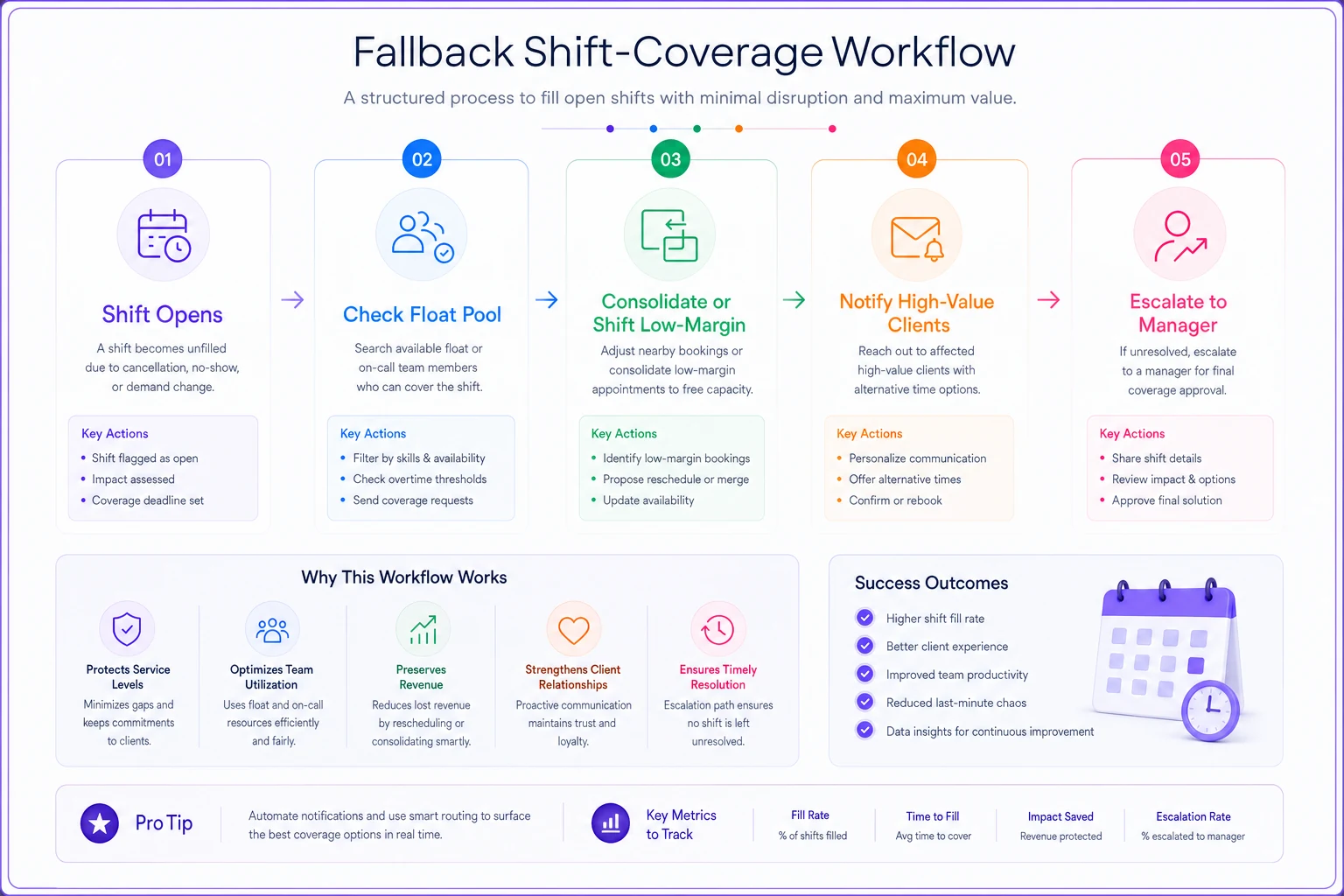
Write the fallback order into your scheduling SOP and train managers on it before peak weeks.
Write this order down before the season — nobody's inventing a good triage policy at 7am with three people out.
Move 6: Run labor‑cost scenarios instead of a single budget
Cooler wage growth changes your per‑hour math, and that should flow into your scheduling rules — overtime thresholds, minimum shift lengths, redeployment triggers. Build three scenarios, not one.
-
Soft demand scenario demand comes in below last year. Lean hard on float, minimize fixed hours, tighten overtime to near zero.
-
Base scenario demand roughly matches last year. Standard roster plus a small flex buffer.
-
Strong scenario demand surprises up. Pre‑approved overtime windows and on‑call activation ready to go.
Each scenario should have its own staffing level and its own scheduling rules, defined ahead of time. The mistake isn't failing to predict which scenario plays out — nobody does that reliably. The mistake is having no predefined response when reality picks one for you.
A short checklist before you lock the season
-
Reforecast demand from your own booking history, not the jobs headline
-
Decide core vs. float vs. on‑call split
-
Re‑tier slots by margin and set protection rules
-
Adjust deposits and cancellation windows on protected tiers only
-
Write the shift‑triage fallback order down
-
Build soft / base / strong labor scenarios with distinct rules
-
Pick 2–3 services to run short demand tests on (next move)
Running through this list in early October is a lot less painful than trying to fix things mid‑December.
Move 7: Run short demand experiments now, before the surge
Almost nobody does this one, and it's probably the highest‑leverage move on the list. You have a few weeks before holiday demand gets serious. Use them to test, cheaply, which services actually hold up.
Run small, time‑boxed experiments: a priority‑queue test on your premium tier, a limited deposit requirement on a specific service, a short promotional window on an off‑peak block. Watch what actually converts and what cancels. You're trying to identify which services are resilient — the ones that fill regardless of a softer consumer mood — before you commit staffing to them.
Operators are usually surprised by the results. The service they assumed was the holiday workhorse sometimes wobbles, while a quieter high‑margin service proves stickier than expected. Learning that in October is cheap. Learning it in December, with a full seasonal roster already hired, is expensive.
A quick real scenario
A mid‑sized grooming and pet‑boarding business was running around 300–340 bookings a month going into last holiday season. Their default plan was to hire four full‑time seasonal staff, same as the prior year.
When they reforecast against their own history, two things stood out: boarding demand was reliably strong over the holidays, but their grooming add‑ons — which they'd assumed were peak earners — were actually soft and heavily discounted. So they shifted the plan: two permanent seasonal hires for boarding, a float pool of five part‑timers for grooming peaks, deposits added to premium boarding slots, and grooming add‑ons left easy and friction‑free to protect volume.
The result wasn't dramatic on the top line — revenue landed roughly where they projected. The difference was cost. They avoided carrying two full‑time hires through weeks that didn't need them, trimmed overtime during the two genuine peak weeks, and late‑cancellation losses on boarding dropped once deposits were in place. Same revenue, meaningfully better margin, and a lot less scrambling.
The deeper problem the report exposes
The soft September print isn't really the story. The story is that most seasonal staffing plans are built on a single assumption — usually "last year, plus a bit" — and then a report like this one lands and the whole plan wobbles because it was never built to flex.
A labor market that cools faster than expected is just one of many surprises a holiday season can throw at you. The operators who handle it well aren't the ones who predicted the number. They're the ones whose scheduling rules, hiring mix, and capacity tiers were already designed to bend without breaking.
You don't need a perfect forecast. You need a plan that behaves reasonably whether demand comes in soft, flat, or strong — and the few weeks before the surge are exactly when you can still build that.
Here are the moves that actually matter, in roughly the order you should make them.
Ready to optimize your scheduling and operations?
Join thousands of businesses using Schedily to save time, improve coordination, and enhance operational efficiency.