



Recurring appointment subscriptions look clean on paper. Someone pays for four visits a month, you block the slots, they show up, everybody's happy. But the moment you look at real usage data across a few billing cycles, the picture falls apart. People skip a week, then want to "make it up." A slot sits reserved and empty. Someone with a premium plan wants to bump ahead of a regular booking. And at the end of the month, your finance person is staring at a subscriber who paid for four sessions, used two, and is now arguing they're owed rollover.
This is the messiest part of recurring appointment allocation — not the selling, but the accounting and the rules that govern what happens when reality doesn't match the subscription. Most businesses set this up loosely, then spend the next year improvising policies one angry customer at a time. That improvisation is where capacity — and money — leaks out.
Hard reserve vs soft allocation: pick the wrong one and you bleed
The single biggest structural decision in a recurring subscription is whether each member's capacity is a hard reserve or a soft allocation. Most owners never consciously choose. They just go with whatever their booking tool defaulted to, and the consequences show up months later.
A hard reserve means the slot is physically held for that subscriber whether or not they book it. Think of a Tuesday 10am pilates spot that "belongs" to a monthly member. It's blocked. Nobody else can take it. If the member doesn't show, the slot dies empty.
A soft allocation means the subscriber has the right to book a slot of a certain type, but no specific time is held until they claim it. Their entitlement is "4 sessions this month," not "these 4 specific times."
The trade-off nobody spells out clearly:
| Dimension | Hard Reserve | Soft Allocation |
|---|---|---|
| Member experience | Predictable, same time every week | Requires them to book actively |
| Capacity utilization | Lower — empty holds waste slots | Higher — unclaimed capacity is reusable |
| No-show cost | You eat the empty slot | Slot can be released and resold |
| Best for | High-loyalty, habit-based services | Variable-demand, high-margin services |
| Failure mode | Chronic empty reserved slots | Members get shut out at peak times |
What shows up repeatedly across subscription-based service businesses: owners default to hard reserves because it feels premium, then quietly lose 15–25% of reserved capacity to no-shows and forgotten standing appointments. A studio with 40 recurring members each holding a weekly slot can easily have six to eight ghost reservations running every week. That's roughly a full class worth of capacity, gone — paid for but not resellable to anyone.
The fix is rarely "switch everyone to soft." It's usually a hybrid: hard reserve for the first standing appointment (the habit anchor), soft allocation for the remaining monthly entitlements. That keeps the loyalty benefit while recovering the flexible capacity.
The unused-credit problem, and why "use it or lose it" isn't a policy
The thing that quietly destroys margins is the unused credit. Someone pays for four, uses three, and now there's a floating credit sitting in limbo. If you have no explicit rule, that credit becomes a negotiation — and negotiations always tilt toward the customer who's standing at your front desk being disappointed.
Eliminate scheduling conflicts and missed meetings.
Schedily helps you organize and manage all appointments and team availability effortlessly.
- Unified appointment and resource management
- Automated notifications & reminders
- Team calendar synchronization
No credit card required
-
Expire at cycle end (clean, but feels harsh, drives churn if overused)
-
Roll over with a cap (fair-feeling, but accumulates liability)
-
Roll over fully (customer-friendly, operationally dangerous)
-
Convert to account balance / store credit (flexible, needs finance tracking)
The mistake almost everyone makes is picking "roll over fully" because it's the easy answer in the moment, then discovering eighteen months later they have members sitting on twelve banked sessions. That banked capacity is a real liability. If forty members each carry an average of five unused sessions, you're on the hook for two hundred future appointments that are already paid for — appointments that will land unpredictably and crowd out new revenue.
This usually happens when there's no rollover cap and no expiration. The credits don't disappear; they just wait to ambush your busiest month.
A workable default that tends to hold up in practice: rollover capped at one cycle, expiring after that. A monthly member can carry unused sessions into next month, but can't stack them indefinitely. It gives grace without building a balance-sheet monster.
A rollover / expiration decision table you can actually use
Most guides skip this part, but you need a table, not a paragraph. When a front-desk person or an automated rule has to decide what happens to a credit, they need a lookup, not a judgment call. Judgment calls are where inconsistency and lost capacity live.
| Scenario | Credit action | Rollover allowed? | Expiration | Revenue recognition |
|---|---|---|---|---|
| Member used all sessions | None | N/A | N/A | Fully recognized in cycle |
| Member missed 1, gave notice | 1 soft credit | Yes, 1 cycle | End of next cycle | Deferred until used or expired |
| Member missed 1, no-show | Forfeited (per policy) | No | Immediate | Recognized (breakage) |
| Member paused subscription | Freeze credits | Held during pause | Resumes on reactivation | Deferred, no recognition |
| Member cancelled mid-cycle | Prorated per terms | No | On cancellation | Recognized minus refund |
Two things make this table matter. First, it forces you to define the no-show forfeiture in writing before it becomes an argument. Second, it ties each row to a revenue-recognition treatment — which is the piece almost nobody connects until an accountant asks awkward questions.
If you haven't nailed down the underlying cancellation and notice terms that feed this table, that work has to come first. The rules around deposits, notice windows, and cancellation consequences are what make each row enforceable — we covered that groundwork in policy-first governance for appointment pricing, deposits, and cancellations, and this allocation logic sits directly on top of it.
Priority bumping: the feature that quietly angers your best regular customers
Once you have tiered subscriptions, someone eventually asks: can premium members bump ahead of standard bookings for a scarce slot? The answer you build into your rules matters more than it seems.
Priority bumping done badly creates a specific, corrosive failure. A loyal weekly customer books their usual Saturday slot. A higher-tier member claims priority. Your system silently reassigns the slot. The loyal customer shows up, gets turned away, and never comes back. You "served" the premium tier and destroyed a long-term relationship in the process.
The rule that avoids this: priority applies only to unclaimed capacity, never to confirmed bookings. Premium members get earlier booking windows, wider availability, or first access to newly released slots — but a confirmed appointment is confirmed. Bumping a held booking should require an explicit exception with human sign-off and an automatic compensation offer to the bumped party.
Worth watching for: when priority bumping runs automatically against confirmed slots, churn quietly concentrates in your most loyal cohort — the exact customers you can least afford to lose. They don't complain loudly. They just stop rebooking.
When each model actually makes sense
Hard reserves make sense when the service is habit-anchored — a standing therapy slot, a weekly training session — and predictability is the product. People are paying partly for the certainty that their time is always there.
Soft allocation makes sense when demand is variable, margins are high, and you can resell released capacity quickly. Anything with a waitlist should lean soft.
Aggressive rollover is a bad idea when your peak season is concentrated. If seventy percent of demand hits in three months, banked credits will all get spent in exactly the months you have no spare capacity. If your business has that seasonal shape, tie your allocation rules to your demand forecast — the method for mapping that seasonality is in turning appointment history into seasonal headcount plans, and it directly informs how generous your rollover can safely be.
Who should NOT offer rollover at all: businesses with tight, fixed capacity and no ability to add supply. A single-room operation with one provider cannot absorb banked demand. For them, "use it or lose it with generous notice-based credits" is the only version that protects the schedule.
Reconciliation: the month-end template that catches the leaks
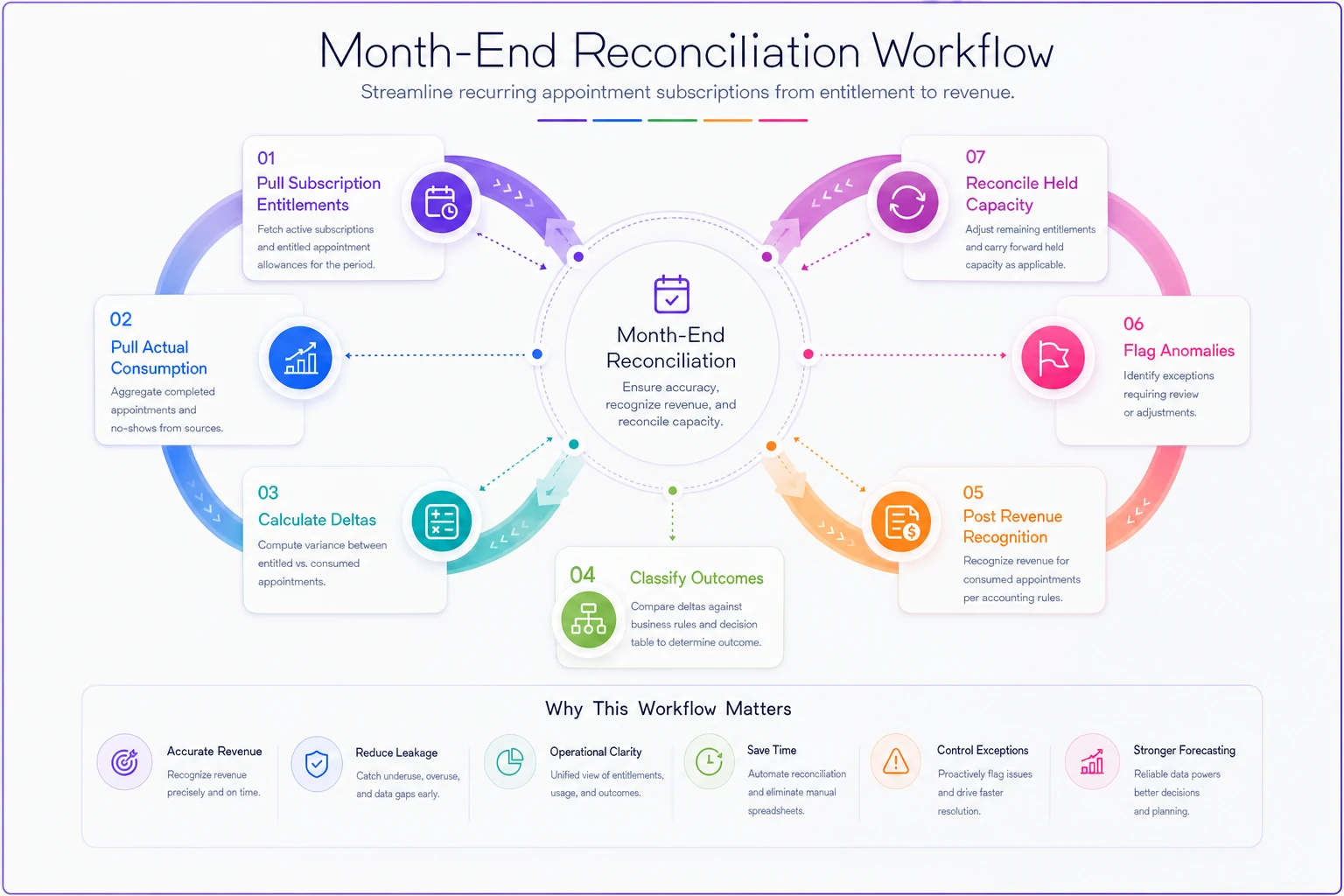
Allocation policies mean nothing if you can't reconcile them at cycle close. Reconciliation is where you confirm that sessions sold, sessions used, credits carried, and revenue recognized all tie out. When they don't, you've either given away capacity or over-recognized revenue — both problems.
-
Pull subscription entitlements for the cycle (who was owed what).
-
Pull actual consumption (sessions attended, by member).
-
Calculate the delta per member
entitled minus used.
-
Classify each delta against the decision table — rollover, forfeit, freeze, refund.
-
Post revenue recognition accordingly
recognize used sessions and breakage, defer valid rollovers.
-
Flag anomalies — members with growing credit balances, repeated no-shows, or priority-bump exceptions.
-
Reconcile held capacity — count hard-reserved slots that ran empty and quantify the lost resale value.
A simple workflow visualization helps teams run the monthly reconciliation consistently.
A short checklist to run before closing the books each cycle:
-
[ ] Every unused session mapped to a decision-table outcome
-
[ ] No member carrying credits beyond the rollover cap
-
[ ] Breakage revenue recognized for forfeited sessions
-
[ ] Deferred revenue balance matches outstanding valid credits
-
[ ] Priority-bump exceptions logged with compensation issued
-
[ ] Empty hard-reserved slots counted and costed
-
[ ] Paused subscriptions excluded from recognition
That last step is the one almost everybody omits, and it's the most revealing. Putting a dollar figure on empty reserved slots is what finally makes owners rethink their hard-reserve defaults.
A real scenario: the ghost-reserve boutique studio
A small movement studio — one main room, two instructors — sold monthly memberships as four sessions with standing weekly slots, all hard-reserved. Around 55 active members. On paper, capacity looked fully booked.
When they actually reconciled a few cycles, the picture was ugly. Roughly 18–22% of the standing reserved slots ran empty each week. Members would skip, assume they'd catch up, and the held slot just evaporated because nobody could book it. Meanwhile they were turning away drop-in interest on their busiest evenings because those times looked full.
They made two changes. The first standing appointment stayed a hard reserve — the habit anchor. The remaining three monthly sessions became soft allocations that released back to general availability if unclaimed 24 hours out. They added a one-cycle rollover cap with expiration, and a written no-show forfeiture rule feeding a reconciliation table.
Over the next couple of months, utilization of that main room climbed noticeably — they were filling previously-ghosted slots with drop-ins and waitlisted members. The recovered capacity worked out to somewhere in the range of $2k–$3k of additional monthly revenue that had simply been evaporating before. No new members, no price change. Just allocation rules that matched reality instead of the sales pitch.
Recurring subscriptions don't lose money at the point of sale. They lose it in the gap between entitlement and usage — the empty reserves, the uncapped rollovers, the silent bumps, the credits nobody reconciled. Every one of those is a policy decision you either make deliberately or make by accident.
Build the decision tables. Cost out your empty reserved slots. Tie every unused credit to a defined outcome and a revenue treatment. The businesses that treat allocation as an operational discipline — not a customer-service afterthought — are the ones whose subscription revenue actually reflects the capacity they're selling.
Ready to optimize your scheduling and operations?
Join thousands of businesses using Schedily to save time, improve coordination, and enhance operational efficiency.