
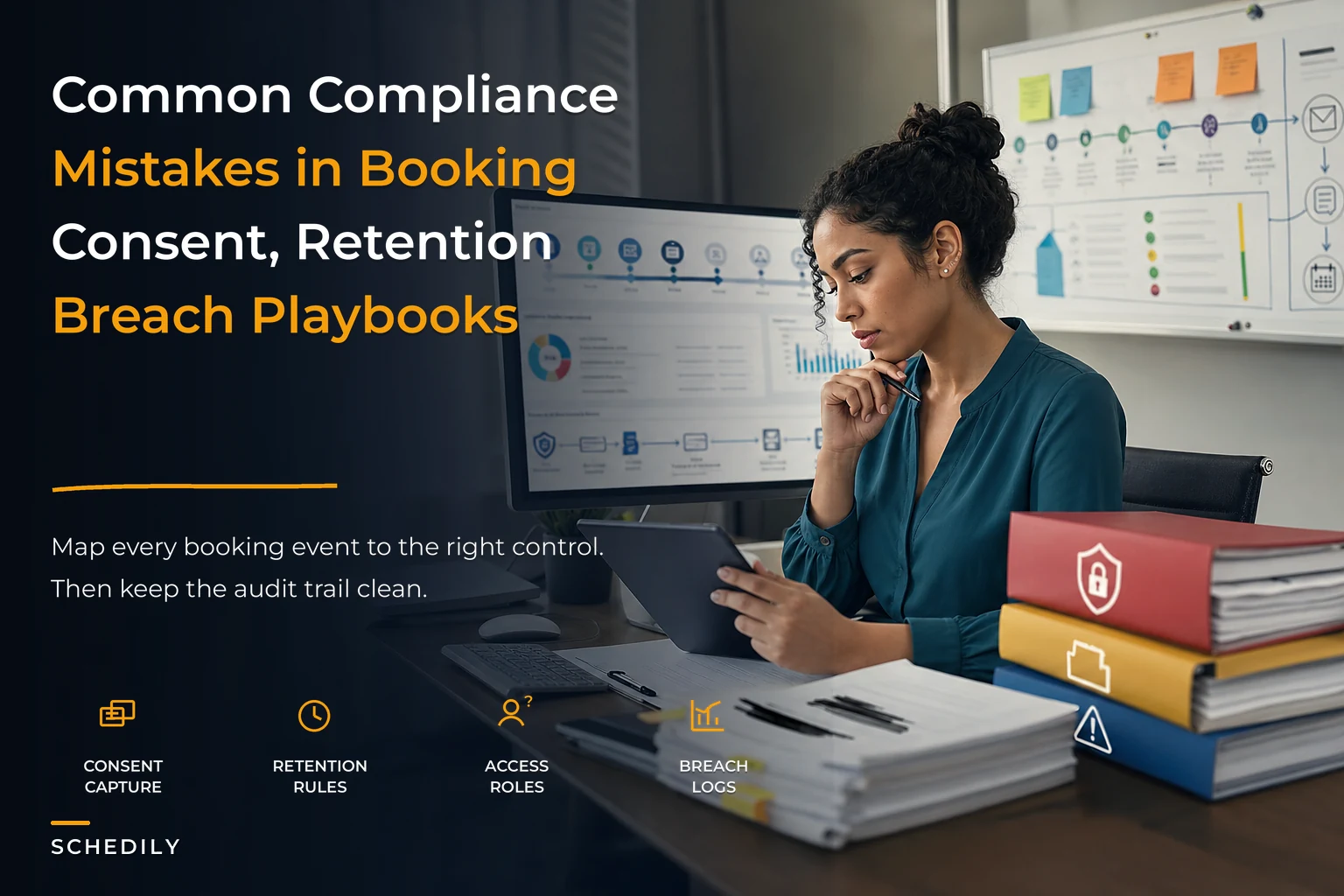

I spent three hours last month helping a dental practice untangle a scheduling privacy mess after a patient complained about receiving appointment reminders for someone else's root canal. The practice thought they were compliant because they had patients sign a generic consent form at intake. But their actual booking lifecycle? Complete chaos. No consent tracking for SMS reminders. No retention policies for cancelled appointments. No process for handling data deletion requests. Just a booking system accumulating years of patient data with zero governance.
This isn't unique. Most appointment-driven businesses handle sensitive data through their scheduling systems without really understanding the compliance requirements buried inside HIPAA and GDPR. Medical practices, wellness centers, even hair salons that store client medical conditions for chemical treatments — they all run into the same blind spots.
The real problem isn't understanding the regulations. It's mapping those requirements to every single touchpoint in your booking lifecycle. From the moment someone searches for available slots to three years after their last appointment, you're managing consent, retention, and potential breach scenarios across dozens of system interactions.
The booking lifecycle creates more compliance touchpoints than most operations realize
Think about a standard appointment booking. A patient searches available times on your website — that's the first data collection point. They enter personal details to book (consent requirement). The system sends a confirmation email (processing activity). A reminder SMS goes out 24 hours before (another consent checkpoint). After the appointment, their data sits in your system for... how long exactly?
Each interaction creates compliance obligations. HIPAA requires specific safeguards for any health information collected during booking. GDPR demands explicit consent for each type of processing — booking confirmations, marketing emails, and appointment reminders all technically need separate consent captures. Most scheduling systems treat these as one blob of permission, which fails both regulatory tests.
The complexity multiplies with modern booking flows. Online scheduling widgets embedded on third-party sites. Two-way SMS conversations for rescheduling. Video consultation links that spin up temporary meeting rooms. Calendar sync pushing appointment details to personal devices. Every feature adds compliance requirements that standard booking platforms rarely handle correctly.
What makes this particularly frustrating is that scheduling privacy compliance HIPAA GDPR requirements shift based on context. A massage therapist collecting health conditions for treatment needs different consent flows than a salon tracking chemical sensitivities. A telehealth platform handles video consent differently than an in-person clinic. Generic compliance templates fall apart fast when you map them to real operations.
Missing consent capture points that create immediate liability
A new patient books online and checks a box saying "I agree to receive communications." Operations assumes this covers everything. It doesn't. That single checkbox doesn't distinguish between:
Eliminate scheduling conflicts and missed meetings.
Schedily helps you organize and manage all appointments and team availability effortlessly.
- Unified appointment and resource management
- Automated notifications & reminders
- Team calendar synchronization
No credit card required
-
Operational messages (appointment confirmations)
-
Care reminders (follow-up scheduling)
-
Marketing communications (promotional offers)
-
Data sharing with insurance providers
-
Third-party integrations (calendar sync, payment processing)
Under GDPR, each purpose needs explicit consent. Under HIPAA, you need documented authorization for most uses beyond treatment, payment, and healthcare operations. That generic checkbox creates liability from day one.
The consent gaps get worse at booking modifications. A patient calls to reschedule and mentions a new medical condition. The receptionist updates their record. Did anyone capture consent for storing that additional health information? When someone books for a family member, who consented to whose data being stored? These scenarios happen daily without proper consent workflows.
Then there's withdrawal handling. GDPR gives individuals the right to withdraw consent at any time. But if someone withdraws consent for marketing emails, can you still send appointment reminders? What about billing communications? Most scheduling systems can't granularly track consent by purpose, forcing operations into all-or-nothing scenarios that either break regulations or break basic functionality.
Building consent capture flows that actually work operationally
Effective consent capture starts with mapping every data collection point in your booking lifecycle. Create a simple table:
| Touchpoint | Data Collected | Legal Basis | Consent Type | Retention Period |
|---|---|---|---|---|
| Online booking form | Name, email, phone | Contract (appointment) | Implied for booking | 3 years post-appointment |
| Health questionnaire | Medical history | Legitimate interest (care) | Explicit health consent | 7 years (medical records) |
| SMS reminders | Phone, appointment details | Consent | Explicit SMS consent | Until withdrawn |
| Insurance verification | SSN, insurance ID | Legal obligation | Notice only | Per state requirements |
| Follow-up surveys | Email, service feedback | Consent | Explicit survey consent | 1 year |
This table becomes your consent architecture. Each row needs its own capture mechanism, storage method, and withdrawal process. Online booking forms should use progressive consent — start with minimal data for slot selection, then layer additional consents as needed. Don't force patients to agree to marketing emails just to book an appointment.
For multi-channel operations, centralize consent preferences. When someone opts out of SMS through your text platform, that preference must sync to your booking system, email platform, and phone scripts. Practices have been fined because their SMS platform and booking system held different consent records for the same patient. It happens more than you'd expect.
Implement versioned consent tracking. When you update privacy policies or add new data uses, you need to know who consented to which version. Store consent events with timestamps, version numbers, and specific permissions granted. This protects you during audits by proving exactly what someone agreed to and when.
Store consent events with timestamps and version numbers in a central system so you can answer audit requests without querying multiple services.
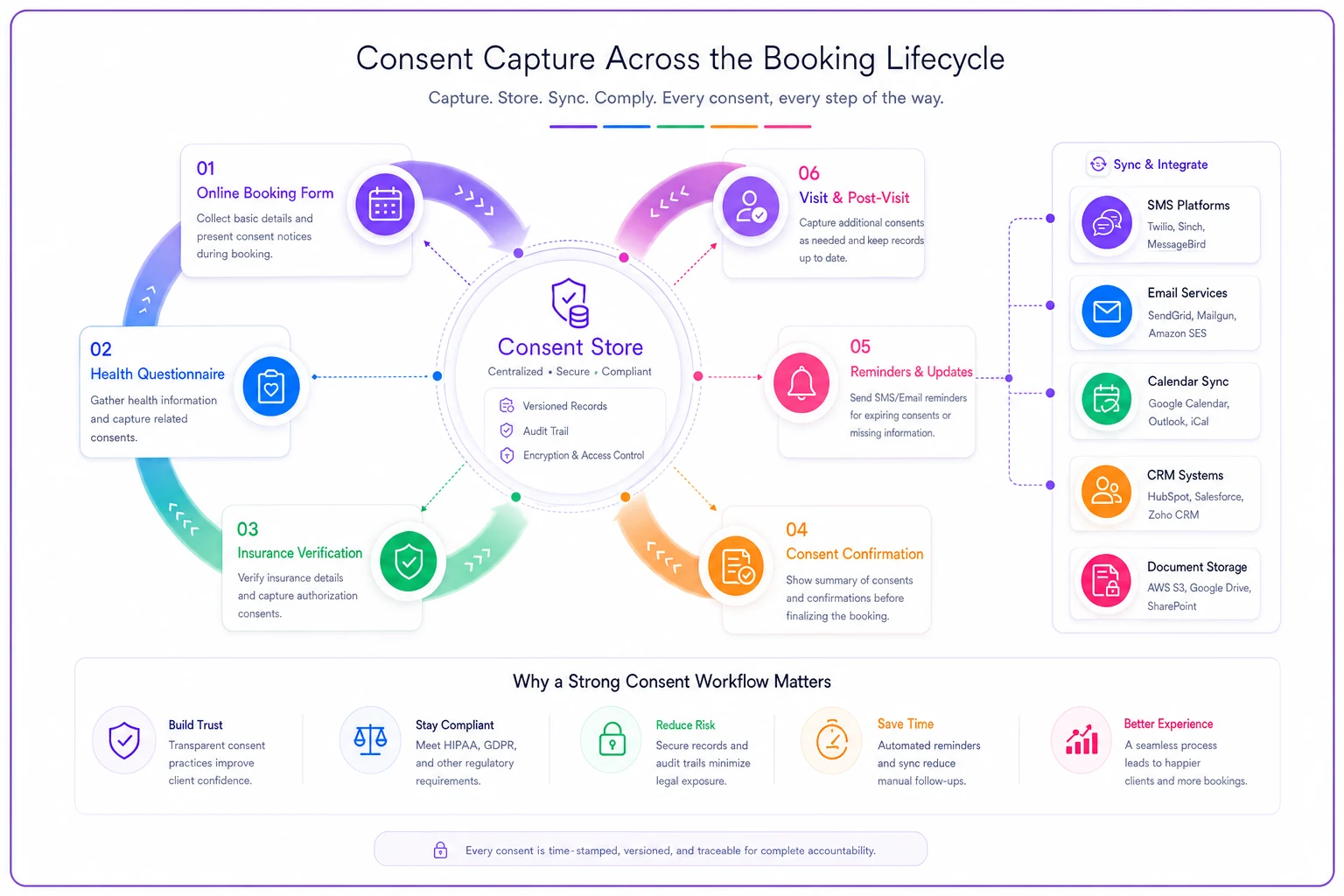
The image shows how consent flows from capture points into a central consent store that records versions and timestamps, and how preferences sync back to integration endpoints.
Retention policies that balance compliance with operational needs
Most scheduling systems become graveyards of old appointment data. Five-year-old cancelled bookings. Decade-old patient records. No-shows from 2019 still sitting in the active database. This isn't just poor data hygiene — it's a compliance liability waiting to surface.
HIPAA generally requires maintaining medical records for six years from creation or last use. But appointment data isn't always medical records. A cancelled booking with no health information might not need six-year retention. Meanwhile, some states require longer retention for certain types of medical data. Your retention policy needs to account for these variations.
Active patient records: Full records while patient is active, plus required retention period after last visit
Appointment history: 3 years for operational records, 6–7 years if the record contains health information
Cancelled/no-show bookings: 90 days for non-medical, longer if health data was collected
Marketing preferences: Maintain until withdrawn, plus 3 years for audit trail
Payment records: 7 years for tax purposes, regardless of health data
The operational challenge is actually enforcing these policies automatically. Manual deletion doesn't scale and creates inconsistency. Your scheduling platform needs retention rules that trigger based on record type, data categories, and last activity date. When retention expires, the system should delete records entirely or anonymize them for analytics while stripping identifying information.
Retention isn't only about deletion timelines either. You also need to handle data minimization during active use. Why keep full medical histories in your scheduling system if you only need them during appointments? Consider archiving detailed records to secure storage while keeping only essential booking data accessible in active systems.
Redaction playbooks for handling data requests
Under GDPR, individuals can request their data be deleted (right to erasure) or corrected (right to rectification). HIPAA gives patients rights to access and amend their records. These requests arrive randomly and need reasonably quick, thorough responses.
The problem is that appointment data spreads across multiple systems. The booking might live in your scheduling platform. Payment data in your billing system. Communications in your email service. Notes in your EMR. A single deletion request might require changes across five to ten different systems.
Build a data mapping inventory:
-
Scheduling system (appointments, contact info, preferences)
-
Payment processor (transaction history, payment methods)
-
Email platform (communication history, marketing preferences)
-
SMS service (message history, opt-in status)
-
Calendar integrations (synced appointments)
-
Backup systems (historical snapshots)
-
Analytics platforms (anonymized or identified usage data)
For each system, document what data it stores, how to search for individuals, export and deletion capabilities, backup and archive locations, and any retention overrides like legal holds or active disputes.
When requests arrive, the process should already be mapped out. For access requests — can you compile data from all systems within the required timeframe (30 days under GDPR)? For deletion requests — what must you keep for legal obligations versus what can be removed? Some data genuinely can't be deleted. Financial records for tax compliance, for instance. Your response should clearly explain what was deleted, what was retained, and why.
Breach response procedures that minimize damage
A breach isn't always a dramatic hack. More often it's mundane. An employee emails appointment lists to the wrong recipient. A departed staff member still has active system credentials. The online booking widget exposes patient names in URL parameters. These things happen regularly, and your response determines whether they become compliance disasters.
HIPAA requires breach notification within 60 days to affected individuals and, depending on the scope, to media and government agencies. GDPR demands notification within 72 hours to authorities and without undue delay to affected individuals for high-risk breaches. Those timelines seem manageable until you're simultaneously trying to investigate, assess, and respond while keeping operations running.
Your breach response SOP needs clear triggers and escalation paths:
Discovery Phase (Hour 1–4)
-
Isolate affected systems
-
Stop ongoing exposure
-
Preserve evidence
-
Initial scope assessment
Assessment Phase (Hour 4–24)
-
Determine data types exposed
-
Identify affected individuals
-
Evaluate risk level
-
Document timeline
Response Phase (Day 1–3)
-
Legal and compliance team engagement
-
Notification preparation
-
Remediation planning
-
Authority reporting if required
Recovery Phase (Day 3–60)
-
Individual notifications
-
System improvements
-
Process updates
-
Compliance documentation
Have templates ready before you need them. Breach notification letters. Investigation checklists. Authority reporting forms. When you discover exposed appointment data at 4 PM on a Friday, you can't spend the weekend writing procedures from scratch.
Sample consent forms and audit logs
A consent capture flow that actually works for online booking:
Stage 1 — Slot Selection "To check availability, we need your email and phone. We'll only use these to manage your appointment." [Required consent]
Stage 2 — Booking Confirmation "How would you like to receive appointment reminders?"
-
[ ] Email reminders
-
[ ] SMS reminders (standard rates apply)
-
[ ] Phone call reminders
Stage 3 — Additional Services "Would you like to receive:"
-
[ ] Care recommendations and health tips
-
[ ] Special offers and promotions
-
[ ] Birthday and holiday greetings
Your audit log needs to capture every consent interaction:
2024-03-15 14:32:41 | PatientID: 4832 | Action: CONSENTGRANTED | Type: SMSREMINDER | Version: 2.1 | IP: 192.168.1.1 2024-03-15 14:33:02 | PatientID: 4832 | Action: CONSENTDENIED | Type: MARKETINGEMAIL | Version: 2.1 | IP: 192.168.1.1 2024-03-18 09:15:33 | PatientID: 4832 | Action: CONSENTWITHDRAWN | Type: SMSREMINDER | Method: PHONEREQUEST | Agent: StaffID_231
This granular logging protects you during audits. You can prove exactly what someone consented to, when they consented, and how they withdrew. Store these logs separately from operational data with longer retention periods — you might need them years later to defend against a complaint.
Connecting time zones and payment compliance
Scheduling privacy compliance HIPAA GDPR requirements intersect with other operational details that are easy to overlook. Your time zone and DST handling affects consent timestamp accuracy — which matters when you're trying to prove compliance timing. If someone withdraws consent at 11:58 PM in their local time zone but your system logs it as 2:58 AM the following day, you've got a gap that's awkward to explain during an audit.
Payment data adds another layer. Your chargeback and dispute procedures need to account for data retention requirements. You might need to keep payment records for tax purposes even after someone requests deletion of their appointment history. This creates split retention scenarios where financial data stays on while health information gets purged — and you need documentation showing you managed both correctly.
Implementation priority for operations teams
Start with your highest-risk gaps. For healthcare providers, that's usually health information sitting in booking notes without proper consent. For wellness businesses, it's often marketing communications going out without explicit permission. For any operation with EU-facing customers, it's typically the lack of granular consent management.
Build your compliance infrastructure in stages:
Month 1: Map data flows and create retention policies
Month 2: Implement consent capture at booking
Month 3: Deploy retention automation
Month 4: Create breach response procedures
Month 5: Build request handling workflows
Month 6: Audit and refine
This approach lets you address immediate risks while working toward something more comprehensive. Don't try to fix everything at once — focus on the gaps that create the most liability or affect the most customers.
Modern scheduling platforms with AI automation help by centralizing these compliance workflows. Instead of tracking consent across disconnected systems, AI-powered operational software can maintain unified consent records, automate retention policies, and surface potential breach indicators before they escalate. The automation handles repetitive compliance tasks while your team deals with the exceptions.
Maintaining compliance at scale
Perfect compliance is a myth. Even with solid procedures, edge cases emerge constantly. A patient's guardian changes and requires consent updates. A franchise location falls under different state requirements. A system update breaks your retention automation. The goal isn't perfection — it's defensible, improving compliance that protects your business and your customers.
What separates compliant operations from chaos is systematic thinking. Every new feature, integration, or process should trigger a compliance review. Adding video consultations? Review recording consent requirements. Launching SMS campaigns? Update your consent capture flows. Opening in a new state? Check local retention mandates.
The businesses that handle scheduling privacy compliance HIPAA GDPR successfully treat it as an ongoing operational discipline, not a one-time project. They build compliance checks into regular workflows, train staff on data handling, and refine their processes based on real incidents and near-misses.
Your scheduling system processes some of your most sensitive customer data. The time between "we should probably review our compliance" and "we just got a complaint" tends to be shorter than most operations expect. Build your consent, retention, and response infrastructure now, while you still have the luxury of being proactive.
Ready to optimize your scheduling and operations?
Join thousands of businesses using Schedily to save time, improve coordination, and enhance operational efficiency.