



Managing appointment billing across borders creates a specific kind of chaos that most businesses only discover after they're already buried in compliance issues. A consultation request comes in from someone in France for your London-based practice, or a Canadian client books your New York services online, and suddenly your billing process turns into a jurisdictional puzzle that standard payment processors weren't built to solve.
The operational nightmare hiding in cross-border appointments
The complexity isn't just about different tax rates. Cross-border appointment billing tax requirements ripple through every stage of your booking lifecycle—from quote generation to payment capture to monthly reconciliation. Each jurisdiction has different rules about when tax applies, which entity collects it, what documentation you need, and how you report it. Miss one requirement and you're looking at penalties, audits, or blocked payment processing that can freeze your entire operation.
Most appointment-based businesses stumble into this gradually. You start local, build a reputation, and naturally start attracting clients from neighboring countries or states. The booking system that handled local appointments without any issues suddenly needs decision trees for tax determination, variable payment timing based on jurisdiction, and reconciliation processes that track transactions across multiple tax authorities.
Why standard billing breaks down at borders
Standard invoicing tools assume a single tax jurisdiction, consistent payment timing rules, and straightforward reconciliation. International appointments create edge cases at every step.
Eliminate scheduling conflicts and missed meetings.
Schedily helps you organize and manage all appointments and team availability effortlessly.
- Unified appointment and resource management
- Automated notifications & reminders
- Team calendar synchronization
No credit card required
Take a wellness clinic in Vancouver that starts seeing Seattle clients. The moment that first U.S. client books, the clinic needs to figure out whether Canadian GST applies, whether they need to register for Washington state tax, whether service location or client location determines jurisdiction, and how to handle currency conversion in their tax reporting. Their billing person, who's been handling straightforward local invoices for years, suddenly needs to become an international tax specialist overnight.
Timing mismatches create another layer of problems. Different jurisdictions have different rules about when you can capture payment for appointments. Some allow immediate charging upon booking, others require service completion, and some have specific rules around deposits versus full payments. A standard "charge when booked" policy might actually be illegal in certain jurisdictions, turning automated billing into a compliance violation.
These scenarios aren't rare edge cases anymore. Remote consultations, traveling clients, cross-border service delivery—these are just normal parts of running an appointment-based business. A physiotherapy practice might treat vacationing tourists, a legal consultant might advise international clients, a design studio might run workshops for clients flying in from overseas. Each of those scenarios creates different tax obligations your billing system needs to handle correctly.
Building decision trees that actually work
The mistake most businesses make is trying to build universal rules instead of transaction-specific logic. Tax determination needs to evaluate each appointment individually—service type, delivery location, client location, service date.
A functional decision tree starts with service location as the primary branch. If the service happens at your physical location, that typically determines base jurisdiction. Then you need sub-branches for client residence, because some jurisdictions tax based on where the buyer lives regardless of where the service was performed. Then another branch for service type, since many jurisdictions treat professional services and personal services differently.
For remote appointments, the tree gets more complicated. You need to determine whether the service is "performed" where the provider sits or where the client receives it. Some jurisdictions use provider location, some use client location, and some require registration and collection in both.
A Toronto-based business coach I worked with ended up with a decision tree with well over ten branches just for North American clients. Ontario residents at an Ontario location—straightforward HST. Alberta residents at that same Ontario location—HST still applies because the service occurs in Ontario. Ontario residents receiving virtual coaching while temporarily in California—depends on length of stay and whether they maintain Ontario residence. U.S. clients receiving coaching while in the U.S.—no Canadian tax, but potentially U.S. state tax obligations. That's four scenarios and we're barely getting started.
The decision tree also needs temporal logic. Tax rules change—sometimes retroactively—and the tree needs to apply the correct rules based on when the service occurs, not when it was booked. An appointment booked in December for January might fall under completely different rules than the ones in effect at booking time.
Example jurisdiction decision flow for a remote consultation: Is service delivered remotely or in-person? ├── In-person → Use physical service location jurisdiction │ └── Is client resident in a different jurisdiction? │ ├── Yes → Check destination-based tax rules │ └── No → Apply standard local tax └── Remote → Determine "place of supply" ├── Provider location jurisdiction ├── Client location jurisdiction └── Both required? → Register in each └── Apply service type classification ├── Professional services rules └── Personal/wellness services rules
Here's a simple visualization of a decision-tree workflow.
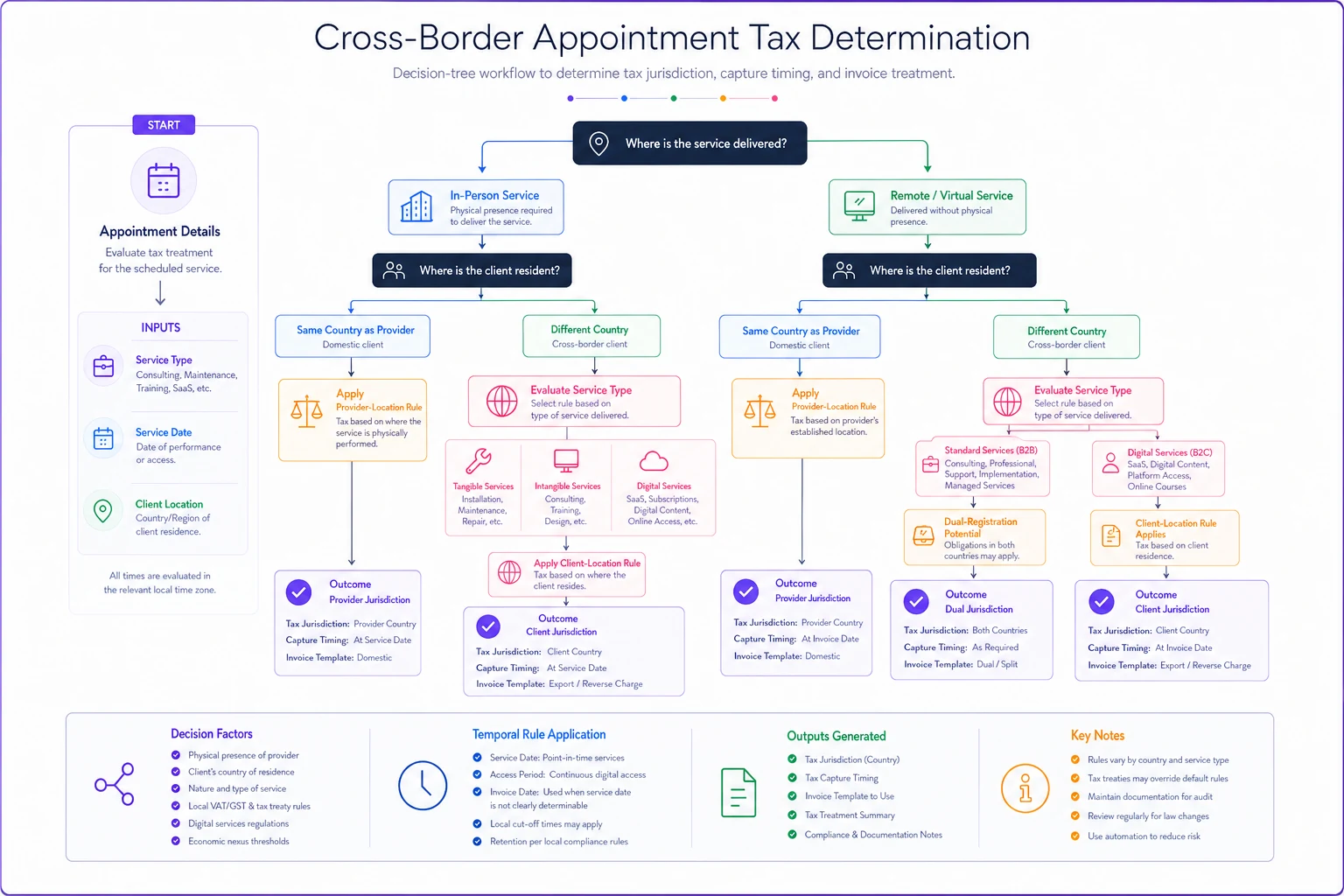
The visualization maps inputs (service type, client location, service date) to decision nodes and final tax treatment outputs.
Payment capture timing across jurisdictions
Cross-border transactions scramble standard payment capture timing. What works in one jurisdiction can trigger penalties in another, mostly because different regulatory frameworks have different views on when a transaction actually occurs for tax purposes.
European clients often fall under rules that restrict charging before service delivery. You can take a deposit, but the VAT treatment of that deposit varies by country. Some treat deposits as prepayments subject to immediate VAT, others treat them as security deposits with no VAT until service completion. Capturing full payment from a German client before their appointment might violate consumer protection laws.
North American transactions seem simpler but have their own traps. State tax nexus rules mean that capturing payment can establish tax obligations you weren't expecting. Process payments from enough California clients and you might suddenly have California filing requirements, even if all services are delivered from your home state.
These timing issues compound when you factor in refunds and cancellations. Each jurisdiction has different rules about tax treatment on refunded services. Some require you to reverse the tax payment, others don't. Some let you net refunds against future tax liability, others want separate refund filings. Your payment capture timing strategy needs to account for those downstream implications.
Currency conversion adds yet another timing variable.
| Capture Timing Trigger | Common Jurisdiction Rule | Risk if Ignored |
|---|---|---|
| At booking (full payment) | Restricted in several EU countries | Consumer protection violations |
| Deposit only at booking | Varies by country for VAT treatment | Incorrect VAT remittance |
| At service completion | Common rule in professional services | Cash flow gaps if not planned for |
| Currency lock-in point | Jurisdiction-specific for tax calc | Phantom FX gains/losses on filings |
When do you lock in the exchange rate for tax calculation—at booking, at payment capture, at service delivery, or at tax filing? Different jurisdictions have different rules, and getting it wrong can create phantom gains or losses that complicate your tax position considerably.
Invoice templates that prevent compliance failures
Standard invoice templates fail for cross-border appointments. Each jurisdiction requires different information, in different formats, sometimes in different languages. A one-size-fits-all template basically guarantees compliance problems.
It starts with basic identification requirements. Some jurisdictions require specific tax registration numbers on invoices. EU countries need VAT numbers in a specific format. Canadian provinces want both federal and provincial registration numbers. Some U.S. states require state tax permits on invoices. Miss any of these and the invoice might be legally invalid—which can block payment collection or prevent you from claiming input credits.
Language requirements add another layer. Quebec requires French invoices for Quebec residents. Some EU countries mandate local language for consumer invoices. Even where English is acceptable, specific terms matter—"sales tax" versus "GST" versus "VAT" versus "consumption tax" has real compliance implications.
The real complexity is in information requirements that shift based on transaction type. B2B cross-border invoices need different fields than B2C invoices. Service exports might require certificates of service location. Digital services might need customer self-certification of location. Professional services might need practice registration numbers.
Dynamic invoice templates that adjust based on transaction characteristics are what actually prevent these failures. A massage therapy clinic treating both local clients and tourists needs templates that automatically adjust based on client jurisdiction, service type, and transaction date—not a single static format someone manually tweaks each time.
Reconciliation systems for multi-jurisdiction chaos
Monthly reconciliation becomes exponentially harder with cross-border transactions. You're no longer just matching payments to services—you're tracking tax collected versus tax owed across multiple authorities, each with different reporting periods, remittance schedules, and reconciliation requirements.
The underlying problem is that your payment processor, booking system, and tax reporting all use different data models. Your payment processor records transactions in settlement currency at processing time. Your booking system tracks appointments in service currency at booking time. Your tax reporting needs transaction currency at service time. Reconciling those three views surfaces gaps you didn't know existed.
A practical reconciliation process starts with standardizing transaction records. Each appointment needs consistent identifiers that carry through booking, payment, and tax reporting. When a Swiss client books a London appointment, that transaction needs the same reference number in your Stripe dashboard, your booking system, and your VAT return. Without consistent identifiers, you're manually matching transactions—which becomes impossible at any real scale.
Each appointment needs consistent identifiers that carry through booking, payment, and tax reporting.
The reconciliation checklist needs jurisdiction-specific sections:
-
Canadian GST reconciliation — looks for zero-rated exports and input tax credits
-
EU VAT reconciliation — checks reverse-charge transactions and intra-community supplies
-
U.S. state tax reconciliation — tracks nexus thresholds and exemption certificates
Each requires different supporting documentation and calculations.
Timing mismatches make reconciliation particularly tricky. A December appointment booked in November and paid in January might fall into three different tax periods depending on jurisdiction rules. Your reconciliation process needs to track each timing element separately and apply the correct rules for each authority.
Here's a simplified reconciliation process that holds up across jurisdictions:
-
Export all appointment records with service date, booking date, and payment capture date as separate fields
-
Tag each transaction with client jurisdiction, service location, and delivery method
-
Group transactions by tax authority and reporting period—not calendar month
-
Match payment processor settlements to booking system records using consistent transaction IDs
-
Calculate tax collected versus tax owed for each authority separately
-
Flag currency conversion discrepancies between booking rate and settlement rate
-
Generate jurisdiction-specific reports with supporting transaction detail attached
Generate jurisdiction-specific reports with supporting transaction detail attached
The compound cost of manual tax management
Running cross-border appointment billing manually doesn't just risk compliance failures—it creates compound operational costs that quietly eat into margins. Businesses handling even modest cross-border volume can easily spend several hours a week just on tax determination, compliant invoice generation, and multi-jurisdiction reconciliation. Not dramatic in isolation, but it adds up fast when you factor in the cleanup time after something goes wrong.
And something usually does go wrong. Miscalculating tax on a single high-value appointment can trigger an audit that consumes weeks. Missing a registration threshold in a new jurisdiction can result in penalties plus interest on every past transaction. Using incorrect invoice formats can delay payment collection while you sort out the compliance issue.
The opportunity cost might actually be worse than the direct cost. Plenty of appointment-based businesses refuse cross-border bookings outright because the complexity doesn't feel worth it. The London therapist turns away Paris clients. The New York consultant skips Canadian bookings. The Vancouver clinic refers Seattle patients elsewhere. Tax compliance complexity becomes a ceiling on growth that never had to be there.
Automating compliance without losing control
This is where properly configured operational software changes the picture. Modern platforms can embed tax decision trees directly into the booking flow, automatically determine correct tax treatment, generate jurisdiction-specific invoices, and maintain reconciliation audit trails across all your tax obligations—without requiring someone to manually review every transaction.
The key is choosing software that handles the full lifecycle—from quote through to reconciliation. Partial solutions that only handle tax calculation or only generate invoices create new gaps between systems. You need platforms that understand appointment-based businesses and can map tax logic to your specific service delivery model.
AI automation helps particularly with the pattern recognition needed for accurate tax determination. Instead of manually reviewing each booking, automated systems can evaluate service type, client location, delivery method, and applicable exemptions instantly. They can also flag regulatory changes that affect your decision trees, keeping compliance current without constant manual review.
The reconciliation benefits are just as significant. Automated platforms maintain clean audit trails from booking through payment to tax filing, eliminating the manual matching that consumes hours every month. They can generate jurisdiction-specific reports in the format each tax authority requires, complete with supporting transaction detail.
Protecting against future complexity
Cross-border appointment billing complexity only grows over time. New digital service taxes, economic nexus rules, and marketplace facilitator laws keep adding layers to compliance requirements. Building solid processes now prevents future fire drills when regulations shift.
Start by documenting your current cross-border transactions and how you're treating them for tax purposes. Which jurisdictions are you actually serving? What rules apply? What documentation do you maintain? That baseline helps you identify gaps and plan improvements systematically rather than reactively.
Manual spreadsheet tracking might work fine at a handful of foreign appointments per month, but it falls apart quickly at higher volume. The invoice template you customize for each client might be thorough now, but it breaks down when you're generating dozens daily.
More than anything, cross-border tax compliance is an operational capability, not just a finance task. It touches your booking process, your payment systems, your client communications, and your growth strategy. Treating it as an integrated operational challenge—rather than an isolated tax problem—leads to solutions that actually hold up as the business scales.
The businesses that sort this out early get access to markets their competitors simply won't touch. That's not a small thing.
The businesses that sort this out early get access to markets their competitors simply won't touch. That's not a small thing.
Ready to optimize your scheduling and operations?
Join thousands of businesses using Schedily to save time, improve coordination, and enhance operational efficiency.