

Something counterintuitive I've noticed after building operational software for over a hundred appointment-based businesses: the companies with the cleanest scheduling data aren't the ones with perfect processes. They're the ones whose systems expect chaos and handle it gracefully.
A medical clinic processed around 18,000 appointments monthly through their booking API. Their error rate was under 0.3%. Not because their staff never made mistakes or their network never dropped packets — their API architecture just assumed things would go wrong eventually, and built recovery mechanisms directly into the contract design.
Most businesses treat API failures as exceptions. The ones that scale well treat them as standard operating procedure.
Why booking APIs break differently than other systems
Booking operations create unique API challenges that standard e-commerce patterns don't handle well. When a payment fails, you retry it. When inventory runs out, you show "out of stock." But when two systems disagree about whether Tuesday at 3pm is booked, you've got a real person showing up to an appointment that may or may not exist.
The complexity comes from temporal dependencies. A single appointment touches multiple systems — the booking platform, payment processor, practitioner calendar, reminder service, billing system. Each maintains its own version of "truth" about that time slot. Without proper event contracts, these truths drift apart.
A dental practice lost around $12,000 in a single month because their booking API and calendar sync operated on different assumptions about cancelled appointments. The API marked slots as available immediately upon cancellation. The calendar system waited for a 24-hour confirmation period. Patients booked phantom slots that appeared free in one system but occupied in another.
The practice manager showed me their reconciliation spreadsheet — three hours daily just comparing system states. That's when we rebuilt their entire event contract architecture.
Event schemas that prevent state divergence
Standard CRUD operations assume instantaneous, reliable state changes. Real booking operations need event schemas that capture intent, acknowledge processing delays, and maintain audit trails.
Eliminate scheduling conflicts and missed meetings.
Schedily helps you organize and manage all appointments and team availability effortlessly.
- Unified appointment and resource management
- Automated notifications & reminders
- Team calendar synchronization
No credit card required
What most businesses get wrong: they model appointments as objects instead of event streams. An appointment isn't just data sitting in a database. It's a sequence of state transitions, each potentially failing or arriving out of order.
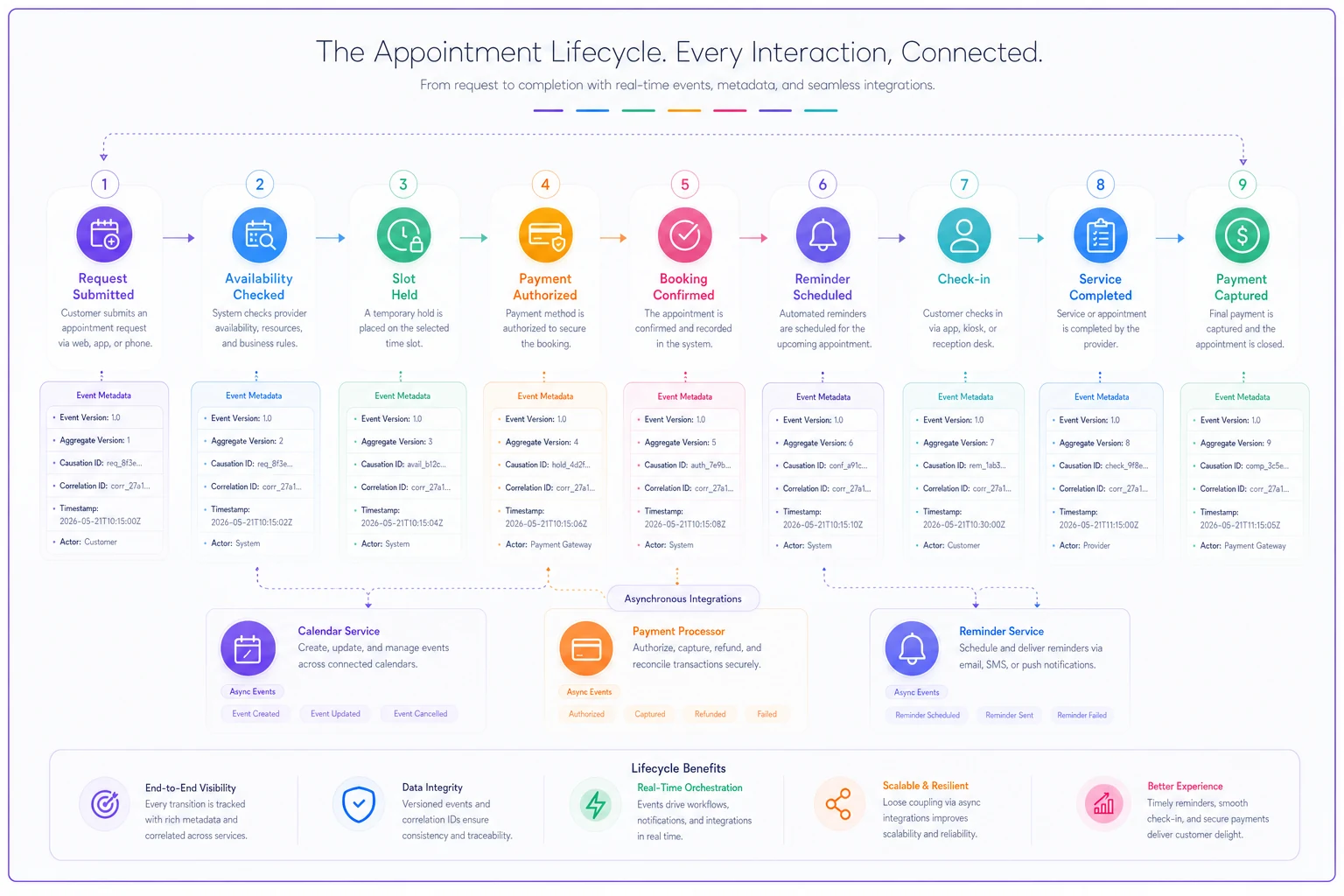
A typical appointment lifecycle looks something like this:
-
Request submitted
-
Availability checked
-
Slot held temporarily
-
Payment authorized
-
Booking confirmed
-
Reminder scheduled
-
Check-in recorded
-
Service completed
-
Payment captured
Each transition generates an event. Without proper schemas, you lose critical context. A booking_confirmed event needs to include not just the appointment ID, but the specific availability snapshot it was confirmed against, the hold expiration timestamp, and the authorization reference.
Visualize the appointment lifecycle and the event metadata that must travel with each transition.
A home services company discovered this the hard way. Technicians would arrive to find customers expecting different services than what showed in their system. The booking confirmed event only contained basic appointment data, and when customers modified bookings, those modification events had no way to reference which version they were modifying. Changes got applied to already-changed states, creating compounding errors.
The fix wasn't complex — just disciplined. Every event now includes:
-
Event version (schema evolution)
-
Aggregate version (optimistic locking)
-
Causation ID (what triggered this)
-
Correlation ID (related events)
-
Timestamp with timezone
-
Actor (who/what generated it)
Small schema changes. Their mismatch rate dropped from roughly 8% to under 1%.
Idempotency keys and why timestamps aren't enough
A pattern that keeps showing up: booking systems using timestamps as unique identifiers. "What are the odds two bookings happen at the exact same millisecond?"
Pretty good, actually, when your payment processor hiccups and retry logic kicks in.
A wellness center charged a client's card six times for the same appointment. Their booking API retried a failed request, but the payment had actually succeeded — the success response just never made it back. Each retry generated a new timestamp, creating six "unique" transactions for one appointment.
Idempotency isn't just about preventing duplicates. It's about making operations safely retryable. Scheduling APIs need explicit idempotency keys that survive across retries, system restarts, and network partitions.
The tricky part with bookings: idempotency at which level? The API call? The business operation? The entire workflow?
A veterinary clinic had API-level idempotency but still created duplicate appointments. Their frontend generated new idempotency keys for each retry attempt. The API correctly rejected duplicate calls with the same key, but happily processed "new" requests for the same time slot.
The solution requires layered idempotency:
-
API level
prevents duplicate HTTP requests
-
Operation level
prevents duplicate business operations
-
Workflow level
prevents duplicate multi-step processes
For bookings, the operation-level key should combine:
-
Customer identifier
-
Practitioner/resource identifier
-
Requested time slot
-
Service type
Generate operation-level idempotency keys in a way that is stable across client retries (e.g., server-side composition) to avoid frontend retries creating new keys.
This creates a natural idempotency boundary. Even if API calls get duplicated, you can't double-book the same customer for the same service at the same time.
Reconciliation windows and the myth of real-time
Every scheduling API promises real-time updates. None actually deliver them. Networks have latency. Databases have replication lag. Webhooks get delayed. The question isn't whether your systems will disagree — it's how long you'll tolerate the disagreement.
A multi-location fitness studio struggled with this. Their class booking API updated immediately, but instructor apps synced every 15 minutes. Members would book spots that appeared available online but were already filled according to the instructor's tablet. Classes ran over capacity or turned members away.
The fix wasn't faster syncing. It was explicit reconciliation windows. Instead of pretending updates were instant, they built the delay into their operational model:
-
Instant confirmation for bookings made 2+ hours in advance
-
"Pending confirmation" status for last-minute bookings
-
5-minute reconciliation window for conflicts
-
Clear communication about confirmation timing
That transparency actually improved customer satisfaction. Members preferred honest expectations over false promises of instant confirmation.
Reconciliation windows should account for:
Technical delays:
-
API processing time
-
Database replication lag
-
Webhook delivery time
-
Third-party system sync intervals
Operational delays:
-
Manual approval workflows
-
Payment authorization holds
-
Resource confirmation requirements
-
Schedule conflict resolution
Set different windows for different operations. Cancellations might reconcile immediately. Modifications might need human review. New bookings might require payment clearance.
Synthetic event test suites that catch problems before customers do
Most businesses test their booking APIs by creating a few test appointments. That's like testing a car by starting the engine. You need to simulate the full chaos of production.
Synthetic events are fake but realistic event streams that exercise your entire scheduling system — not just happy paths, but the weird edge cases that happen at 2 AM on a holiday weekend when half your systems are under maintenance.
A healthcare network's synthetic test suite revealed a critical bug: their API handled single cancellations perfectly but corrupted recurring appointment series when cancelled on specific dates. The bug only surfaced when a recurring appointment spanned a daylight saving time transition and got cancelled on that exact date. No manual tester would have caught it.
A solid synthetic event suite needs:
Temporal edge cases:
-
Appointments at midnight
-
Daylight saving transitions
-
Month boundaries
-
Year boundaries
-
Timezone changes
Concurrency patterns:
-
Simultaneous bookings for the same slot
-
Rapid-fire modifications
-
Bulk operations
-
Race conditions between different event types
Failure scenarios:
-
Partial webhook delivery
-
Out-of-order event arrival
-
Network timeouts mid-transaction
-
Database connection drops
Business logic violations:
-
Double-booking attempts
-
Bookings outside business hours
-
Capacity limit violations
-
Invalid state transitions
The key is running these tests continuously, not just during deployments. A massage therapy franchise runs synthetic events every 30 minutes, generating around 200 fake bookings that flow through their entire system. These synthetic bookings are flagged to prevent them from affecting real operations, but they trigger all the same code paths, integrations, and workflows.
They catch several production issues monthly before any real customer is affected. More importantly, they provide continuous confidence that their scheduling performance metrics reflect actual system capability, not just lucky timing.
Reconciliation SOPs when systems disagree
Even with proper schemas and comprehensive testing, systems will disagree. What matters is how quickly you detect it and how systematically you resolve it.
A pet grooming business had three different sources of truth — their booking app, their POS system, and their groomer scheduling platform. When discrepancies arose, staff would spend hours playing detective, comparing screenshots and arguing about which system was right.
We built a simple reconciliation SOP:
-
Establish system hierarchy - Primary
POS system (handles money) - Secondary: Booking platform (customer-facing) - Tertiary: Groomer app (internal scheduling)
-
Define comparison checkpoints - Every 2 hours during business hours - Full reconciliation at day end - Deep audit weekly
-
Create resolution rules - If POS and booking disagree
POS wins, booking gets updated - If all three disagree: POS wins, others sync to it - If POS has no record: investigate before any changes
-
Document every reconciliation - Timestamp of check - Systems compared - Discrepancies found - Resolution applied - Root cause (if identified)
Within three months, their reconciliation time dropped from hours to minutes. Patterns also started emerging — most discrepancies happened during their 2-3 PM rush when network latency peaked. They adjusted their sync governance rules to handle high-latency periods differently.
The SOP should be executable by anyone, not just developers. A good reconciliation process:
-
Runs partially automated, partially manual
-
Generates clear reports
-
Tracks patterns over time
-
Feeds back into system improvements
The SOP should be executable by anyone, not just developers. A good reconciliation process:
Building recovery paths into the contract
The best scheduling APIs don't just handle success — they make failure recovery a first-class citizen of the contract design.
Think about a standard booking confirmation flow. Most APIs return success or failure. But what about partial success? What if the appointment was created but the payment failed? Or the payment succeeded but the calendar sync failed?
A tutoring platform dealt with this daily. Their API would successfully create appointments but fail to notify tutors. Students would show up to empty rooms. The API returned "success" because technically the appointment was created — the notification failure was treated as a separate concern.
| State | Recovery |
|---|---|
| appointmentcreatedpending_confirmation | retrytutornotification or manualtutorassignment |
| paymentauthorizedbooking_failed | reverseauthorization or retrybooking_creation |
| bookingconfirmedsync_pending | forcesync or markmanual_review |
Each state includes:
-
What succeeded
-
What failed
-
What recovery options exist
-
Time limits for recovery
-
Escalation paths if recovery fails
Staff went from seeing cryptic errors to seeing exactly what broke and how to fix it. The API contract became an operational playbook.
Testing your contracts against real chaos
Your test environment doesn't match production. It can't. Production has edge cases you haven't imagined yet.
The solution isn't more test cases — it's chaos engineering for scheduling systems. Deliberately break things in controlled ways to see how your contracts hold up.
A dental chain implemented monthly "Chaos Scheduling Days." They would:
-
Randomly delay webhooks by 5-60 seconds
-
Drop 5% of API responses
-
Corrupt 1% of event payloads
-
Simulate clock skew between systems
-
Trigger race conditions intentionally
The first one was rough. Their scheduling system essentially fell apart. But each iteration made their contracts more resilient. After six months, they could lose entire system components and still maintain accurate bookings through recovery mechanisms.
Start small. Pick one failure type — delayed webhooks, for example. Introduce it gradually in production during low-traffic periods. Watch how your contracts handle it. Build recovery mechanisms. Then add another failure type.
The compound effect of resilient contracts
A private practice with 12 providers implemented these patterns over six months. The immediate impact was subtle — fewer strange booking errors, less time investigating discrepancies. But the compound effect was significant.
Their front desk stopped keeping paper backup schedules. They used to spend 45 minutes each morning reconciling the previous day's appointments. Their no-show rate dropped because reminder systems stayed in sync. They could finally trust their booking numbers for capacity planning.
The real value wasn't preventing failures — it was making failures manageable. When their payment processor went down, they didn't lose a single booking. The system queued authorization requests, maintained provisional bookings, and processed everything once service restored. What would have been a crisis became a minor operational hiccup.
This is what resilient scheduling APIs and event contracts actually deliver: not perfection, but predictability. Staff know exactly what to do when things go wrong. Systems recover automatically from common failures. Customers experience consistency even when chaos happens behind the scenes.
The difference between good and great scheduling operations isn't preventing problems — it's recovering from them quickly. The right event contracts, idempotency patterns, and reconciliation processes transform scheduling from a fragile dance of perfect timing into a system that handles whatever reality throws at it. The businesses that hold up aren't the ones where nothing breaks. They're the ones where problems get detected fast, resolved systematically, and prevented from recurring through better contract design.
Ready to optimize your scheduling and operations?
Join thousands of businesses using Schedily to save time, improve coordination, and enhance operational efficiency.