

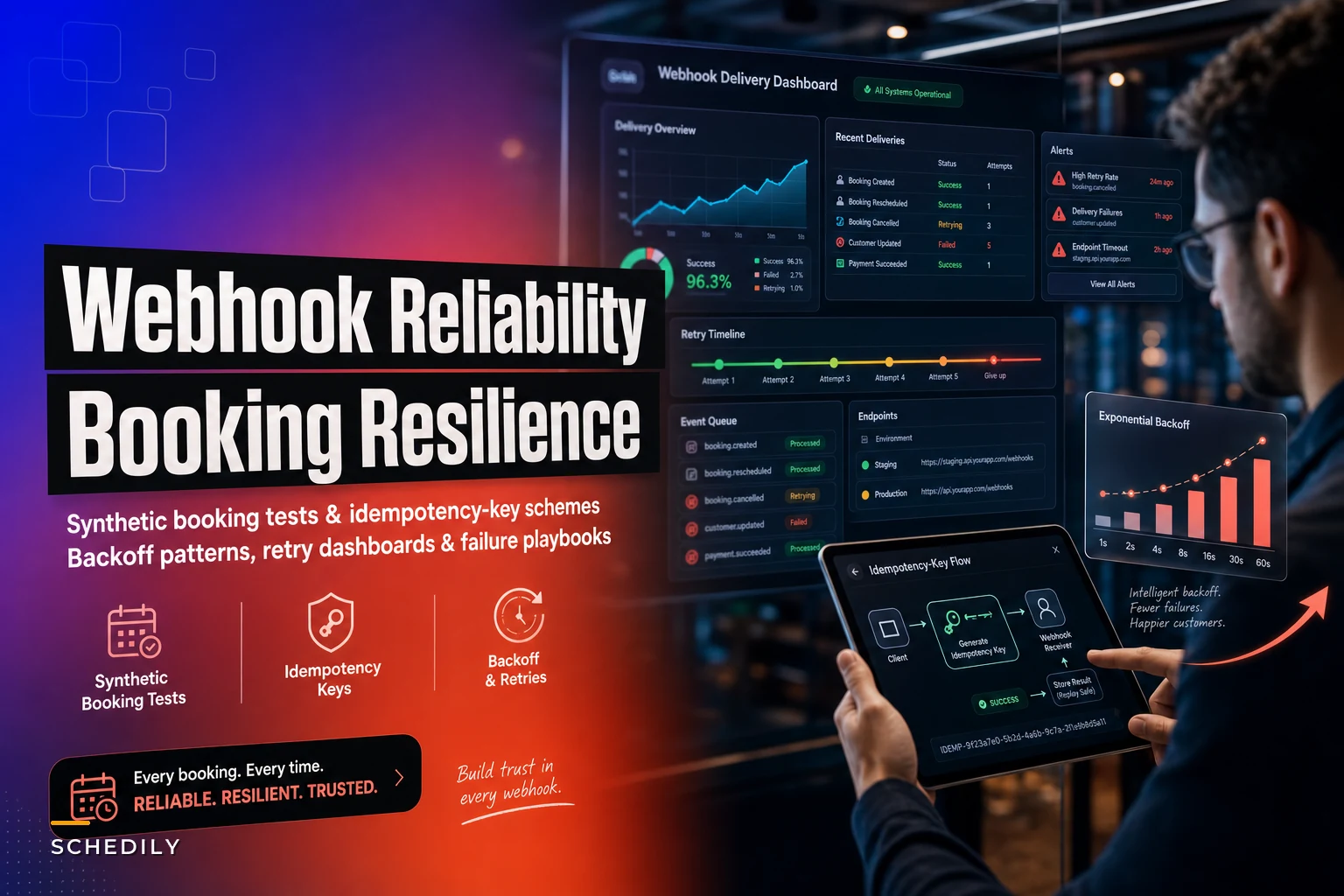

Most booking webhook setups look bulletproof until the day they aren't. The integration passes the smoke test, a booking fires, your CRM gets the event, everyone claps. Then three weeks later a customer reschedules a Tuesday facial to Thursday, immediately cancels it because they changed their mind, and your downstream system ends up with a cancelled appointment sitting in the Thursday slot — while the Tuesday slot never gets released. Nobody can figure out why the calendar shows a ghost booking.
That's not a fluke. That's the default behavior of a webhook system that trusts delivery order, doesn't dedupe, and retries blindly. And it's exactly the kind of thing that survives QA because QA never fires a reschedule and a cancel 900 milliseconds apart.
This post is narrowly about one thing: making booking webhooks survive real-world ordering chaos using synthetic webhooks, booking retries built on idempotency keys, and backoff that respects booking semantics. Not general "webhook best practices." Specifically the create/reschedule/cancel ordering problem that quietly corrupts calendars.
Why booking webhooks fail differently than normal webhooks
A payment webhook is mostly commutative in practice — you get a charge.succeeded, you record it, done. Booking events are stateful and ordered. The meaning of a cancel depends entirely on what happened before it. A cancel for a booking that was already rescheduled means something different than a cancel for the original.
-
The same event delivered twice (retry after a slow 200)
-
A
booking.rescheduledarriving before thebooking.createdit depends on -
A
booking.cancelledarriving before the reschedule that it's supposed to cancel -
Two events with the same logical meaning but different payload timestamps
In real operations, this usually surfaces when your endpoint had a brief hiccup — a 4-second DB lock, a deploy, a cold Lambda — and the provider's retry queue drains out of order once you recover. Everything that was buffered floods in, and your handler processes a stale reschedule after a newer cancel.
The pattern that keeps showing up: teams debug the symptom (ghost slots, double-booked rooms, phantom cancellations) for weeks without realizing the root cause is ordering plus duplication, not a bug in their booking logic.
The three-part fix, and why all three are non-negotiable
You need idempotency keys so duplicates don't double-apply. You need version/sequence awareness so out-of-order events don't overwrite newer state. And you need backoff that's tuned to booking urgency, not a generic exponential curve copied from a Stripe tutorial. Skip any one and the other two paper over the problem until they can't.
Eliminate scheduling conflicts and missed meetings.
Schedily helps you organize and manage all appointments and team availability effortlessly.
- Unified appointment and resource management
- Automated notifications & reminders
- Team calendar synchronization
No credit card required
The mental model worth holding onto: treat every incoming webhook as a claim about state at a point in time, not as a command to execute immediately.
1. Idempotency keys that actually map to booking identity
A common mistake is generating the idempotency key from the delivery — the webhook event ID. That dedupes redelivery of the same event, which is useful, but does nothing when a reschedule and its retry carry different event IDs for the same logical action.
The key needs to encode the booking action, not the message. A scheme that holds up:
idempotencykey = {bookingid}:{action}:{action_version}
Where actionversion is a monotonically increasing counter the source system assigns each time the booking changes. A reschedule isn't just booking123:reschedule — it's booking_123:reschedule:4. If you process version 4 and version 3 shows up late, you already know 3 is stale.
Store processed keys with the resulting state. When a duplicate lands, return the stored result instead of re-running the handler. This requires the same discipline as designing resilient scheduling APIs from the source — if event versioning isn't nailed down upstream, the consumer can only be as reliable as the contract feeding it.
2. Sequence-aware handling for create/reschedule/cancel
This is the part most guides skip entirely. Idempotency stops duplicates. It does not stop a late-arriving reschedule from clobbering a cancel.
| Incoming event | Current state | Higher version? | Action |
|---|---|---|---|
created v1 | none | yes | Apply, watermark=1 |
rescheduled v2 | created v1 | yes | Apply new time, release old slot, watermark=2 |
cancelled v4 | rescheduled v2 | yes | Cancel, release slot, watermark=4 |
rescheduled v3 (arrives late) | cancelled v4 | no (3<4) | Drop — booking already cancelled by newer event |
created v1 (redelivered) | cancelled v4 | no | Drop — duplicate/stale |
Notice v3 arriving after v4 is the exact scenario that corrupts naive systems. With a watermark, it's a one-line rejection. Without it, you'd un-cancel a cancelled appointment and re-lock a slot nobody wants.
The early-arrival case — a v5 showing up before v4 — is rarer but real. Park it in a short-lived holding table keyed by booking_id and re-drain when the gap fills, or after a timeout, reconcile against the source of truth via API. Don't apply it and don't silently drop it.
3. Backoff tuned to booking semantics
Generic exponential backoff (1s, 2s, 4s, 8s… for hours) is wrong for bookings because booking events decay in value. A cancellation that takes 40 minutes to propagate isn't just late — it's caused a no-show slot that could've been resold, or a technician who drove to a cancelled job.
-
Cancellations and reschedules that free capacity
aggressive early retries (immediate, then 5s, 15s, 45s), tighter cap, and escalate to a human fast if unresolved within around 5 minutes. Freed capacity has a short resale window.
-
Creations
standard exponential with jitter (2s, 8s, 30s, 2m, 10m), longer tail — a slightly delayed create rarely causes harm as long as it lands before the appointment.
-
Everything
full jitter, not fixed intervals. Fixed retry intervals cause thundering-herd re-sync storms after an outage — every buffered event retries on the same schedule and hammers your recovering endpoint.
-
Add a retry budget with a dead-letter path. After N attempts, stop retrying and drop the event into a dead-letter queue with enough context to reconcile against the source. Infinite retries during a downstream outage just deepen the ordering mess when things recover.
Add a retry budget with a dead-letter path. After N attempts, stop retrying and drop the event into a dead-letter queue with enough context to reconcile against the source. Infinite retries during a downstream outage just deepen the ordering mess when things recover.
Synthetic test suites: proving it works before production does it for you
You cannot trust a booking webhook you've only tested with happy-path single events. The failures live in timing and ordering, and those don't surface in manual testing. This is what synthetic webhook booking retries are for — you generate the adversarial sequences on purpose.
A synthetic suite is a set of scripted, replayable webhook sequences that hammer your endpoint with the ordering and duplication patterns production will eventually throw at you. Not load testing. Correctness-under-chaos testing.
The scenarios worth scripting, in rough priority:
-
Duplicate delivery — same event twice, back to back, then again 30s later. Assert state applied once.
-
Out-of-order reschedule/cancel — send v4 cancel, then v3 reschedule. Assert v3 is dropped and the slot stays released.
-
Reschedule before create — send v2 before v1. Assert v2 parks, v1 applies, then v2 drains correctly.
-
Retry storm after simulated outage — buffer 200 mixed events, release them all in a 2-second burst out of order. Assert final state matches source truth and your endpoint didn't fall over.
-
Partial failure mid-handler — kill the handler after it writes the slot but before it writes the watermark. Re-deliver. Assert no double-apply. (This is the one that catches non-transactional handlers.)
-
Stale duplicate after cancel — redeliver an old create for an already-cancelled booking. Assert drop.
Roughly 60–70% of booking-state corruption bugs come from scenarios 2, 4, and 5. Those three give you the most coverage for the least test code, so build them first.
Use a reserved test
booking_idrange or asynthetic:trueflag when running continuous synthetic checks against production.
Here's a quick workflow for running a synthetic suite:
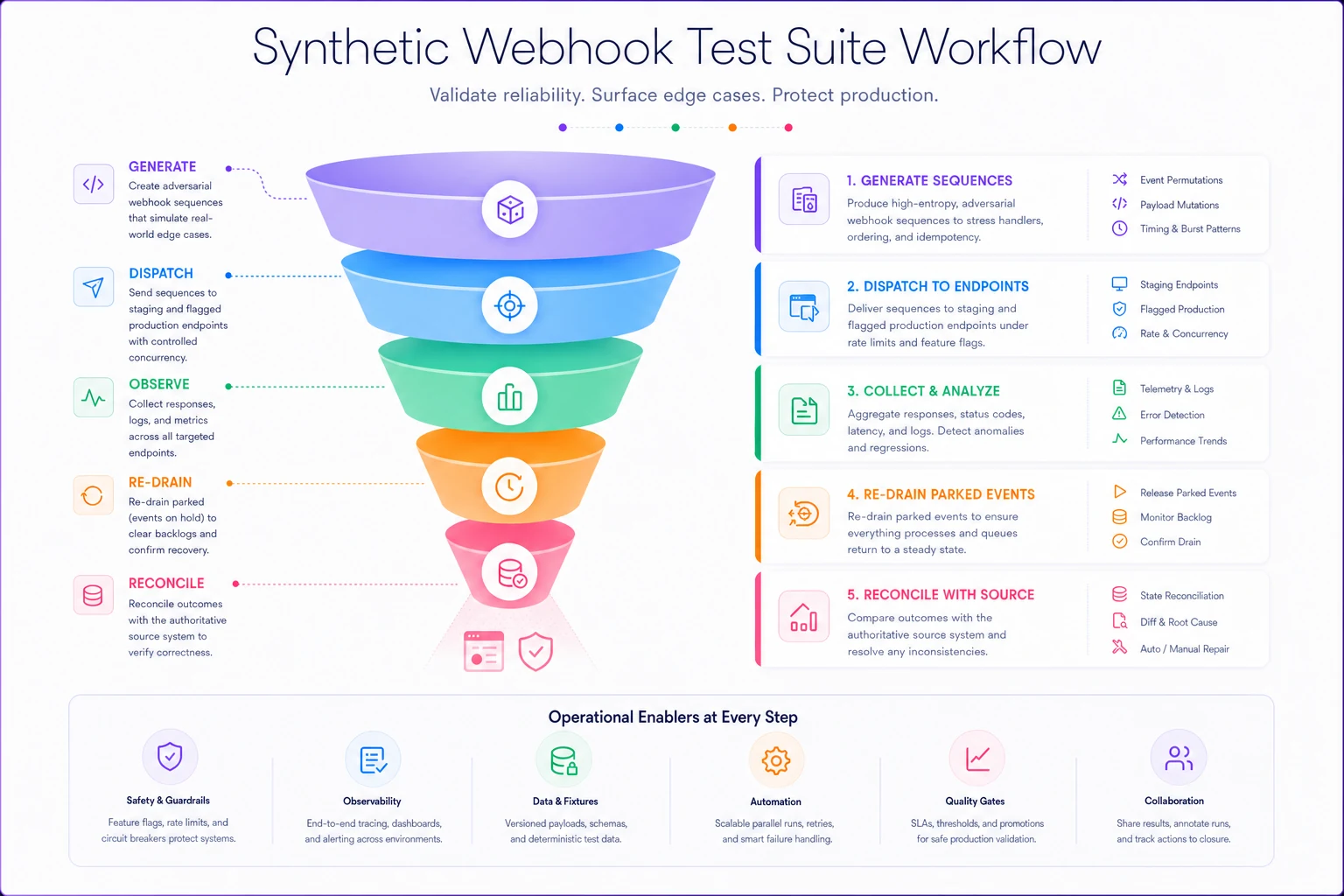
Run the suite in CI against a staging endpoint, and — this is the part people skip — run a lightweight version continuously against production using clearly-flagged synthetic bookings (a reserved test booking_id range or a synthetic:true flag your handler routes to a sandbox). A webhook that passed CI last month can silently break after a provider changes payload timing or your team ships a "harmless" refactor. Continuous synthetic checks catch that within minutes instead of the next time a real customer's reschedule goes sideways.
Delivery dashboards: watch the gap, not the volume
Most teams monitor webhook success rate and call it observability. Success rate tells you almost nothing about ordering health. You can have 99.9% delivery success and still be silently corrupting state because the 0.1% that retried out of order hit your worst-case path.
-
End-to-end propagation latency per event type — time from source action to applied downstream, p50/p95/p99. Watch cancels especially; that's your capacity-resale window.
-
Out-of-order rejection count — how many events your watermark dropped. A sudden spike means a provider or network change, or a deploy that slowed your handler.
-
Parked (early-arrival) event count and age — parked events that never drain are silent data loss.
-
Dead-letter queue depth and age — anything sitting here is unreconciled state.
-
Duplicate hit rate — how often idempotency saved you. If this trends up, something upstream is retrying more aggressively, which is an early warning worth paying attention to.
The genuinely useful move is correlating these against booking outcomes — if out-of-order rejections spike the same hour ghost slots start appearing, you've found your smoking gun in minutes rather than days. If you're already building an operational metrics practice, this fits naturally into the same discipline as the rest of your scheduling KPI framework rather than living as an isolated engineering dashboard nobody in ops ever looks at.
Failure playbooks mapped to booking meaning
When something goes wrong at 6pm Friday, nobody should be reasoning from scratch. The playbook has to be written in booking terms, not HTTP terms. "500 error rate elevated" is useless to the person covering the front desk. "Cancellations aren't releasing slots — manually free anything cancelled in the last 20 minutes" is actionable.
Cancels/reschedules not propagating (slots not freeing): This is the highest-cost failure mode. Immediate action: flag affected slots as manually-reviewable, page whoever owns the integration, and open a manual reconciliation against the source system for the affected window. Don't wait for retries to sort themselves out — freed capacity is perishable.
Duplicate applies (double-booked resources):
Usually means idempotency isn't keyed correctly or a handler isn't transactional. Immediate action: identify affected bookingids from the duplicate-hit log, hold conflicting slots, resolve by keeping the highest actionversion. Longer-term this connects to the same conflict logic in sync governance for calendar integrations — the resolution rule should be identical whether the conflict came from a webhook or a two-way calendar sync.
Retry storm after recovery: Symptom: endpoint recovers, then latency spikes and CPU pegs. Action: confirm jitter is on, temporarily lower concurrency to drain in order, and let the watermark do its job dropping stales. If your handler is idempotent and version-aware, a storm is noisy but harmless.
Dead-letter buildup: Batch-reconcile against source truth on a schedule. Nothing in dead-letter should ever be applied blindly — always re-derive current state from the authoritative system before doing anything with it.
A real scenario
A mid-sized med-spa group — three locations, somewhere around 330–360 appointments a week — kept getting ghost bookings a few times a month. Slots showed occupied on the calendar but had no active appointment behind them. Front desk staff were manually hunting them down, and roughly twice a month a real customer got turned away from a slot that was actually free.
The root cause was exactly the reschedule-then-cancel ordering problem, made worse by fixed-interval retries that caused mini-storms every time their booking widget's backend blipped. No idempotency keying on booking action, no version watermark.
The fix wasn't glamorous: action-versioned idempotency keys, a per-booking watermark that dropped stale events, split backoff (aggressive on cancels, gentler on creates), and a six-scenario synthetic suite in CI plus a continuous synthetic check running against production. Ghost slots dropped to essentially zero the following month. The unexpected win was staff time — the front desk stopped spending what added up to a few hours a week playing calendar detective, and the "turned away from a free slot" complaints stopped showing up in reviews.
Nothing about that required rebuilding their stack. It just required treating webhooks as unreliable, ordered claims about state instead of trustworthy commands.
When this level of rigor makes sense — and when it's overkill
If you're processing a handful of bookings a day through a single first-party integration, full watermarking and continuous synthetic testing is probably more than you need. A solid idempotency key and basic retry with jitter will carry you a long way at small scale.
Build the full setup when any of these apply:
-
You have multiple downstream consumers of booking events (CRM, calendar sync, SMS reminders, billing) — ordering bugs multiply across every consumer.
-
Your capacity is perishable and resellable (rooms, chairs, equipment, technician time) so a late cancel has direct revenue cost.
-
You're integrating third-party booking sources where you don't control delivery order or retry behavior.
-
Volume is high enough that manual reconciliation isn't sustainable — roughly past a few hundred bookings a week is where the math flips.
Who should not invest here yet: a solo operator with one calendar and no downstream integrations. The failure modes above barely exist at that scale, and you'd be building infrastructure to solve problems you won't hit for another year at least.
The teams that get burned by booking webhooks aren't careless — they're trusting a system that was never designed to be trusted the way they're using it. At-least-once, unordered delivery is the normal behavior, not the edge case. Once you accept that and design for stale, duplicate, out-of-order events as the expected input, the create/reschedule/cancel ordering problem stops being a mystery and becomes a handful of well-defined rules you can test on demand. Build the synthetic suite before you need it, and the 6pm Friday race condition becomes a line in a test log instead of an angry customer standing at your front desk.
Ready to optimize your scheduling and operations?
Join thousands of businesses using Schedily to save time, improve coordination, and enhance operational efficiency.