



Most scheduling experiments fail not because the idea was bad, but because nobody wired the metrics correctly, nobody defined what "worse" looked like, and the test ran long enough to do real damage before anyone noticed. A 15-minute buffer change sounds harmless. Then three weeks later your utilization is down four points, nobody can explain why, and half the team swears the old setup was fine.
Scheduling experiments are tricky because they touch revenue, staff workload, and customer experience simultaneously. Change your reminder cadence and you might cut no-shows but annoy enough regulars that rebooking drops. Loosen a buffer and you squeeze more appointments in, but your late-arrival cascade gets worse by 2pm every day. Those second-order effects are the whole game, and a sloppy test misses them every time.
What follows is a practical setup for running scheduling experiments that won't silently regress — cohorts, metric wiring, guardrails, and the runbook thresholds that tell ops when to kill a test before it costs real money.
Three scheduling changes worth testing (and the trap in each)
Before any framework, it helps to be concrete about what you're actually changing. Most scheduling experiments fall into three buckets, and each one has a failure mode that people walk straight into.
Buffer changes. You adjust the gap between appointments — say dropping a service buffer from 15 to 10 minutes to fit more slots. The trap: the benefit shows up immediately and feels like a win, but the cost accumulates through the day and barely registers in daily averages. Compounding delays, rushed handoffs, equipment not reset. You need to measure end-of-day lateness, not average lateness.
Reminder cadence. You change how many reminders go out and when — maybe moving from a single 24-hour SMS to a 48-hour plus 2-hour combo. The trap: you measure no-show rate, see it drop, declare victory, and never notice that opt-outs climbed or that your highest-value clients found the extra messages irritating. Reminder changes almost always have a hidden cost in a segment you weren't watching.
Waitlist rules. You change how cancelled slots get backfilled — auto-offering to the waitlist, widening the offer window, or changing who gets first dibs. The trap: fill rate looks great, but you've quietly increased same-day churn because people booked a slot they weren't really committed to, or your staff is scrambling to accommodate last-minute bookings that need prep they don't have time for.
Each of these is worth testing. The point is that the obvious metric lies to you in every case, which is why the wiring matters more than the idea itself.
Cohort design: don't split by the thing you're changing
The most common cohort mistake is splitting by something correlated with the change itself. Someone wants to test a new buffer for haircuts, so they put morning appointments in the control and afternoon appointments in the treatment. Now your results are tangled with time-of-day effects — afternoons run late regardless of buffer, so of course the treatment looks worse.
Eliminate scheduling conflicts and missed meetings.
Schedily helps you organize and manage all appointments and team availability effortlessly.
- Unified appointment and resource management
- Automated notifications & reminders
- Team calendar synchronization
No credit card required
Split at the right unit. For most scheduling experiments the cleanest unit is the resource (a specific stylist, room, technician, bay) or the booking, randomized. Splitting by resource gives you cleaner operational isolation — one tech runs the new buffer, another runs the old, both across the full day. Splitting by booking gives you more statistical power but muddies the operational picture because the same staff member is juggling two rule sets at once, which is its own source of error.
A rough guide on which to pick:
| Change type | Best cohort unit | Why | Minimum run |
|---|---|---|---|
| Buffer changes | Resource (staff/room) | Delay cascades are per-resource; isolating them keeps the signal clean | 3–4 full weeks |
| Reminder cadence | Booking (randomized) | Reminder effect is per-customer, independent of resource | 4–6 weeks |
| Waitlist rules | Location or resource group | Backfill behavior is a system-level effect, not per-booking | 4+ weeks |
Mind the cohort size. A single-location business with one technician testing buffers has no clean control — you can't split a person in half. In that case you're stuck with a before/after (interrupted time series), which is weaker and demands a longer baseline. Smaller operators tend to run a two-week before/after, see a nice-looking number, and attribute a seasonal swing to their buffer change. If you only have one resource, collect at least 6–8 weeks of baseline before you touch anything, and expect to be less certain about the result.
Watch the contamination. If your waitlist pulls from a shared pool, a treatment resource and a control resource are competing for the same cancelled slots. The treatment's "improved fill rate" might just be stealing fills from control. For anything that shares a resource pool, split at the pool level, not inside it.
Wiring metrics: primary, secondary, and the ones that catch regressions
This is where most teams under-build. They pick one metric — the one the change is supposed to improve — and ignore everything else. You need three tiers.
Primary metric is what the change targets. For a buffer test, it's slots-per-day or utilization. For reminders, it's no-show rate. For waitlist rules, it's fill rate on cancelled slots. One primary metric. If you have two "primary" metrics you'll cherry-pick the winner afterward.
Secondary metrics are the things you expect to move a little and want to track. For a buffer test that's average lateness and same-day overtime. For reminders it's rebooking rate and message opt-out rate.
Guardrail metrics are the ones that must not get worse — the regression tripwires. These are non-negotiable, and they're the whole reason you don't lose money on a bad test. For scheduling, the guardrails that actually matter are end-of-day cumulative lateness (the cascade metric), customer-facing cancellation rate within the treatment cohort, staff overtime minutes, reminder opt-out and unsubscribe rate, and revenue per available hour so capacity gains don't come at the cost of a downgrade in booking mix.
If you don't already have a clean KPI baseline to wire these against, that's the prerequisite work. We've covered how to build that foundation in an operational KPI framework for appointment-driven businesses — without stable definitions for these metrics, your experiment is measuring noise against noise.
The wiring itself needs to be per-cohort. A dashboard showing blended numbers across treatment and control is useless. Every metric needs a cohort tag attached at the booking level so you can slice it. If your system can't tag a booking with which experiment arm it belongs to, fix that before you run anything — reconstructing it afterward from timestamps is painful and unreliable.
Attach cohort tags at booking creation so downstream KPIs inherit the experiment arm reliably.
The wiring itself needs to be per-cohort. A dashboard showing blended numbers across treatment and control is useless. Every metric needs a cohort tag attached at the booking level so you can slice it. If your system can't tag a booking with which experiment arm it belongs to, fix that before you run anything — reconstructing it afterward from timestamps is painful and unreliable.
Guardrails and runbook thresholds: the part that saves you
This is the discipline most teams skip. Before the test starts, you write down the exact numbers that will make you stop it. Not "we'll keep an eye on it" — actual thresholds, checked on a schedule, with a named owner.
A workable structure separates two levels: a warn threshold that triggers a review, and a kill threshold that stops the experiment immediately regardless of how good the primary metric looks.
A realistic example for a buffer-reduction test:
-
Primary (slots/day) target +8% or better to justify keeping it
-
Guardrail — end-of-day lateness warn at +10 min average, kill at +20 min
-
Guardrail — same-day cancellations warn at +2 points, kill at +4 points
-
Guardrail — overtime warn at +15 min/resource/day, kill at +30
Check cadence: daily for the first week, then every two days
The kill thresholds exist because the primary metric is seductive. A buffer cut will show more slots. Without a pre-committed kill line on lateness, you'll rationalize the cascade ("it's just a busy week") until it's baked into your operation.
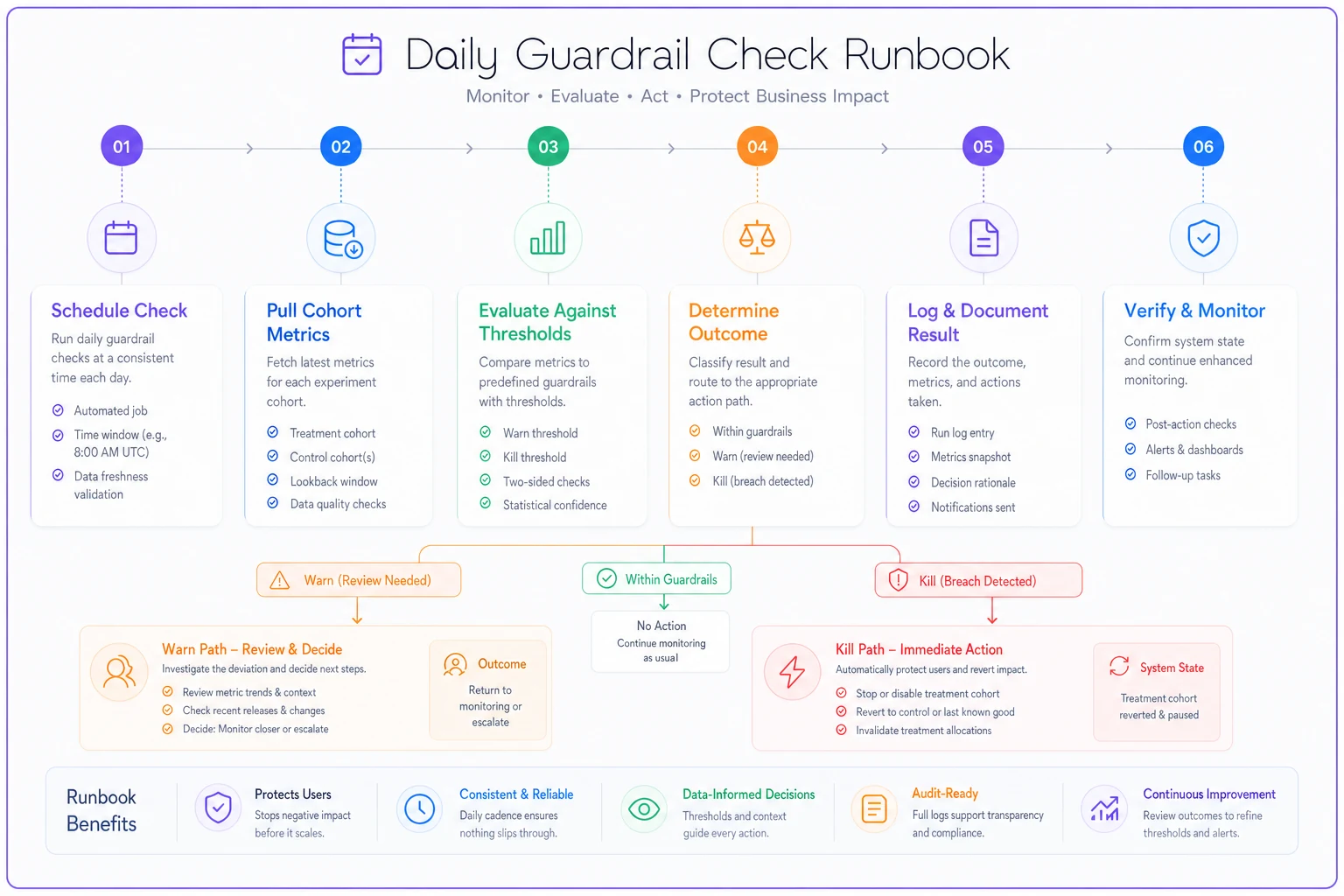
A simple runbook for each check:
-
Pull per-cohort metrics for the window since last check.
-
Compare each guardrail against its warn and kill thresholds.
-
If any guardrail hits kill → revert the rule for the treatment cohort same day, log it, move on.
-
If any guardrail hits warn → flag for review within 24h, decide whether to continue, tighten, or stop.
-
If primary is flat and no guardrails tripped after the minimum run → the change does nothing, kill it anyway (null results are results).
-
If primary wins and all guardrails stay green through full run → prepare rollout.
Step 5 matters more than people expect. A large share of scheduling experiments produce no meaningful movement, and teams let those limp along for months "just to be sure." A null result after a full minimum run is a finish line, not a reason to extend.
Here's a simple runbook flow you can visualize.
Step 5 matters more than people expect. A large share of scheduling experiments produce no meaningful movement, and teams let those limp along for months "just to be sure." A null result after a full minimum run is a finish line, not a reason to extend.
A real scenario: the reminder cadence test that almost shipped a regression
A mid-size dental practice — roughly 330 appointments a week across four chairs — wanted to cut no-shows. They were running a single 24-hour SMS reminder and sitting at around a 9% no-show rate. The proposed change: add a 48-hour email and a 2-hour SMS on top.
They split at the booking level, randomized, and ran it four weeks. The primary metric moved nicely — no-shows in the treatment cohort dropped to about 6%. On that number alone it looked like a clear win and they were ready to roll it out to everyone.
The guardrail is what saved them. They'd wired reminder opt-out rate as a kill-level guardrail, and in the treatment cohort opt-outs had climbed from under 1% to nearly 4% — concentrated almost entirely among patients who'd been coming for years. Those long-term patients found three reminders patronizing and started unsubscribing from messages entirely, which meant they'd get no reminders going forward. The short-term no-show win was setting up a long-term reminder-coverage problem in the exact segment that didn't need the extra nudging.
The fix was straightforward once they could see the split: apply the aggressive three-touch cadence only to patients with a prior no-show or a first visit, and keep the single reminder for established, reliable patients. Rolled out that way, no-shows landed around 6.5% overall and opt-outs stayed flat. If they'd shipped the original version blind, they'd have traded a visible no-show drop for an invisible erosion of reminder reach among their best patients. That segmentation logic ties directly into turning no-show patterns into targeted recovery flows rather than blasting everyone the same way.
When this framework makes sense — and when it's overkill
When it's worth the effort. If a scheduling change touches capacity, revenue, or a meaningful number of customers, run it properly. Buffer changes across a busy multi-resource operation, reminder overhauls, waitlist automation — these all have enough blast radius that a bad call costs real money over a quarter.
When it's overkill. If you're one practitioner with twenty appointments a week, you don't have the volume for a clean A/B test, and pretending you do just gives you false confidence. Use a careful before/after with a long baseline, trust your direct observation, and move on. The statistical machinery needs volume to mean anything.
Who should not do this. Anyone without per-cohort metric wiring in place. If you can't tag a booking with its experiment arm and pull guardrail metrics per cohort, don't start — you'll run a test you can't actually read, and an unreadable test is worse than no test because it produces a decision anyway.
The checklist before you launch any scheduling experiment
The checklist before you launch any scheduling experiment
-
- [ ] One primary metric defined, with a target that justifies keeping the change
-
- [ ] Secondary metrics listed (expected to move, watching)
-
- [ ] Guardrail metrics with explicit warn and kill thresholds written down
-
- [ ] Cohort unit chosen to avoid contamination (resource / booking / pool)
-
- [ ] Minimum run length set based on volume, committed in advance
-
- [ ] Per-booking experiment-arm tagging confirmed working
-
- [ ] Check cadence scheduled with a named owner
-
- [ ] Revert procedure documented — exactly how you roll the treatment cohort back same-day
-
- [ ] A plan for what a null result means (usually
kill it, keep current rules)
The checklist before you launch any scheduling experiment
Closing thought
The teams that get real value from testing scheduling rules aren't the ones with the cleverest hypotheses. They're the ones who decided, before launch, exactly what failure looks like and exactly when they'd stop. The primary metric will almost always give you a reason to keep going. The guardrails are what stop a promising number from quietly draining your capacity, your overtime budget, or the patience of your most loyal customers. Build the wiring first, commit the thresholds in writing, and let the experiment tell you the truth instead of the story you wanted to hear.
The primary metric will almost always give you a reason to keep going. The guardrails are what stop a promising number from quietly draining your capacity, your overtime budget, or the patience of your most loyal customers. Build the wiring first, commit the thresholds in writing, and let the experiment tell you the truth instead of the story you wanted to hear.
The teams that get real value from testing scheduling rules aren't the ones with the cleverest hypotheses. They're the ones who decided, before launch, exactly what failure looks like and exactly when they'd stop. The primary metric will almost always give you a reason to keep going. The guardrails are what stop a promising number from quietly draining your capacity, your overtime budget, or the patience of your most loyal customers. Build the wiring first, commit the thresholds in writing, and let the experiment tell you the truth instead of the story you wanted to hear.
Ready to optimize your scheduling and operations?
Join thousands of businesses using Schedily to save time, improve coordination, and enhance operational efficiency.