

Most front desks run on instinct. Somebody walks in without an appointment, the receptionist glances at the screen, decides whether there's "room," and slots them in. Two hours later the 2:15 confirmed client is sitting in the waiting area past their appointment time, the tech is behind, and nobody can explain exactly where things went sideways.
The instinct isn't the problem. The problem is that instinct doesn't scale — and it definitely doesn't hold up when three walk-ins land in the same 20-minute window. What separates operations that protect their confirmed bookings from ones that constantly breach is whether walk-in overbooking triage is a documented, budgeted system or a judgment call made by whoever happens to be at the desk.
This is about turning that judgment call into numbers. Overbooking budgets per service. Buffer budgets. Named triage lanes. Communication scripts that fire before a client gets frustrated. And a daily reconciliation habit that tells you whether the whole thing actually worked.
The core failure: treating all capacity as one shared bucket
There's a pattern that shows up constantly in appointment-driven operations that mix confirmed bookings with walk-in demand.
The schedule has six chairs or six exam slots per hour. The front desk treats those six as one flexible pool — a confirmed appointment takes one, a walk-in takes one, and when there's an open slot, whoever's standing there gets it. Feels fair. Feels efficient.
The trouble is that not all six slots are interchangeable, and not all of them should be available for walk-ins. A confirmed appointment carries an implicit SLA — the client booked, got a reminder, showed up on time, and expects to be seen at 2:15, not 2:40. A walk-in carries no such promise. When you let walk-ins draw from the same undifferentiated pool, you're silently spending SLA-protected capacity on demand that had no service guarantee in the first place.
In real operations, this usually surfaces on the busiest days — exactly when it hurts most. Slow Tuesday, nobody notices. Saturday morning with a full book plus a wave of walk-ins, and suddenly your most loyal confirmed clients are waiting because the front desk gave their buffer away three walk-ins ago.
Overbooking budgets by service, not by day
The fix starts with accepting that a small amount of overbooking is fine — sometimes even correct, given no-show behavior — but it has to be budgeted per service type, not applied as a blanket rule.
Eliminate scheduling conflicts and missed meetings.
Schedily helps you organize and manage all appointments and team availability effortlessly.
- Unified appointment and resource management
- Automated notifications & reminders
- Team calendar synchronization
No credit card required
Different services have wildly different no-show rates and different tolerance for overlap. A quick 15-minute service where clients rarely flake can absorb a little overbooking. A 90-minute high-touch appointment where the room, the equipment, and the specialist are all locked for the duration can absorb almost none — one overbook there and you've blown two clients' afternoons.
A typical breakdown looks like this:
| Service | Avg duration | Historical no-show | Overbook budget | Rationale |
|---|---|---|---|---|
| Quick service / touch-up | 15 min | ~18% | Up to 2 per hour | High flake rate, fast recovery if all show |
| Standard appointment | 45 min | ~9% | 1 per 3 hours | Moderate risk, some recovery room |
| Specialist / long service | 90 min | ~4% | 0 | Locked resources, no recovery if overlap |
| New-client consult | 30 min | ~22% | 1 per 2 hours | High flake, but first impression matters |
The point isn't these exact numbers — yours will differ. The point is that the overbooking budget is tied to the service's actual behavior, and it's written down. When the front desk considers squeezing in a walk-in, they're not guessing whether there's room. They're checking whether the budget for that service, in that window, still has headroom.
One mistake worth flagging: operations set overbooking budgets off gut feel about how busy things "usually" get, then never revisit them against real no-show data. If your standard-appointment no-show rate quietly drifted from 12% down to 6% over a year, your overbooking budget is now too aggressive and you're manufacturing waits.
Buffer budgets: the capacity you deliberately refuse to sell
Buffer is the flip side of overbooking, and most front desks don't budget it at all. They just let it get eaten.
A buffer budget is capacity you intentionally hold back — not for a specific booking, but as shock absorption. It covers the appointment that runs long, the client who arrives 10 minutes late, the walk-in you genuinely want to accommodate without wrecking the confirmed book. If you never protect buffer, the first bit of friction consumes it and everything after runs behind.
Reserve one recoverable slot per provider per peak block and treat it as spendable only under triage rules.
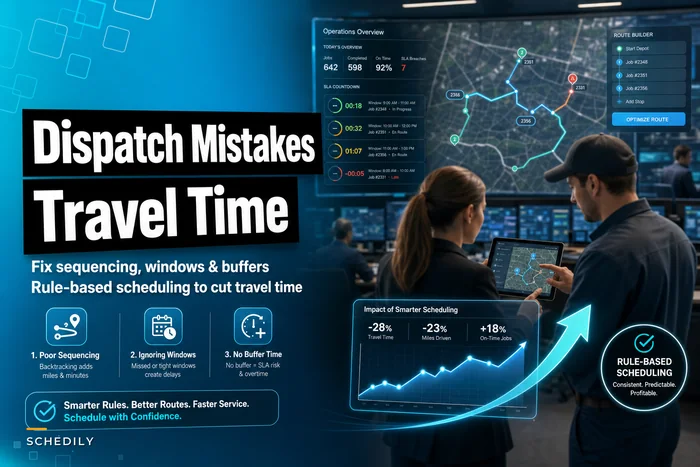
The trap is that buffer feels like waste when you're staring at an empty 3:30 slot and a walk-in standing in front of you. It's not waste. It's the thing standing between "we ran 8 minutes behind and recovered" and "we ran 40 minutes behind by 4pm and never caught up." Late-running schedules don't self-correct — they compound. It's the same dynamic behind how small dispatch inefficiencies snowball, which we broke down in three common dispatch mistakes that inflate travel time.
A practical way to size buffer: reserve one recoverable slot per provider per peak block, and treat it as spendable only under triage rules — not handed to the first walk-in who asks.
Real-time triage lanes
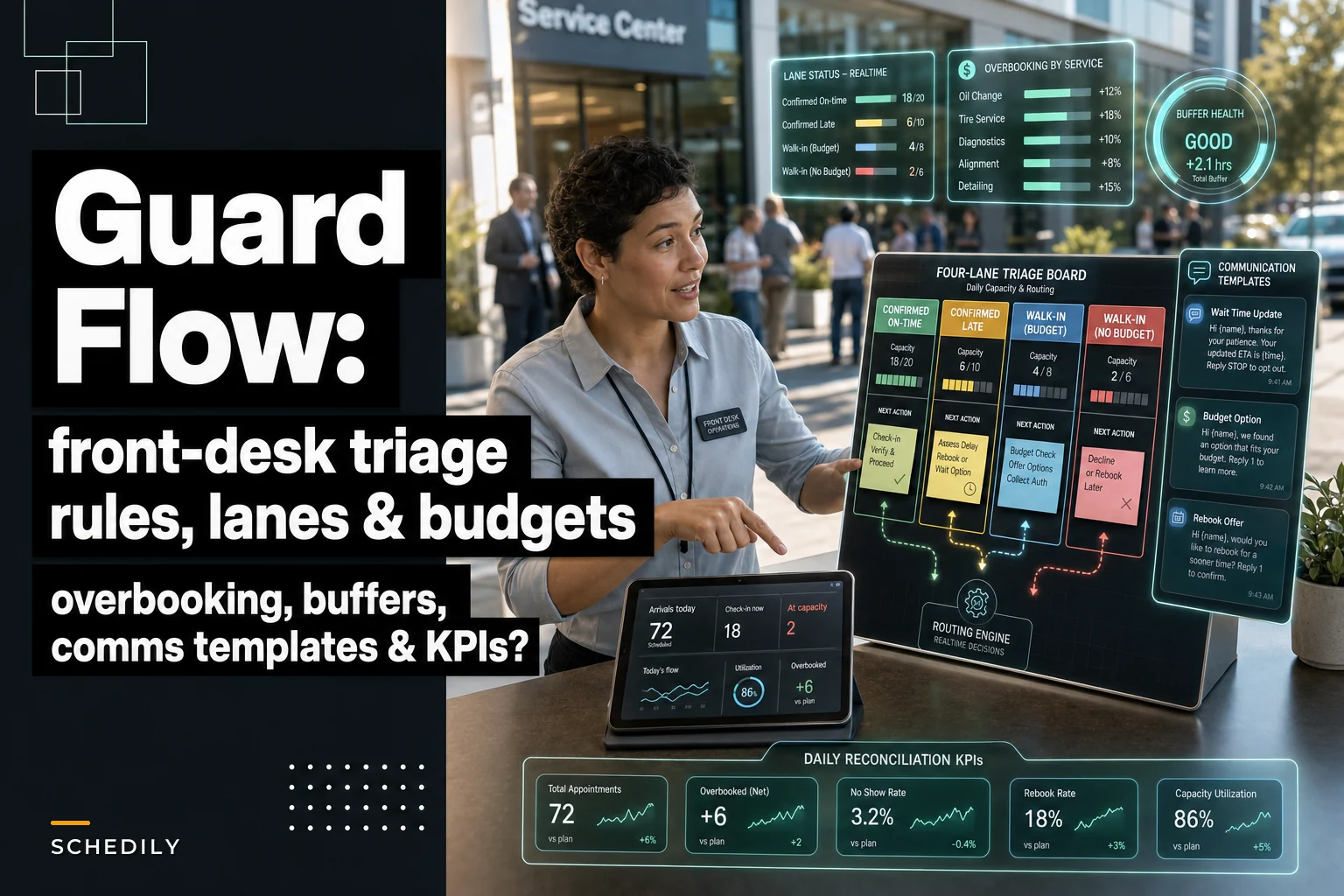
This is the operational heart of it. When demand hits, the front desk shouldn't be improvising priority. They should be sorting arrivals into pre-defined lanes, each with a rule about what capacity it's allowed to touch.
Four lanes cover almost every appointment-driven operation:
-
Confirmed on-time — booked, arrived within their window. Untouchable. Draws from their reserved slot, full SLA protection. Nothing bumps them.
-
Confirmed late — booked, but arrived outside their grace window. Gets served if buffer allows, otherwise gets rebooked or offered the next open slot. They keep priority over walk-ins but lose their original slot's protection.
-
Walk-in, budget available — no appointment, but the requested service still has overbooking budget in this window. Accommodated, told a realistic wait, slotted without touching confirmed capacity.
-
Walk-in, no budget — no appointment, service is at capacity. Offered a later slot, a callback, or an honest "earliest we can do is 4:15." Not squeezed in.
Here's a simple visual of the triage lanes and how capacity flows between them.
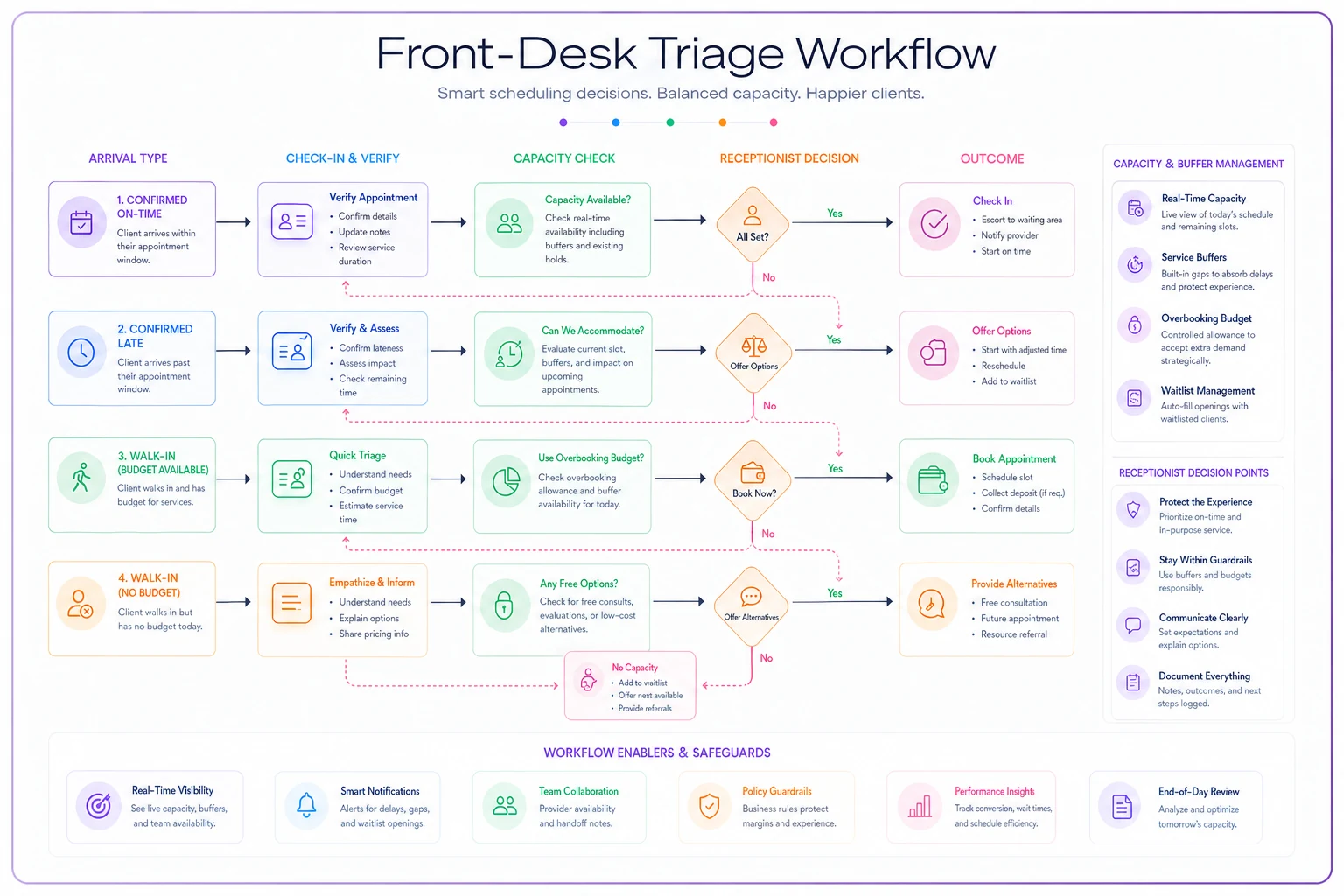
The whole value of naming these lanes is that it removes the argument. The receptionist isn't deciding on the spot whether the friendly regular walk-in outranks the quiet confirmed client who booked a week ago. The lane already decided. That consistency is what actually protects throughput, because throughput dies from a hundred small "just this once" exceptions, not from one big call.
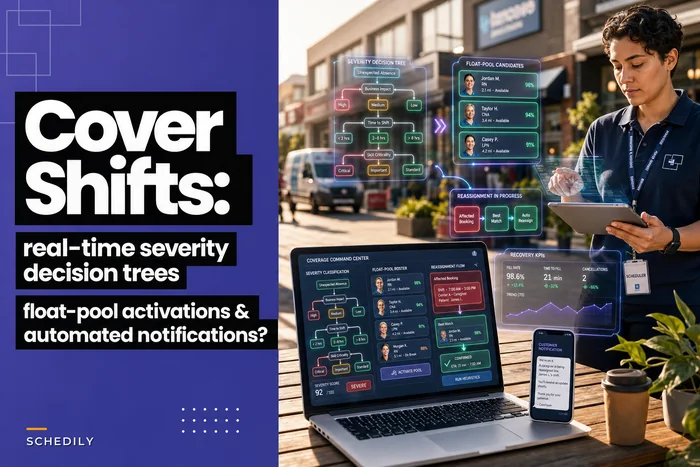
There's a real parallel here with how good operations handle sudden staff gaps — the logic of pre-defining who gets served and how you communicate it is the same muscle we covered in real-time shift triage for unexpected absenteeism.
Customer communication templates that fire before frustration
The single biggest driver of walk-in and overbooking blowups isn't the wait itself. It's the silent wait. A client who's told "you're looking at about 25 minutes, want to grab a coffee?" is fine. A client who's ignored for 25 minutes with no update is filing a complaint.
Communication has to be templated and triggered by the lane, so the front desk isn't inventing what to say under pressure. A few that actually matter:
-
Walk-in accepted with wait "We can fit you in — you're looking at roughly a 20–30 minute wait for [service]. Want me to text you when we're ready so you're not stuck here?"
-
Walk-in deferred, no budget "We're fully booked for [service] right now, but I can get you in at 4:15, or take your number and call the moment something opens. Which works better?"
-
Confirmed client running behind (proactive) "Quick heads up — we're running about 15 minutes behind. You're still next up. Thanks for your patience."
-
Confirmed late arrival "No problem that you're a few minutes late — we're just checking if we can still fit the full service in your window, or if the next open slot works better. Give me one second."
Worth internalizing: proactive messages to confirmed clients matter more than reactive ones to walk-ins. The confirmed client is the one whose SLA you promised. Telling them you're 15 minutes behind before they notice preserves the relationship. Waiting for them to get annoyed and then apologizing does not.
Daily reconciliation KPIs
None of this works if you can't see whether it worked. Reconciliation is a short end-of-day check — 10 minutes — that answers whether your triage protected throughput or quietly failed.
Track a small, honest set:
-
Confirmed on-time served within SLA (%) — the number that actually matters. If this drops, everything else is noise.
-
Buffer consumed vs. budgeted — did you burn through shock absorption early? By what and when?
-
Walk-ins accepted vs. deferred — and how many accepted walk-ins pushed a confirmed client past their window (this should be near zero — if it's not, your lanes are leaking).
-
Overbooking budget breaches by service — where did the front desk exceed the written budget, and why?
-
Average confirmed wait time by peak block — the leading indicator of drift before it becomes a complaint.
The mistake here is tracking walk-in volume as a vanity metric ("we served 40 walk-ins!") while ignoring what it cost your confirmed clients. A day where you served a ton of walk-ins but breached confirmed SLA six times is a bad day dressed up as a busy one.
A short real scenario
A three-provider clinic doing roughly 320–360 confirmed appointments a month kept getting the same complaint: confirmed patients waiting 30–45 minutes past their scheduled time on Saturdays. The front desk was accepting every walk-in because turning people away "felt bad," and there were no written limits anywhere.
They put in overbooking budgets by service — zero for the long specialist visits, small budgets for quick ones — reserved one buffer slot per provider in the Saturday peak block, and named the four triage lanes. No new staff. No new software.
Within about six weeks, confirmed on-time-within-SLA on Saturdays climbed from somewhere in the low 70s to the low-to-mid 90s percent. Walk-in volume actually dropped slightly — they deferred more — but revenue held steady because most deferred walk-ins took the offered later slot instead of leaving. The complaints about waiting basically stopped.
The change wasn't heroics. It was refusing to spend protected capacity on unprotected demand.
When this makes sense — and when it doesn't
This system earns its keep when you have meaningful walk-in demand colliding with a confirmed book, and when your confirmed clients carry a real service expectation. Salons, clinics, urgent-care-style operations, service bays — anywhere "I have an appointment" is supposed to mean something.
When it's overkill: pure appointment-only operations with negligible walk-in traffic. If you turn away walk-ins as a rule anyway, you don't need overbooking budgets — you need a solid no-show policy, which is a different problem entirely.
Who should be careful: very small single-provider operations. With one chair, the triage lanes collapse into "the person in front of me or the one who booked," and heavy formalization can feel like bureaucracy for a two-person team. Even then, though, writing down a simple grace window and a buffer rule prevents the worst days.
Where the tooling helps — quietly
The manual version of this is entirely doable on a whiteboard and a printed script sheet, and plenty of operations run it that way. Where an AI-assisted scheduling platform earns its place is in the parts humans are bad at doing consistently under pressure: watching overbooking budgets in real time, flagging when a walk-in would breach a service's limit, auto-sending the "we're running 15 behind" message to confirmed clients before anyone remembers to, and pulling the reconciliation numbers so the end-of-day check is a glance instead of a spreadsheet exercise.
The system is the value. Software just keeps you honest about following it on the days you're too slammed to think clearly.
The real takeaway
Protecting throughput isn't about serving fewer walk-ins or being rigid with customers. It's about deciding — in advance, in numbers — how much of your confirmed-client capacity you're willing to spend on demand that never made you a promise.
Do that, and the busy days stop being the days your best clients get punished for booking ahead. The front desk stops guessing. And the schedule stops quietly falling apart at 3pm every Saturday.
Ready to optimize your scheduling and operations?
Join thousands of businesses using Schedily to save time, improve coordination, and enhance operational efficiency.