
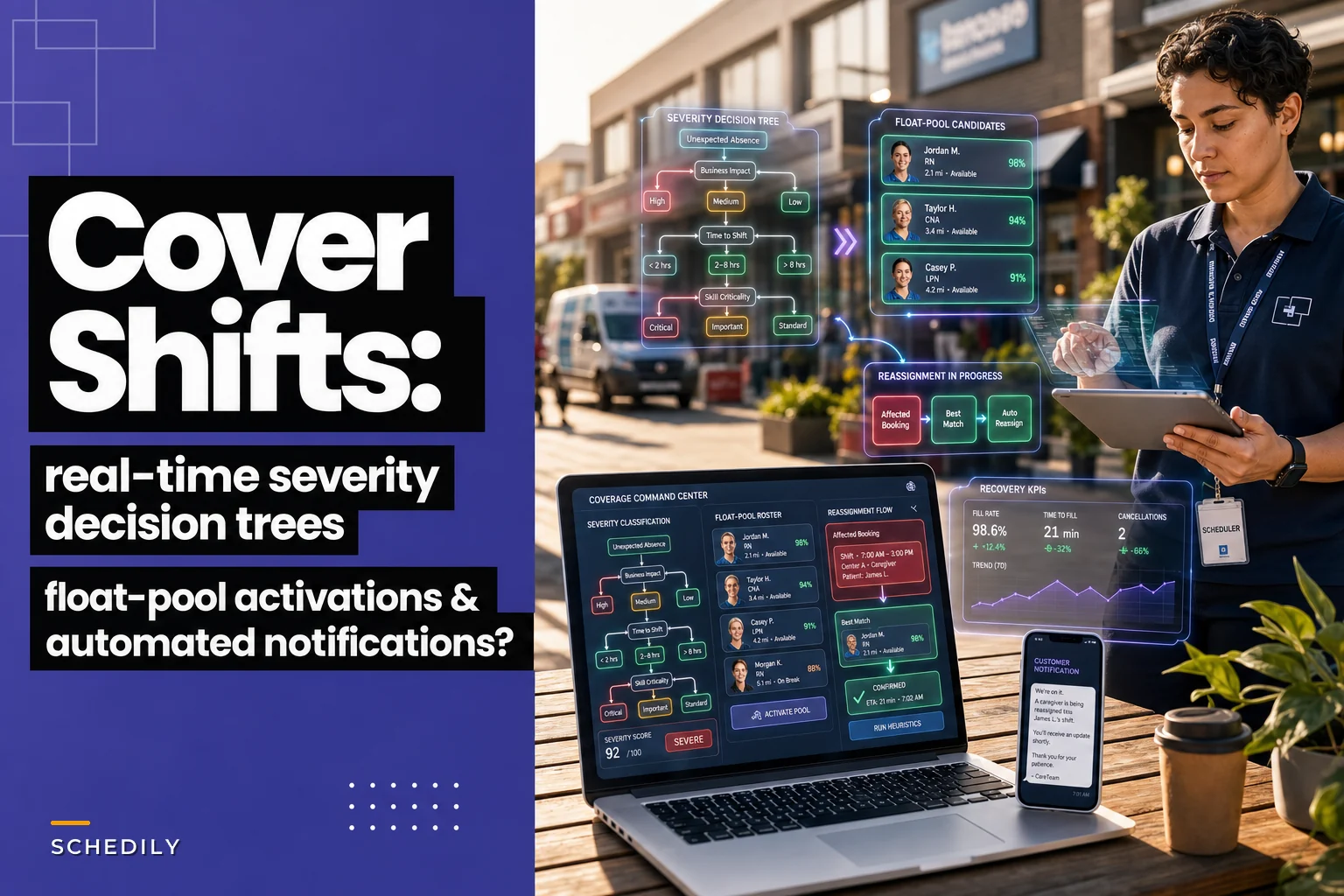

The worst part about an unexpected callout isn't the empty slot. It's the scramble. Somebody texts "can't make it, food poisoning" at 6:52am, and now a shift lead who's supposed to be prepping the floor is instead standing in the break room calling six people who aren't picking up. Meanwhile the appointments that person was assigned to are still on the books, customers are already driving in, and nobody's told them anything.
That gap — between the callout and the moment work actually gets reassigned — is where most of the damage happens. Not in the absence itself. In the disorganized response to it.
This post is about building a real-time shift triage system for absenteeism: a runbook that tells whoever's on duty exactly how to classify the severity, when to pull from a float pool, how to reassign work without creating a second mess, and how to tell customers something before they show up and find out the hard way. I'll keep it practical and multi-site, because single-location advice falls apart the second you're coordinating across three or four places.
Why "just call around" fails every single time
Ad-hoc coverage feels fine until you actually look at what happens under it. A manager's response to a callout is shaped by whoever they happen to remember, who they feel comfortable asking, and how stressed they are at that exact moment. That's not a system. That's a mood.
A few patterns show up over and over when there's no runbook:
-
The same two reliable people get called first every time, burn out, and eventually start declining or quitting.
-
Nobody classifies the absence, so a minor gap (one part-timer, slow morning) gets the same panicked response as a critical one (the only certified person on shift).
-
Reassignment happens verbally, so two staff members each think someone else is covering the 10am, and it gets dropped entirely.
-
Customers are the last to know. They show up, wait 20 minutes, and then someone realizes their provider isn't in.
The core problem is that absenteeism response gets treated as an emergency every time, when most of it should be routine. A good runbook turns 80% of callouts into a boring, repeatable procedure and reserves the actual scrambling for the genuinely hard cases.
Step one: a severity decision-tree, not a gut call
Before anyone touches the schedule, they need to classify the absence. Once it's written down, this takes about fifteen seconds — and it's the single highest-leverage thing you can add to your operation.
Eliminate scheduling conflicts and missed meetings.
Schedily helps you organize and manage all appointments and team availability effortlessly.
- Unified appointment and resource management
- Automated notifications & reminders
- Team calendar synchronization
No credit card required
Here's the logic most operations can adapt. Run through it top to bottom and stop at the first match:
-
Is the absent person the only one qualified/certified for a booked task in the next 4 hours? → Severity 1 (Critical). This is a service-blocking absence. Something on the books literally cannot happen without intervention.
-
Does the absence drop staffing below the minimum safe/legal operating level (ratios, licensing, safety)? → Severity 1.
-
Are there booked, revenue-generating appointments assigned to this person that can't be absorbed by remaining staff? → Severity 2 (High). Service can continue but customers are directly affected.
-
Is the person part of general floor capacity with no direct bookings, but the shift is at or near peak demand? → Severity 3 (Moderate). You'll feel it, but nobody's appointment breaks.
-
Slow period, redundant coverage, no direct bookings affected? → Severity 4 (Low). Log it and move on. No activation needed.
The mistake people make is skipping straight to "who can come in" without asking "do I even need someone." In a well-staffed operation, roughly a third of callouts are Severity 4 — you genuinely don't need to backfill. Treating those as emergencies is how you exhaust your float pool and burn through goodwill on absences that didn't actually matter.
A quick multi-site note on severity
Severity is local. A missing groomer at a two-groomer location is Severity 1. The same role at a six-groomer flagship might be Severity 3. Your decision-tree should reference each site's minimum staffing and certification map, not a company-wide number. This works best when you set the rules centrally but let each location's actual staffing drive the classification — a balance I've written about more fully in central policy with local autonomy for multi-location resource allocation.
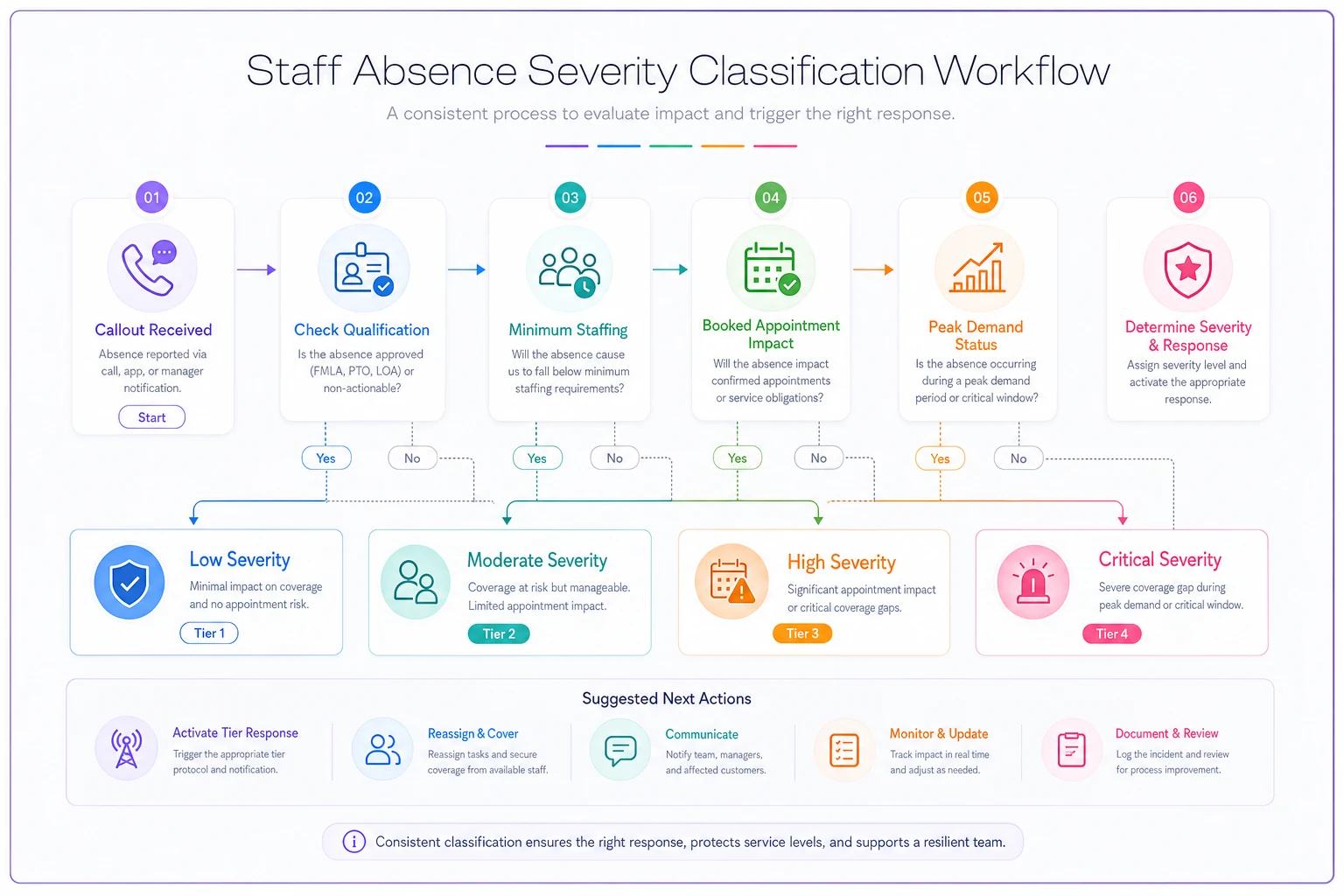
A simple diagram like this helps new shift leads run the tree fast.
Float-pool activation rules: who gets called, in what order, and why
A float pool only works if the activation rules are explicit. Otherwise you're back to "who does the manager remember." Build a tiered call list per site, and — critically — define the order logic, not just the names.
Here's a workable tiering model:
| Tier | Who's in it | When to activate | Typical response time |
|---|---|---|---|
| Tier 0 | On-shift staff who can absorb the work | Severity 3–4, or as first attempt on Sev 2 | Immediate |
| Tier 1 | Dedicated float/cross-trained staff scheduled nearby | Severity 1–2 | 20–45 min |
| Tier 2 | Off-shift staff willing to be called in (opt-in list) | Severity 1, or Sev 2 if Tier 1 fails | 45–90 min |
| Tier 3 | Cross-site borrow (staff from another location) | Severity 1 only, when Tiers 0–2 exhausted | 60+ min + travel |
A few rules that keep this fair and functional:
-
Rotate the Tier 2 call order. If you always call the same person first, they either burn out or start ignoring the phone. A simple round-robin — last person called goes to the bottom — fixes this. It's worth tracking.
-
Log every offer and response, not just the accepts. You need to know who's declining consistently and who's carrying the load, because that data should change your future scheduling.
-
Cap cross-site borrowing. Pulling someone from Site B to cover Site A can quietly turn one Severity 1 into two. Only allow it when Site B is confirmed above its own minimum for the borrowed window.
-
Respect certification at every tier. A warm body who can't legally or competently do the booked task isn't coverage. Your call list should be filtered by qualification for the specific gap, not just general availability.
Rotate Tier 2 on a strict round-robin and log last-called timestamps so the order can be automated and audited.
The cross-site rule is the one people ignore and regret. What shows up repeatedly across multi-location operations is a well-meaning manager borrowing staff to save a morning, only to trigger a callout-style shortage at the donor site by lunch. The borrow has to be gated by the donor site's own severity check — no exceptions.
Automated reassignment: don't do this in your head
Once you know you need coverage and who's coming, the appointments still have to actually move to the right person. This is where verbal handoffs die.
A reassignment heuristic doesn't need to be fancy. It needs to be consistent. A reasonable priority order for redistributing an absent person's booked work:
-
Match by qualification first. Never assign a task to someone who can't complete it, even as a temporary patch.
-
Prefer the least-loaded qualified person for that time block, to avoid cascading delays.
-
Preserve continuity where it matters. For repeat customers or in-progress multi-visit work, keep them with someone who knows the history if at all possible.
-
Protect buffers. Don't stack a reassigned appointment onto someone who's already back-to-back — you'll just create the next gap.
-
Flag anything that can't be reassigned for proactive customer contact. Reschedule, don't silently delay.
The heuristic matters more than the tooling, but this is one place where letting software handle the mechanical matching actually saves something real — specifically, the shift lead's attention. When a callout hits, an operational platform with automated reassignment can surface which qualified staff have open capacity and re-slot affected appointments in seconds, instead of a manager rebuilding the whole board on a sticky note. The point isn't to remove judgment; it's to remove the manual lookup so the person on the floor can spend their time on the human parts.
Customer notifications: the part that saves your reputation
Reassignment fixes your operations. Notifications fix your relationships. This is the step that gets dropped the most, because by the time coverage is sorted, everyone's exhausted and the customer piece feels optional. It isn't.
The rule is simple: a customer should never discover a staffing problem by experiencing it. If their appointment is delayed, moved, or reassigned to a different provider, they hear it from you first — ideally before they leave the house.
Keep a small set of pre-written templates so nobody's composing an apology under pressure. A few that cover most cases:
Same provider, short delay (Severity 3): > "Hi [Name] — quick heads up, we're running about [15–20] minutes behind for your [time] appointment today due to staffing. Your provider is still [Name]. Reply here if that timing no longer works and we'll sort it out."
Reassigned to a different provider (Severity 2): > "Hi [Name] — one of our team is out sick today, so your [time] appointment will be with [New Provider], who's fully up to speed on your visit. Everything's still on for [time]. Let us know if you'd prefer to reschedule instead."
Can't cover — proactive reschedule (Severity 1): > "Hi [Name] — unfortunately we've had an unexpected absence and can't provide the quality we'd want for your [time] appointment today. We're really sorry. Here are the next available times: [options]. We'd also like to [small goodwill gesture] for the inconvenience."
Two things people consistently get wrong here. First, they over-explain — customers don't need the drama, they need the new plan. Second, they wait too long "in case it gets sorted." Send the notification the moment reassignment can't be confirmed, not after. A customer who gets 90 minutes' notice reschedules willingly. A customer who's already in the parking lot files a complaint.
Measuring whether any of this works: recovery-rate KPIs
If you can't measure your triage, you can't tell whether the runbook is helping or whether you just got lucky with a calm month. Track a small, honest set of metrics:
-
Coverage recovery rate — % of Severity 1–2 absences where booked work was successfully covered or proactively rescheduled without a customer no-notice failure. This is your headline number.
-
Time-to-classification — from callout received to severity assigned. Target: under a couple of minutes.
-
Time-to-coverage — from classification to confirmed reassignment. Watch the trend over time, not the absolute number on any given day.
-
Proactive notification rate — % of affected customers contacted before their scheduled time. This should approach 100% for anything customer-facing.
-
Float-pool load distribution — how evenly call-ins are spread across your Tier 2 list. Lumpy distribution predicts burnout before it happens.
-
Cross-site borrow incidents — track these separately. A rising number means your base staffing at some site is too thin, and no runbook fixes chronic understaffing.
That last point deserves emphasis. Triage KPIs will tell you when your problem stopped being "how we respond to absences" and became "we don't have enough people." When recovery rate holds steady but you're leaning on Tier 2 and cross-site borrows every week, the real fix is upstream — in how you plan headcount against demand. If that pattern's showing up, it's worth building proper seasonal headcount plans from your appointment history rather than treating every busy stretch as a recurring emergency.
A real scenario: a three-site pet grooming group
One grooming operation running three locations had a recurring Monday problem. Callouts clustered at the start of the week, and their response was pure improvisation — the owner would get a text, start calling people, and often not reach affected customers until they'd already arrived.
Before the runbook: on a typical bad Monday, roughly 8–10 booked grooms were affected across the sites. About half got covered, a couple got silently delayed until the customer complained, and 3–4 were straight cancellations with no proactive notice. They were losing somewhere in the $600–$900 range in a single morning, plus a steady drip of one-star reviews mentioning "showed up and they weren't ready for me."
They didn't add staff. They added structure: a written severity tree posted at each front desk, a tiered call list with a rotating Tier 2, a hard rule that cross-site borrows required the donor site to confirm it was above minimum, and three saved notification templates on the front-desk phones. Reassignment matching got handled through their scheduling platform so the lead could see qualified open slots instantly instead of rebuilding the board by hand.
Within about two months, their recovery rate on affected grooms went from roughly half to the high 80s, proactive notifications went from "sometimes" to nearly every affected customer, and the "wasn't ready for me" reviews basically stopped. The absences didn't decrease — Mondays were still Mondays. The response just stopped being chaos.
When a formal triage runbook is worth it — and when it isn't
This level of structure isn't free. It takes effort to build and discipline to maintain, so it's worth being honest about fit.
When it makes sense:
-
You run more than one location, or one location with enough staff that "who's qualified and free" isn't obvious at a glance.
-
Your work is appointment-driven, so a gap directly hits booked customers.
-
Certifications or minimum-staffing rules make some absences genuinely blocking.
When it's overkill:
-
A single small team where everyone can do everyone's job and the owner already knows instantly who to call. A one-page call list is enough.
-
Walk-in-only operations with no booked appointments to protect — the customer-notification half of the system doesn't really apply.
Who should NOT build this yet: if your real issue is chronic understaffing — you're short every single week, not occasionally — a triage runbook will just help you manage a fire that shouldn't be burning. Fix the base schedule first. Triage is for the unexpected absence, not the structural one.
Where to start this week
You don't need to build the whole thing at once. The highest-value pieces, in order: write the severity tree first (it changes behavior immediately and costs nothing), then build the tiered call list with rotation, then draft the three notification templates.
Reassignment automation and KPI tracking come after you've got the human procedure working, because automating a broken process just breaks it faster.
Unexpected absenteeism is never going away. People get sick, cars break down, kids have emergencies. What you're actually building isn't a way to prevent callouts — it's a way to make your response boring. A boring, predictable response to a callout is the whole goal. When the 6:52am text arrives and nobody panics, you've won.
Ready to optimize your scheduling and operations?
Join thousands of businesses using Schedily to save time, improve coordination, and enhance operational efficiency.