

Medical imaging centers know this pain well. A patient needs an MRI with contrast, which requires three sequential steps: pre-screening bloodwork, the scan itself, and a radiologist review. Book the MRI before confirming the bloodwork? The whole sequence breaks. Lock the MRI slot too early? You're holding revenue hostage while waiting on lab results. Release it too soon? Another patient grabs it and your original sequence collapses.
This is sequenced appointment scheduling — services that require multiple dependent steps, each with their own resources, timing constraints, and failure points. Having built scheduling systems for businesses ranging from automotive service chains to medical clinics, the pattern is consistent: most businesses handle these sequences manually, and that creates bottlenecks that compound fast.
The hidden complexity of dependent bookings
A transmission rebuild at an auto shop seems straightforward until you actually map the dependencies. First, a diagnostic appointment — senior tech, lift, an hour. Then parts ordering, which can't happen until the diagnosis confirms the issue. The rebuild itself needs that same lift for most of a day plus a specialized transmission tech. Then a test drive and customer pickup.
Every step depends on the one before it completing successfully. Miss a single dependency and you end up with partial work sitting on lifts, techs waiting around, and customers calling about delays.
The challenge compounds when you realize each step pulls different resources. The diagnostic needs Tech A and Lift 2 for an hour. The rebuild needs Tech B and the same lift for six to eight hours. If Tech B isn't available when the parts arrive, Lift 2 just sits there — occupied but completely unproductive. Multiply that across 15 to 20 vehicles in various stages of completion and you understand why shops struggle with throughput.
Healthcare is even more complex. A surgical procedure might require a pre-op consultation with a surgeon and exam room, lab work with a phlebotomist and equipment, an anesthesia evaluation in a separate room, the surgery itself with a full OR team, post-op recovery, and a follow-up appointment. Each step has different lead times, availability windows, and failure conditions. The lab work might need 48-hour processing. The anesthesiologist might only do evaluations on Tuesdays. The OR might require specific equipment shared across multiple procedures.
Why traditional scheduling breaks with dependencies
Standard appointment booking assumes independence — each appointment stands alone. Sequenced services create a web of constraints that basic scheduling simply wasn't built to handle.
Eliminate scheduling conflicts and missed meetings.
Schedily helps you organize and manage all appointments and team availability effortlessly.
- Unified appointment and resource management
- Automated notifications & reminders
- Team calendar synchronization
No credit card required
Resource locking problems When do you lock resources for future steps? Lock too early and you're holding valuable capacity hostage. A dental practice books an extraction and crown placement two weeks apart, locking the chair and dentist for both. But if the extraction site doesn't heal properly, that crown slot becomes dead time.
Lock too late and someone else grabs it. The extraction heals perfectly, but the patient waits another three weeks because all crown appointments are gone.
Conditional progression Many sequences have decision points built in. A home renovation company schedules an inspection, and the follow-up entirely depends on what they find. Asbestos discovered? That needs remediation before anything else happens. Do you pre-book the renovation crew assuming it's clean? Or hold them in reserve and eat the potential revenue loss?
Most service businesses handle this with elaborate spreadsheets and manual coordination. One HVAC company was running a 47-column spreadsheet to track installation sequences, with a coordinator spending six hours a day just managing dependencies. That's not a workflow problem — that's a structural one.
Partial completion scenarios Real operations get messy. A patient finishes pre-op labs but backs out before surgery. A car owner approves the diagnosis but balks at the repair estimate. A home inspection turns up foundation issues that halt everything.
Now you have partially completed sequences consuming administrative overhead with no clear path forward. That patient might return in three months. Do their old labs still count? Is the original surgical slot pattern still valid? The car owner comes back two weeks later, ready to proceed — but now needs re-diagnosis because the car sat outside the whole time.
Without clear partial-completion policies, staff make inconsistent calls that create operational chaos and frustrate customers.
Building dependency models that actually work
Effective sequenced appointment scheduling starts with explicit dependency mapping. Not the flowchart laminated on the wall that nobody actually follows — operational rules that drive real scheduling decisions.
Define hard vs soft dependencies Hard dependencies must complete before the next step can begin. The bloodwork must clear before the MRI with contrast. Parts must arrive before the rebuild starts.
Soft dependencies are preferred but not mandatory. It's better if the same tech handles both the diagnosis and repair, but it's not required. The post-op follow-up should happen within two weeks but can flex if needed.
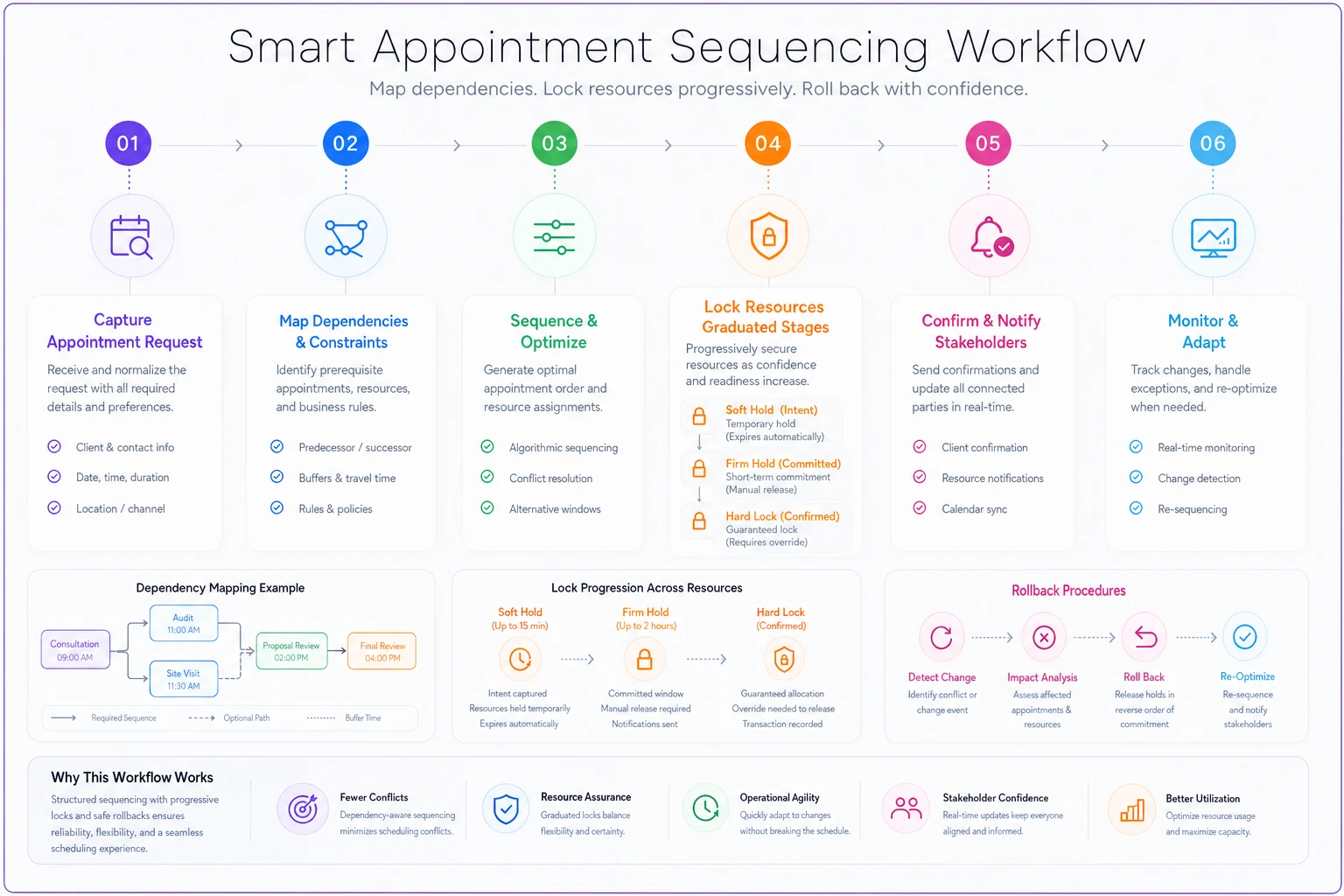
Implement graduated resource locking Instead of binary locked/unlocked states, use graduated holds that reflect where you actually are in the sequence:
| Sequence Stage | Lock Type | Release Trigger |
|---|---|---|
| Initial booking | Soft hold | 24 hours without confirmation |
| Dependency confirmed | Firm hold | Previous step completes |
| In-progress | Hard lock | Step completes or fails |
| Awaiting results | Conditional hold | Results received or timeout |
A veterinary hospital might soft-hold surgery slots when scheduling pre-op bloodwork, convert to firm holds when blood results come back normal, and hard-lock once the pet is admitted.
Use timeboxed soft holds (e.g., 24–48 hours) to avoid long-term capacity loss while giving customers a reasonable confirmation window.
This diagram shows the typical flow across dependencies, locking stages, and rollback points.
Create explicit rollback procedures When sequences fail mid-stream, clear rollback procedures prevent resource waste. An orthodontic practice installing braces might define it this way:
-
If consultation no-shows → release all downstream appointments, send rescheduling sequence
-
If impressions fail → keep appliance fabrication slot but push back one week, notify lab
-
If patient rejects treatment plan → immediate release of all holds, transfer to follow-up campaign
-
If partial payment received → maintain holds for 72 hours, then graduated release
These aren't just policies — they're operational rules that anyone (or any system) can execute consistently without having to think through it fresh each time.
Handling conditional confirmations and decision points
Many sequenced services have branches that traditional scheduling can't handle. A roofing company schedules an inspection, but the follow-up depends entirely on what they find. Minor wear? Schedule a half-day crew. Full replacement? That's three days, permits, and material delivery coordination.
Decision table approach Rather than handling every possibility on the fly, decision tables map findings to scheduling actions:
-
Minimal wear → Book 2-hour repair within 2 weeks
-
1-3 damaged sections → Book half-day repair + materials
-
>3 sections or structural → Create replacement sequence
- Permit filing - Material ordering - 3-day crew block - Inspector follow-up
-
Water damage found → Add internal inspection before proceeding
This gives schedulers (or automated systems) clear paths without requiring complex judgment calls in the moment.
Probability-based pre-booking Some businesses use probability-based pre-booking for common sequences. An oral surgeon knows that roughly 70% of wisdom tooth consultations lead to extraction scheduling. They might pre-hold extraction slots for high-probability consultations, releasing those holds if not confirmed within 48 hours.
The key is actually tracking conversion rates by sequence type. An auto glass shop found their windshield inspection-to-replacement conversion was 85% for insurance claims but only 35% for self-pay. They adjusted their pre-booking strategy accordingly and stopped over-holding slots for self-pay appointments.
Managing partial completions and reconciliation
Partial completions are where sequenced scheduling gets expensive. A landscaping company starts a three-phase project: design, hardscaping, and planting. The customer approves the design, proceeds with hardscaping, then delays planting indefinitely because of budget issues.
Now there's an open loop in the system. The project manager keeps following up. The incomplete sequence clutters reports. The original planting window passes and seasonal conditions change entirely.
Partial completion policies
-
Expiration timelines
Phase 2 must start within 30 days of Phase 1 completion or the sequence closes
-
Reactivation requirements
Returning after expiration requires a new assessment or consultation
-
Partial completion fees
Uncompleted sequences trigger administrative or holding fees
-
Sequence closure criteria
After a defined number of days or contact attempts, formally close and archive
A medical aesthetics clinic might state clearly: "Laser treatment sequences not completed within 6 weeks require new consultation due to potential skin changes." Sets expectations, prevents outdated treatment plans from moving forward.
Reconciliation workflows When sequences break, reconciliation workflows prevent loose ends from piling up:
-
Identify sequences with missed milestones
-
For each broken sequence
- Under 48 hours old → Attempt immediate recovery - 48 hours to 1 week → Send reengagement sequence - Over 1 week → Evaluate for formal closure
-
Release any holds on future resources
-
Update customer record with sequence status
-
Trigger any partial completion fees
Running this check daily keeps broken sequences from silently holding resources or creating confusion for customers weeks down the line.
Resource locking across multiple steps
Managing resource locks across extended timeframes is the hardest part of sequenced appointment scheduling. Lock everything upfront and you create massive inefficiency. Lock nothing and sequences constantly break when they shouldn't have to.
Progressive locking strategies
-
Stage 1
Tentative capacity block (visible but overbookable)
-
Stage 2
Soft lock (requires override to book over)
-
Stage 3
Hard lock (cannot be moved without breaking sequence)
A physical therapy clinic running post-surgical rehab programs might tentatively block recurring slots when surgery is scheduled, soft-lock when surgery completes successfully, and hard-lock 24 hours before each individual appointment.
Cross-resource coordination Complex sequences often need completely different resources at each step. Multi-resource scheduling systems become critical when you're coordinating people, equipment, and spaces across multiple appointments.
-
Initial consultation
Cardiologist + Exam Room A (30 min)
-
Stress test
Technician + Treadmill Room + EKG Machine (90 min)
-
Imaging
Technician + Nuclear Camera + Injection Room (2 hours)
-
Results review
Cardiologist + Exam Room B (20 min)
Each step needs different resource combinations, and nuclear imaging requires radioactive tracer with a short shelf life. The scheduling system has to understand those dependencies to prevent booking conflicts that waste expensive materials and staff time.
Template-based orchestration patterns
Rather than recreating sequences from scratch each time, operational consistency comes from templates that encode proven patterns.
Service package templates
"Complete Brake Service" Template: ├── Step 1: Inspection (Tech Level 2+, Lift, 30 min) │ └── Decision point: Proceed with repair? ├── Step 2: Parts ordering (Automatic, 2-3 day lead) ├── Step 3: Brake replacement (Tech Level 2+, Lift, 2 hours) ├── Step 4: Test drive (Any Tech, 15 min) └── Step 5: Customer pickup (Service Advisor, 15 min) Dependencies: Step 3 requires Step 2 complete Rollback: If Step 1 = no repair, cancel all downstream
Staff don't need to remember every dependency — the template enforces them. This accelerates booking and reduces the risk of someone skipping a step.
Conditional branch patterns
"Kitchen Remodel" Base Template: ├── Initial consultation ├── Design phase ├── [BRANCH POINT: Permits required?] │ ├── Yes: Add permit sequence (2-6 weeks) │ └── No: Skip to demolition ├── Demolition ├── Infrastructure (plumbing/electrical) ├── Installation └── Final inspection Each branch maintains its own resource requirements and timelines
For services with common variations, branching templates handle the complexity.
Operational software that handles the complexity
This is where properly designed operational software makes a real difference. Manually tracking sequences, dependencies, and resource locks across dozens of active projects becomes unmanageable at scale — not because people aren't trying, but because the cognitive overhead is genuinely too high.
Scheduling platforms with AI automation can maintain these dependency models while adapting to real-world disruptions. When a sequence breaks, the system flags affected downstream appointments and surfaces recovery options based on current resource availability and your business rules — rather than waiting for a coordinator to notice the problem two days later.
The automation handles the monitoring work: tracking sequence progress, triggering notifications at decision points, managing graduated resource locks, and running reconciliation workflows. Staff can focus on exceptions and customer relationships instead of spreadsheet maintenance.
Better platforms also learn from patterns over time — identifying which sequences commonly fail at specific steps, which conditional branches come up most often, and which resource combinations create recurring bottlenecks. That kind of operational visibility is hard to build manually. For businesses running complex multi-step services, the question is whether to keep absorbing manual coordination overhead or invest in proper scheduling orchestration.
The real cost of poor sequence management
A home services company running bathroom remodels tracked their sequence failures over three months. Without formal dependency management:
-
About 23% of projects had at least one scheduling break requiring manual intervention
-
Coordinators spent roughly three hours per project just managing dependencies
-
Resource utilization dropped to around 60% because broken sequences were holding resources that couldn't be reassigned
-
Customer satisfaction reflected the chaos — multiple reschedules, delays, and calls that shouldn't have been necessary
After implementing formal sequence management with clear dependency models and automated orchestration, scheduling breaks dropped below 8%, coordinator time per project fell to around 45 minutes, and resource utilization climbed above 75%.
The financial improvement came from completing more projects with the same resources and cutting administrative overhead — not from raising prices.
Moving from reactive to proactive sequence management
Most businesses manage sequenced appointments reactively — scrambling when dependencies break, manually coordinating resources, and hoping things complete on time. That creates real stress for staff, real frustration for customers, and real money left on the table.
Proactive sequence management means defining dependencies explicitly before things go wrong, setting clear policies for partial completions and failures, and using tools that can handle multi-step orchestration without constant manual intervention.
Start by documenting your most common sequences. Map the dependencies. Identify the decision points. Define your rollback procedures. Then build from there as you learn what works for your specific operation.
The businesses that get this right gain a genuine operational advantage — they complete more complex services successfully, waste less resource capacity, and deliver a more consistent customer experience. In markets where everyone offers roughly the same services, that kind of execution starts to matter a lot.
The complexity is real, but it's manageable with the right models in place. Whether you're running a medical practice with complex treatment protocols or an auto shop handling multi-day repairs, treating sequenced appointments as the distinct operational challenge they are — rather than forcing them into a simple scheduling paradigm — is what separates businesses that scale smoothly from ones that stay stuck in coordination chaos.
Ready to optimize your scheduling and operations?
Join thousands of businesses using Schedily to save time, improve coordination, and enhance operational efficiency.