


Most scheduling problems that reach a customer — the double-booked room, the "we never got your cancellation," the technician who shows up when the job was moved three days ago — aren't really scheduling problems. They're data problems wearing a scheduling costume.
The booking happened correctly somewhere. The event fired. But by the time it moved through your booking widget, your payment processor, your calendar sync, your SMS provider, and finally landed in whatever dashboard the front desk is staring at, the meaning had drifted. Three systems now disagree about the same appointment, and nobody knows which one to believe.
This is what a scheduling data strategy is actually for. Not analytics. Not pretty charts. It's about making sure every system, team, and person in your operation agrees on what an appointment is, what state it's in, and who's responsible when those two things fall out of sync. Below is the full playbook — ingestion, canonical schema, versioning, ownership, and data-quality SLOs — with contract samples, reconciliation queries, and runbook templates that make it real instead of theoretical.
Why booking data drifts in the first place
The pattern is almost always the same: a business grows past a single source of truth and nobody notices the exact moment it happened.
At the start, everything lived in one calendar tool. The appointment record was the truth. Then came online booking. Then a payment system that needed to track deposits. Then a reminder service. Then a reporting layer because the owner wanted utilization numbers by location. Each addition seemed reasonable. Each one quietly created a new copy of "the appointment" with its own idea of what mattered.
The problem isn't having multiple systems — every real operation does. The problem is that none of them were designed to reconcile against a shared definition. So you end up with something like this:
-
The booking tool says the appointment is
confirmed -
The payment system says
deposit_pendingbecause the card auth is still processing -
The calendar shows it as
tentativebecause the sync ran before confirmation -
The SMS log shows a reminder was sent — for the old time slot
Every one of those systems is technically working. They're just answering different questions with the same word. When a customer calls asking why they got a reminder for the wrong time, your front desk has four screens open and no way to know which one to trust.
A real scheduling data strategy fixes this by deciding — on purpose — which system is authoritative for which field, then building the plumbing to keep everyone else honest.
The five layers that actually matter
Think of it as five layers stacked on top of each other. Skip one and the layers above it inherit the mess.
Eliminate scheduling conflicts and missed meetings.
Schedily helps you organize and manage all appointments and team availability effortlessly.
- Unified appointment and resource management
- Automated notifications & reminders
- Team calendar synchronization
No credit card required
The table below summarizes the layers, what they answer, and what breaks without them.
| Layer | What it answers | What breaks without it |
|---|---|---|
| Ingest | How do events get in, and in what shape? | Silent data loss, duplicate bookings, out-of-order updates |
| Canonical schema | What is an appointment, in one shared definition? | Every team invents its own version; reports never match |
| Schema versioning | How do we change the definition without breaking consumers? | One field rename takes down three downstream systems |
| Ownership / RACI | Who fixes it when it's wrong? | Everyone assumes someone else owns the reconciliation |
| Data-quality SLOs | How good is "good enough," and when do we page someone? | Problems get discovered by customers, not dashboards |
Most businesses have layer one and then skip straight to building dashboards on raw event streams. That's why the dashboards are always slightly wrong and nobody trusts them.
This diagram shows how the layers interact and flow from ingest to SLOs.
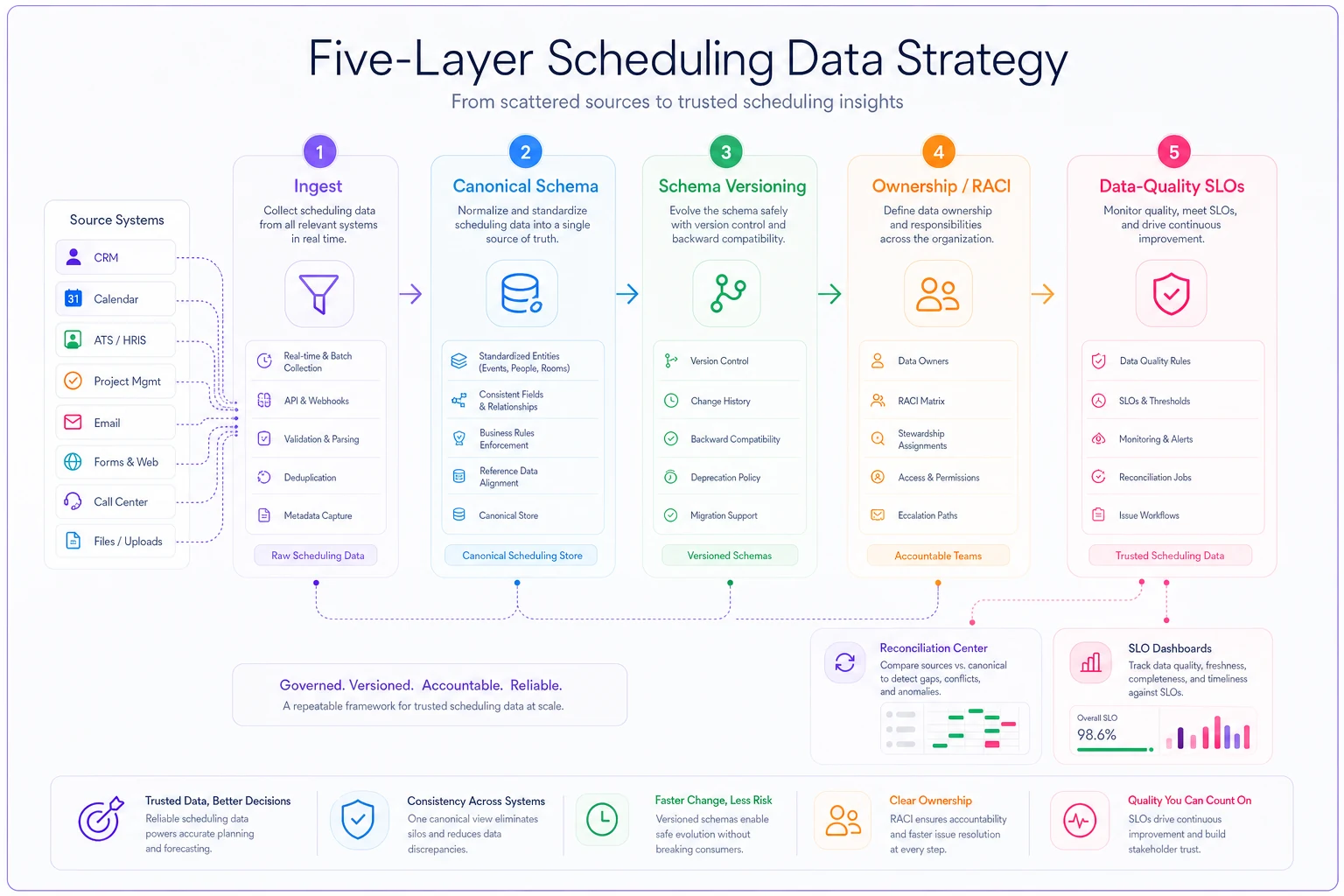
Skip one and the layers above it inherit the mess.
Layer 1: Ingest — treat every event like it might lie to you
The ingestion layer is where you decide the rules of entry. Its job is to take unreliable, out-of-order, sometimes-duplicated events from a dozen sources and turn them into a clean, ordered stream you can reason about.
The most common mistake here: teams trust the arrival order of events. They assume that if a booking.rescheduled event lands after a booking.confirmed event, the reschedule must have happened later. That's wrong more often than you'd expect. Network retries, webhook backoff, and provider outages routinely deliver events out of sequence. A reschedule that happened at 2:04 PM can arrive after a confirmation that happened at 2:06 PM.
-
A globally unique event ID (for deduplication)
-
The booking ID it refers to
-
An
occurred_attimestamp generated at the source, not at ingest time -
A monotonic sequence number or version counter per booking
-
The event type and a schema version tag
If you're building the event side of this, the idempotency and reconciliation-window patterns in Design resilient scheduling APIs and event contracts are the companion piece — this article assumes those contracts exist and focuses on what happens to the data after it's been safely received.
A booking event contract sample
{ "eventid": "evt9f2c14a7b3", "eventtype": "booking.rescheduled", "schemaversion": "2.3.0", "bookingid": "bk4471902", "sequence": 7, "occurredat": "2026-03-12T14:04:11.320Z", "receivedat": "2026-03-12T14:06:02.881Z", "sourcesystem": "onlinewidget", "payload": { "previousstart": "2026-03-15T09:00:00-05:00", "newstart": "2026-03-18T13:30:00-05:00", "resourceid": "roomB2", "changedby": "customer", "reasoncode": "customer_request" } }
Pro-tip: Persist the source's occurred_at and a per-booking monotonic sequence so reconciliation is deterministic even when events arrive out of order.
The sequence field is the quiet hero here. When two events for bk_4471902 arrive, you apply the one with the higher sequence number and discard the other — regardless of which arrived first. That single rule prevents a whole category of "the schedule went backwards in time" bugs.
The ingestion layer alone doesn't make your data trustworthy, but every layer above it depends on getting this right. Sloppy ingestion means every query downstream is working with a distorted picture.
Layer 2: The canonical schema — one definition to end the arguments
Once events are safely ingested, they need to collapse into a single canonical representation of each booking. This is the record everyone agrees to treat as truth. Not the widget's version, not the calendar's version — this one.
The hard part isn't the technical modeling. It's the negotiation. Building a canonical schema forces your teams to actually agree on definitions they've been quietly disagreeing about for years. Questions that sound trivial become forty-minute debates:
-
Is a "no-show" the same status as a "late cancellation"? Finance says no. Operations says who cares. Marketing wants both to trigger a recovery flow.
-
When a customer reschedules, is that a new booking or the same booking in a new slot? Your retention reports depend entirely on the answer.
-
Does "completed" mean the service finished, or that payment was collected?
There are no universally correct answers. What matters is that you pick one and write it down, because every ambiguous definition becomes a reconciliation failure later.
``
requested → confirmed → inprogress → completed
                ↓             ↓
           cancelled      noshow
                ↓
          rescheduled (points to successor booking_id)
``
The rescheduled-points-to-successor detail is one of those small decisions that saves a lot of pain. Instead of mutating a booking in place, a reschedule closes the original and links to its replacement. Your history stays intact, no-show rates stay accurate, and "how many times did this customer move their appointment" becomes a query instead of a mystery.
These definitions feel like bureaucratic overhead until the first time you run a no-show report and it's obviously wrong. Getting the schema right beforehand is much cheaper than correcting two years of misclassified data later.
Layer 3: Schema versioning — change the definition without breaking everyone
Your canonical schema will change. You'll add a field for hybrid appointments, split a status, or start tracking which staff member confirmed the booking. The question is whether those changes are controlled or chaotic.
The failure mode is brutal and common: someone renames a field or tightens a validation rule, and three downstream consumers that depended on the old shape silently break. The reporting layer starts dropping rows. The reminder service starts skipping a booking type. Nobody notices for a week because there's no error — the data just quietly gets wrong.
-
Additive changes are safe; destructive changes are events. Adding an optional field is fine. Removing a field, renaming one, or changing a status's meaning is a versioned, announced change with a migration window.
-
Consumers declare which version they read. That
schema_versiontag on every event isn't decoration. It lets you run two versions in parallel during a transition instead of forcing a big-bang cutover. -
Deprecation has a deadline and an owner. "We'll remove the old field eventually" means never. Put a date on it and assign a name to it.
The practical move is keeping a schema changelog that reads like a contract, not a git history. Each entry names the change, the version, the affected consumers, and the migration deadline. When someone asks why the utilization report changed in March, you have an answer instead of an investigation.
Layer 4: Ownership and RACI — the part everyone skips
You can have flawless ingestion, a clean canonical schema, and disciplined versioning, and still fail — because when the data goes wrong at 4 PM on a Friday, nobody knows whose job it is to fix it.
This is the least technical and most neglected layer. Data quality dies in the gap between "ops assumed the data team owned it" and "the data team assumed ops owned it." A clear RACI matrix closes that gap.
Here's a starting point you can adapt:
| Responsibility | Ops Lead | Data Team | Eng | Business Owner |
|---|---|---|---|---|
| Define canonical statuses | Consulted | Responsible | Consulted | Accountable |
| Maintain event contracts | Informed | Consulted | Responsible | Informed |
| Run daily reconciliation | Responsible | Accountable | Consulted | Informed |
| Approve schema changes | Consulted | Responsible | Consulted | Accountable |
| Respond to SLO breaches | Responsible | Consulted | Consulted | Informed |
| Fix root-cause data bugs | Informed | Consulted | Responsible | Informed |
The single most useful line in that table is "run daily reconciliation." Someone has to own the boring daily check that the systems still agree. When that ownership is fuzzy, reconciliation stops happening, and you're back to discovering problems through customer complaints.
Ownership conversations are uncomfortable. People don't want to sign up to be paged on a Friday. But ambiguity here is more expensive than the discomfort of the conversation.
Layer 5: Data-quality SLOs — decide what "good enough" means before it breaks
You can't hold a scheduling data pipeline to a vague standard like "it should be accurate." Accurate to what tolerance? Fresh within what window? Complete by when? SLOs turn those fuzzy hopes into numbers you can actually alert on.
-
Freshness — how long after an event occurs does the canonical record reflect it? (e.g., 95% of booking events reflected in the canonical store within 60 seconds.)
-
Completeness — what fraction of events make it through ingestion successfully? (e.g., fewer than 1 in 10,000 events dropped or stuck in dead-letter over a rolling week.)
-
Consistency — how often do source systems agree with the canonical record at reconciliation? (e.g., 99.9% agreement on booking status across the calendar and canonical store at daily reconciliation.)
The trap is setting these too tight and paging people constantly, or too loose and never catching anything real. Start looser than feels comfortable, watch where actual incidents cluster, and tighten toward the failures that hurt customers. If you already track operational performance, tie these SLOs into the same framework you use for the rest of your scheduling metrics — the approach in an operational KPI framework for appointment-driven businesses works well as the parent structure, with data-quality SLOs sitting underneath.
A simple SLO breach runbook template
-
Detect — daily reconciliation flags booking status mismatch above threshold.
-
Triage — is this a systemic pipeline failure or a handful of edge-case bookings? Check the dead-letter queue and recent schema-change log first.
-
Contain — if a source system is emitting bad data, pause its writes to canonical, not the whole pipeline.
-
Reconcile — run the correction query against the affected booking set and re-derive canonical state from event history.
-
Root-cause — was it a schema change, a provider outage, a sequence bug? Log it against the RACI owner.
-
Close — update the SLO dashboard and note whether the threshold itself needs adjusting.
For the customer-facing side of an incident — fallback booking flows while your pipeline recovers — the scheduling incident response runbook covers what the front desk should be doing while the data team reconciles behind the scenes.
The runbook only works if people have actually seen it before the incident. Print it, post it somewhere, run through it once on a slow day. A process nobody's practiced isn't a process.
Reconciliation in practice: the queries that catch drift
Reconciliation is where the whole strategy earns its keep. The idea is simple: regularly compare each source system against the canonical record and surface disagreements before a customer does.
SELECT c.bookingid, c.status AS canonicalstatus, cal.status AS calendarstatus, c.updatedat AS canonicalupdated, cal.syncedat AS calendarsynced FROM canonicalbookings c JOIN calendarbookings cal ON c.bookingid = cal.bookingid WHERE c.status <> cal.status AND c.updatedat < NOW() - INTERVAL '5 minutes' ORDER BY c.updated_at DESC;
The 5 minutes buffer matters. Without it you'll flag every booking that's mid-sync as a mismatch and drown in false alarms. You're not looking for momentary disagreement — you're looking for disagreement that persisted past the point where sync should have caught up.
SELECT e.bookingid, COUNT(*) AS eventcount, MAX(e.occurredat) AS lastevent FROM ingestedevents e LEFT JOIN canonicalbookings c ON e.bookingid = c.bookingid WHERE c.bookingid IS NULL GROUP BY e.bookingid HAVING MAX(e.occurred_at) < NOW() - INTERVAL '1 hour';
Every row that comes back is a booking that exists in your event stream but not in your source of truth. That's the exact failure that turns into "we have no record of your appointment" at the front desk.
The output of these queries becomes your reconciliation report — a daily artifact the ops lead reviews. A good report doesn't just list mismatches; it trends them. If status mismatches jump from a handful per day to a few hundred, that spike is usually telling you a schema change or a provider integration just broke, often before any individual customer notices.
A real scenario: a three-location clinic group
A small multi-site clinic group — three locations, somewhere around 900 to 1,100 appointments a month combined — kept hitting the same wall. Their online booking tool, practice management system, and reminder service all held appointment data independently, and roughly two or three times a week a patient would show up for a slot the front desk had no record of, or get a reminder for an appointment that had already been moved.
When they traced it, the cause wasn't a bug in any one system. Reschedules from the online tool sometimes arrived out of order relative to confirmations, and nothing reconciled the three systems against a shared record. Each location's front desk had quietly developed its own workaround — one printed the day's schedule from the practice management system, another trusted the calendar, a third called to confirm every high-value visit manually, which ate around 40 minutes of staff time a day.
They didn't rebuild anything dramatic. They introduced a canonical booking record with explicit statuses, added sequence numbers to their events so reschedules applied in the right order, and stood up a daily reconciliation report with a named owner at each site. Within about two months the "no record of your appointment" incidents dropped to roughly one a week, and most of those turned out to be genuine patient errors rather than data drift. The manual confirmation calls at the third location mostly stopped because the front desk finally trusted the one screen they were supposed to trust.
Nothing about that is glamorous. That's kind of the point — reliable bookings come from boring, well-owned data plumbing, not clever features.
When this level of rigor makes sense — and when it doesn't
Not every business needs the full playbook, and pretending otherwise wastes real effort.
This makes sense when:
-
You're running more than one or two systems that all think they know the current schedule
-
You have multiple locations or teams that need to agree on the same booking truth
-
Booking errors are reaching customers regularly enough that staff have invented workarounds
-
You're about to add a new integration and you can already feel the drift coming
This is overkill when:
-
You're a single operator with one calendar and no integrations — your calendar is the canonical record, and adding reconciliation machinery would just be ceremony
-
Your booking volume is low enough that a human can eyeball the whole day without missing anything
-
You have exactly one system and no plans to add another
The teams that should be most careful before diving in are the ones that want to jump straight to building the canonical schema without first agreeing on definitions. If ops and finance can't agree on what "no-show" means, clean pipeline plumbing won't save you — you'll just have very reliable delivery of a number nobody trusts. Sort the definitions first. The technical layers are genuinely the easy part.
Pulling it together
A scheduling data strategy isn't a project you finish. It's a standing agreement about what an appointment means, backed by the plumbing to keep every system honest about it. Ingest gives you clean, ordered events. The canonical schema gives you one definition to argue toward instead of five to argue between. Versioning lets that definition evolve without collateral damage. RACI makes sure someone actually owns the fix when things go sideways. And SLOs turn "the data feels off" into a number that pages the right person before a customer feels it too.
The businesses that get this right rarely have flashier scheduling tools. They just have fewer surprises — and a front desk that trusts the screen in front of them. Start with the definitions, wire up one honest reconciliation query, give it an owner, and grow the rest as your operation demands it.
Ready to optimize your scheduling and operations?
Join thousands of businesses using Schedily to save time, improve coordination, and enhance operational efficiency.