
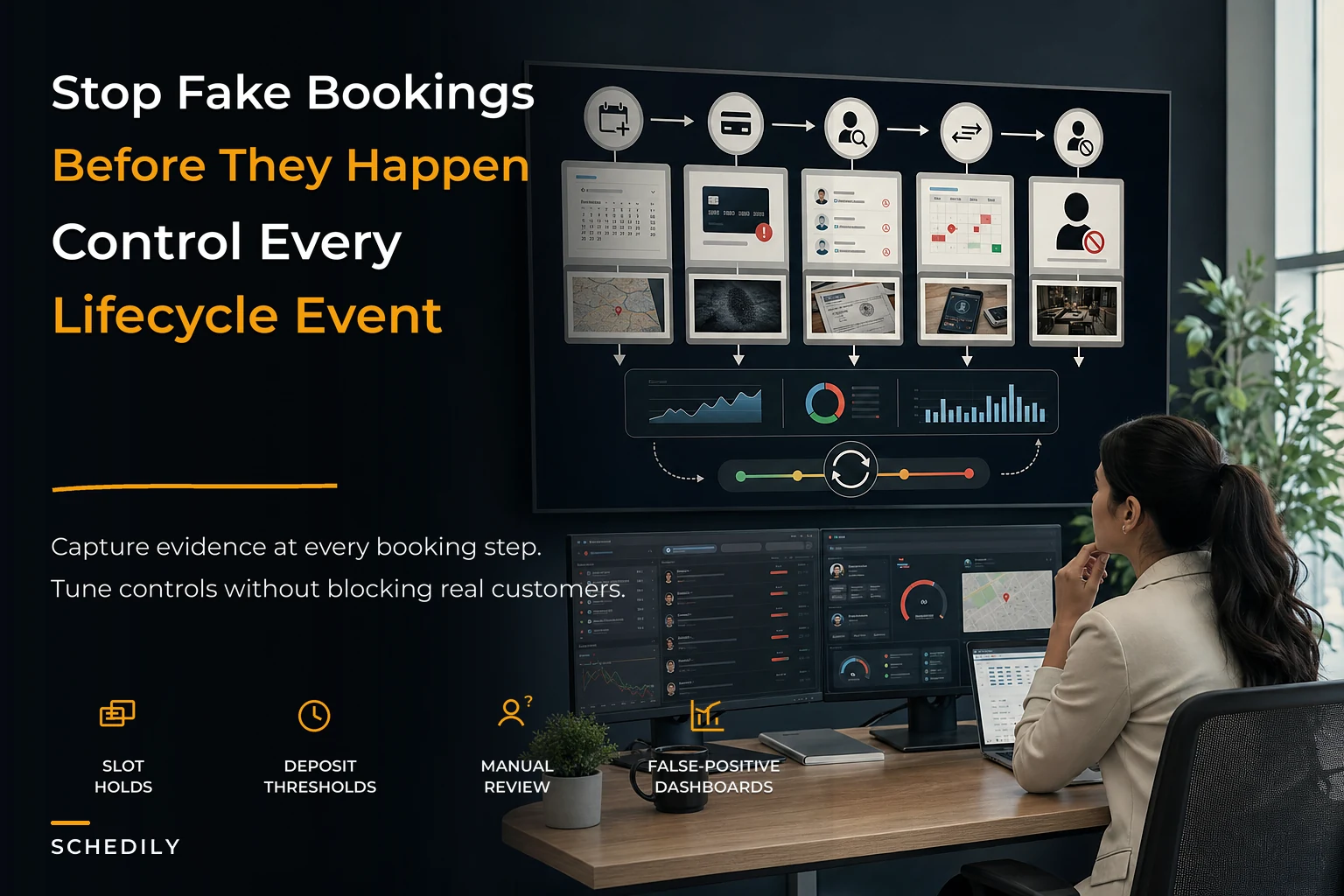

Fake bookings don't usually look dramatic. There's no obvious "attack." What you actually see is a slow erosion: a chair sitting empty during a peak slot, a deposit that never clears, a customer phone number that belongs to nobody, a technician who drove 40 minutes to an address that doesn't exist. Individually these look like normal operational noise. Together, they're a pattern — and the businesses that get hurt most are the ones treating each incident as a one-off instead of a system to monitor.
The mistake most teams make is thinking about fraud as a security problem that lives in some other department. In appointment-driven operations, fraud is a scheduling problem. It rides on the same booking lifecycle events your whole operation depends on — created, confirmed, deposited, rescheduled, completed. The controls that actually work aren't bolted on at the edges. They're wired into the lifecycle itself, with tunable thresholds, review flows, and evidence collected automatically at the moments that matter.
This is the whole-system view: how detection signals feed scheduling-specific mitigations, how thresholds get tuned so you don't drown in false positives, and how you build the dashboards and runbooks that keep the whole thing honest as you scale.
Why fake bookings are a scheduling problem, not just a security one
Smaller operations often copy anti-fraud thinking from ecommerce — block the card, flag the IP, done. But an appointment isn't a shipped package. An appointment holds capacity. The moment a booking is created, it locks a resource: a chair, a room, a consultant hour, a service van. That's the real currency being stolen.
A fraudulent booking causes damage even when no money changes hands. Someone books six of your eight Saturday slots under fake names, never intending to show. Real customers see "no availability," go elsewhere, and you eat the empty chairs. No chargeback, no obvious loss on the books — but you lost a full day of revenue and probably some repeat customers too.
This is why detection has to be tied to the booking lifecycle, not just the payment step. Fraud signals show up before the payment problem does. The booking pattern is weird first. The deposit failure is the confirmation, not the warning.
-
Slot squatting — bulk bookings to deny availability to real customers, sometimes by a competitor, sometimes just malicious.
-
Deposit-dodging — bookings designed to skip or reverse deposits, especially on high-value services.
-
Identity-thin bookings — mismatched name/phone/email combinations, disposable emails, freshly created accounts hitting premium slots.
-
Reschedule laundering — booking a legitimate-looking slot, then repeatedly rescheduling to churn your calendar and dodge cancellation windows.
-
Card-testing through deposits — using your deposit flow to validate stolen cards in small increments.
Each of these attaches to a different lifecycle event, which is exactly why your controls need to live inside the lifecycle.
The detection signals that actually predict fraud
Not all signals are equal. The ones that matter have a low base rate among your real customers. If half your legitimate bookings trip a signal, that signal is worthless — it just generates review work.
Eliminate scheduling conflicts and missed meetings.
Schedily helps you organize and manage all appointments and team availability effortlessly.
- Unified appointment and resource management
- Automated notifications & reminders
- Team calendar synchronization
No credit card required
The strongest signals tend to cluster into three groups.
Velocity and pattern signals. How many bookings from one account, one device, one card, one IP range in a short window. A single account booking four appointments across three locations in ten minutes isn't a normal customer rhythm. Neither is fifteen bookings from one IP hitting only your most expensive service tier.
Identity-consistency signals. Does the phone area code match the billing zip? Is the email a known disposable domain? Is the name field gibberish or a copy-paste of the email prefix? Individually weak, but they stack fast.
Behavioral signals. Time-to-book after account creation, whether they skipped reminders, whether the booking targets exclusively peak or high-margin slots, reschedule frequency. Real customers browse. Fraud tends to move fast and go straight for value.
The important thing: no single signal should trigger a hard block. You score them. A booking accumulates points, and the score — not any one flag — decides which mitigation path it goes down. A fresh account is fine. A fresh account plus a disposable email plus a peak slot plus a failed first deposit attempt is a different story.
A lot of teams treat the signal layer as static, which is a mistake. Fraud adapts. If your deposit threshold is $50, card-testers will probe at $49. Your signals need periodic review against what's actually getting through, which is where the false-positive/negative dashboards come in.
Scheduling-specific mitigations that don't nuke your conversion rate
Appointment businesses have an advantage over generic fraud tools — you have mitigation options that aren't just "approve" or "decline." You can hold, delay, require, or route. The art is matching the mitigation to the risk score so low-risk customers never feel friction.
Soft slot holds instead of confirmed bookings. For medium-risk bookings, don't confirm the slot. Place a hold — the slot is reserved but marked provisional. If the booking clears verification within 20–30 minutes, it converts to confirmed. If not, the hold expires and the slot reopens. This kills slot squatting without touching good customers, because most legitimate bookings clear the hold almost immediately.
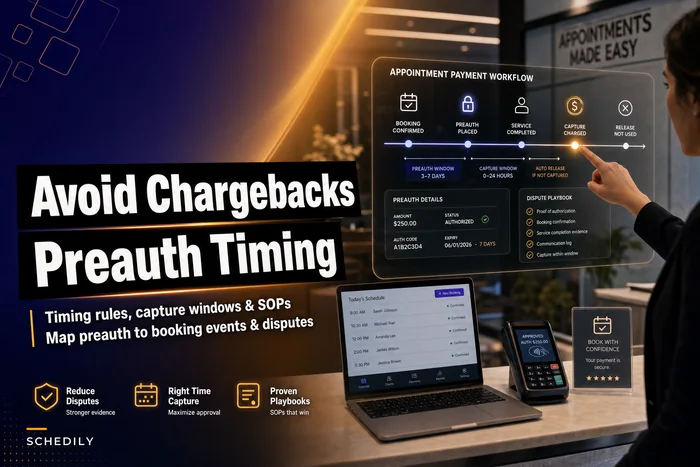
Deposit thresholds that scale with risk. A flat deposit policy is a blunt tool. Low-risk booking on a $40 service? No deposit, frictionless. High-risk booking on a $400 service? Deposit required, and captured — not just authorized — before the slot confirms. The timing of that capture matters a lot and ties directly into how you handle disputes later. The mechanics of preauthorization versus capture are worth getting right, covered in depth in Avoid chargebacks: appointment preauthorization, capture timing and dispute playbooks.
Manual review queues for the murky middle. The highest-risk bookings can auto-decline. The lowest sail through. But there's a band in the middle where you genuinely don't know — and that band should route to a human review flow, not get auto-blocked. This is the part teams skip because it feels like work, but it's what protects your conversion rate. Auto-blocking the middle band is how you quietly reject real customers.
A sample of how mitigation tiers can map to risk scores. Treat the numbers as a starting point, not gospel:
| Risk score | Interpretation | Mitigation applied | Customer friction |
|---|---|---|---|
| 0–24 | Clean | Instant confirm, no deposit | None |
| 25–49 | Slightly elevated | Confirm, standard deposit auth | Minimal |
| 50–69 | Uncertain | Soft slot hold + deposit capture required | Moderate |
| 70–84 | High | Manual review queue before confirm | Delayed |
| 85+ | Very high | Auto-decline + evidence logged | Blocked |
The band boundaries are the levers you'll spend the most time adjusting. Move them a few points and your review queue volume changes dramatically.
Tunable thresholds: the part everyone gets wrong
Static thresholds fail in both directions. Set them too tight and your front desk drowns in review tasks while real customers bounce off the friction. Set them too loose and fraud walks right through. The businesses that keep this balanced treat thresholds as something they tune on a schedule, not something they set once at launch and forget.
A practical rule: every threshold should have an owner, a current value, a review cadence, and a record of the last change. If nobody owns the deposit-threshold number, it will drift into either uselessness or customer-hostility, and nobody notices until it's already a problem.
Every threshold should have an owner, a current value, a review cadence, and a record of the last change.
The tuning process is straightforward once you commit to it:
-
Sample the last 30–60 days of bookings that tripped each threshold.
-
Label them — confirmed-legit, confirmed-fraud, unknown — using actual outcomes (did they show? did the deposit clear? did it chargeback?).
-
Calculate the hit rate for each threshold
of the bookings it flagged, how many were actually fraud?
-
Adjust one variable at a time. Never move three thresholds in the same week or you'll never know which change did what.
-
Watch the downstream queue volume for two weeks before the next adjustment.
The single-variable discipline matters more than it sounds. Teams that batch-change everything at once end up flying blind because they can't attribute the outcome to any specific change. It's the same reasoning behind isolating variables in webhook and idempotency testing — controlled, observable changes beat big-bang rewrites, a principle laid out well in Don't trust naive webhooks: synthetic booking tests, idempotency keys and backoff patterns you must implement.
Evidence collection tied to lifecycle events
When a booking turns out to be fraud — or when a customer disputes a legitimate decline — you need evidence, and you need it collected automatically at the moment it happened. Trying to reconstruct what a booking looked like three weeks later, after the account has been deleted and the session data is gone, is a losing game.
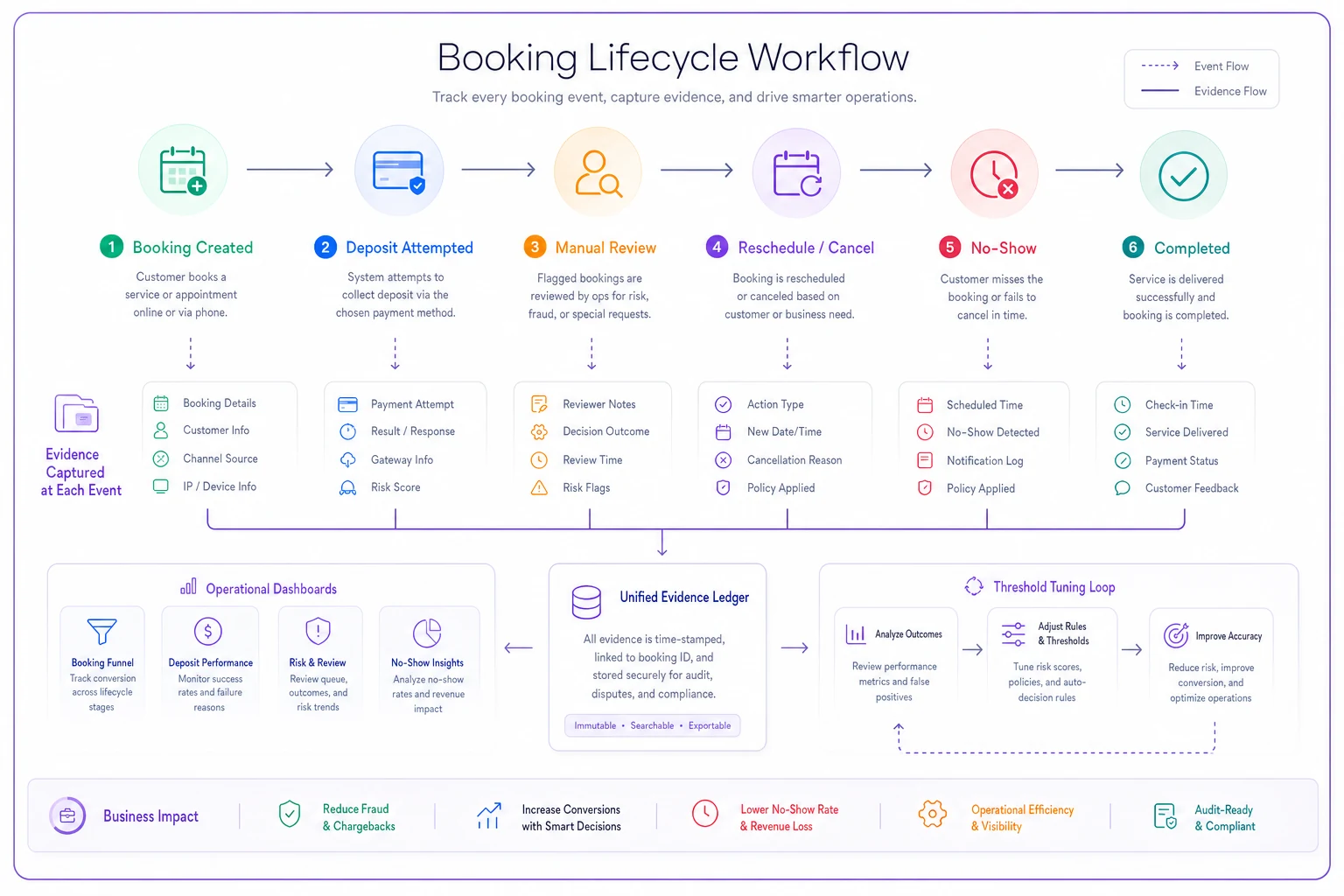
Attach evidence-collection templates to the lifecycle events themselves. Each event captures a snapshot:
-
On booking created device fingerprint, IP, account age, all signal scores at that moment, requested slot and service value.
-
On deposit attempted payment result, AVS/CVV response, attempt count, time from booking.
-
On manual review action who reviewed, what they saw, decision, and reason code.
-
On reschedule/cancel timing relative to policy windows, count of prior reschedules on that booking.
-
On no-show/completion final resolution, which closes the evidence loop for later labeling.
This does double duty. It gives you dispute-ready evidence, and it feeds the labeled dataset you need to tune thresholds properly. Businesses that skip the snapshot step end up with fraud controls they can't improve, because they have no clean record of what actually happened.
A simple workflow diagram showing lifecycle events and evidence snapshots can help teams visualize the loop.
There's also a compliance dimension worth flagging. Collecting device fingerprints, IPs, and payment metadata tied to identifiable customers means retention windows and consent handling come into play. Getting sloppy here trades a fraud problem for a privacy problem, and the common pitfalls around booking-lifecycle data are covered in Common compliance mistakes in appointment systems — booking-lifecycle consent, retention and breach playbooks.
Monitoring false positives and negatives
Two dashboards keep the whole system honest. Skip either and you're guessing.
The false-positive dashboard tracks bookings you flagged, held, or declined that turned out to be legitimate. The clearest signal: manual-review approvals. If 80% of your review queue gets approved, your thresholds are too aggressive — you're paying labor to inconvenience real customers. A healthy review queue lands somewhere in the middle, where reviewers are genuinely making judgment calls, not rubber-stamping.
The false-negative dashboard tracks fraud that got through. This is harder because you only learn about it after the fact — the chargeback lands, the no-show pattern emerges, the deposit reverses. The key metric is time-to-detection: how long from booking to discovery. If your average detection lag is measured in weeks, your signals are missing the early indicators and you're catching fraud only at the payment stage, which is the most expensive place to catch it.
A short monitoring checklist worth keeping visible to the ops team:
-
[ ] Review-queue approval rate (target the middle, not extremes)
-
[ ] Auto-decline rate week over week (sudden spikes mean either an attack or a broken threshold)
-
[ ] Deposit-failure-to-fraud correlation
-
[ ] Average time-to-detection for confirmed fraud
-
[ ] Slot-hold expiry rate (high expiry can mean legit customers hitting friction)
-
[ ] Reschedule frequency outliers
-
[ ] False-positive complaints from front-desk staff
That last one is underrated. Your front desk hears "why did my booking get rejected?" before any dashboard shows it. Give them a fast channel to flag it.
A runbook for escalation
When a signal fires or a pattern emerges, people need to know exactly what to do — not improvise. A simple tiered runbook removes the guesswork:
Tier 1 — Single suspicious booking. Front desk or booking coordinator handles it. Check the evidence snapshot, apply the assigned mitigation (hold, deposit, or decline), log the reason code. No escalation needed.
Tier 2 — Pattern across multiple bookings. Same device, same card, or same slot-squatting behavior across several bookings. Ops manager gets pulled in. Temporarily tighten the relevant threshold, review the cluster together, decide whether to reverse any confirmed bookings.
Tier 3 — Coordinated attack or systemic breach. Sudden spike in decline rate, card-testing volume, or availability being wiped out. This is an incident. Escalate to whoever owns the booking system, consider enabling stricter default mitigations across the board temporarily, and preserve all evidence for potential payment-processor or law-enforcement follow-up.
Runbooks only work if they're written before the incident, not during it. A team scrambling to invent a response mid-attack makes worse decisions than one following a rehearsed plan.
A real scenario
A mid-sized aesthetics clinic — three locations, roughly 300–350 bookings a month, high-value services in the $250–$600 range — started seeing a strange pattern. Saturday premium slots kept showing "fully booked" by mid-week, but the no-show rate on those exact slots was creeping toward 20%. Real customers couldn't get in; the slots that were booked kept going empty.
Turned out to be slot squatting mixed with deposit-dodging. Accounts were booking the premium Saturday windows with card details that failed at capture, and the clinic's flat "authorize-later" deposit policy meant the slots stayed locked for days before the failed payment surfaced.
The fixes were unglamorous. Soft slot holds on any booking scoring above the uncertain band. Captured — not just authorized — deposits on premium slots for elevated-risk bookings. A small manual-review queue for the middle tier. They tuned the thresholds over about six weeks, one variable at a time.
Within two months, Saturday no-shows on premium slots dropped back into single digits. Real customers started getting those slots again. The recovered Saturday revenue worked out to somewhere in the low thousands per month across the three locations. No dramatic overnight win, just a leak that got closed and stayed closed because they were now watching it.
When this level of control makes sense — and when it doesn't
Not every business needs the full apparatus. Building risk scoring, review queues, and dual dashboards is real work, and for a solo practitioner doing 40 low-value bookings a month, it's overkill. A simple deposit requirement probably covers 90% of your exposure.
This makes sense when: you have high-value services, capacity that's genuinely scarce during peak windows, multiple locations or staff, and you've already seen more than a couple of fraud incidents. Once fake bookings are costing you real capacity — not just occasional annoyance — the system pays for itself.
This is probably overkill when: your volume is low, your services are cheap, and fraud incidents are rare. You'll spend more on review labor and lost conversion from friction than you'll ever recover. Start with a deposit and a reschedule limit, and only build up when the data says you need to.
Who should be careful: businesses with thin margins and price-sensitive customers. Every point of friction you add costs you some real bookings. Tune too aggressively and you can lose more to abandoned bookings than you were ever losing to fraud. That's why the false-positive dashboard isn't optional — it's the thing that stops your fraud controls from becoming their own, quieter revenue leak.
Pulling it together
The reason fake bookings are so hard to stamp out with a single fix is that they're not a single problem. They ride the whole booking lifecycle — created, held, deposited, confirmed, rescheduled, completed — and they adapt to whatever static rule you throw at them. The businesses that get ahead of it stop thinking in terms of blocks and start thinking in terms of a loop: signals feed mitigations, mitigations generate evidence, evidence feeds the dashboards, the dashboards drive threshold tuning, and the tuning sharpens the signals.
Modern scheduling platforms make this loop far easier to run than it used to be — risk scoring, automatic evidence snapshots at each lifecycle event, monitoring that surfaces false positives before your front desk has to complain about them. But the tooling only helps if the operational thinking is there first. Set the owners, set the cadence, watch both dashboards, and treat your thresholds as living numbers.
Do that, and fake bookings go from a recurring mystery to just another operational metric you keep in range.
Ready to optimize your scheduling and operations?
Join thousands of businesses using Schedily to save time, improve coordination, and enhance operational efficiency.