


Most integration failures don't start with bad code. They start with a partner that was never properly onboarded — no agreed contract shape, no test suite that covered the ugly cases, no shared understanding of what "working" even means. Six months later someone's calendar double-books during a product launch, and the post-mortem reads like a list of things nobody thought to check before signing.
The teams that get scheduling partner onboarding right treat it less like a procurement checkbox and more like admitting a new tenant into a shared building. You set the rules before they move in, because fixing behavior after the fact is miserable for everyone.
This is the governance layer that wraps around integrations: how you vet, test, contract, and operationally align with the booking systems, payment processors, dispatch tools, and calendar providers you connect to. Get it wrong and your reliability becomes the weakest partner's reliability. Get it right and your system keeps working even when theirs wobbles.
Why partner integrations fail more often than internal code
Internal systems fail in predictable ways because you own the whole surface. Partner integrations fail because you own half a conversation and have to guess at the rest.
A common pattern looks like this. You integrate a scheduling partner during a quiet month. Everything passes in the demo. Both sides are motivated, both engineers are responsive, and the happy path works on the first try. The integration ships. Then three things happen over the next quarter that nobody planned for:
-
The partner changes a field format in a minor release and doesn't flag it as breaking.
-
Your volume triples during a seasonal spike and their rate limits start rejecting requests you never saw rejected before.
-
A customer cancels an appointment at the same moment your system is syncing it, and the two systems disagree about what the "current" state is.
None of these are exotic. They're the normal weather of running integrations at scale. The problem is that the onboarding process only tested for sunshine.
What shows up repeatedly across operations is that the failure isn't technical sophistication — teams know how to write retry logic. The failure is that the agreement about behavior was never written down. Nobody defined what the partner guarantees under load, what happens during their maintenance windows, or who owns reconciliation when the two systems drift. So when something breaks, both sides point at each other, and the customer eats the double-booking.
What actually breaks as you add more partners
One partner is a relationship. Five partners is a system, and systems have emergent failure modes that single integrations don't.
Eliminate scheduling conflicts and missed meetings.
Schedily helps you organize and manage all appointments and team availability effortlessly.
- Unified appointment and resource management
- Automated notifications & reminders
- Team calendar synchronization
No credit card required
The shift that catches teams off guard: with one integration, you can hold the whole thing in your head. You know the partner's quirks, you remember their rate limits, you've got the engineer's Slack handle. With five or six, that knowledge fragments. Different people onboarded different partners with slightly different assumptions, and now you have a web of integrations where:
-
Each partner has a different definition of idempotency.
-
Each uses different retry and backoff behavior.
-
Some send webhooks, some expect polling, and the two models fight each other during incidents.
-
Nobody has a single view of which partner is currently degraded.
The result is that a problem in one integration starts masquerading as a problem in another. A partner's slow response pushes your queue depth up, which delays a sync to a different partner, which trips a timeout that looks like the second partner is failing. You spend two hours debugging the wrong vendor.
This is why resilient event contracts matter so much at the boundary. If you haven't already, the mechanics of designing resilient scheduling APIs and event contracts with idempotency and reconciliation windows are the technical foundation this governance layer sits on top of. Governance decides what you require from partners; event contract design decides how you enforce it.
The onboarding governance structure that holds up
Think of partner onboarding as four layers that each have to pass before a partner goes to production. Skip a layer and it comes back to bite you during peak season.
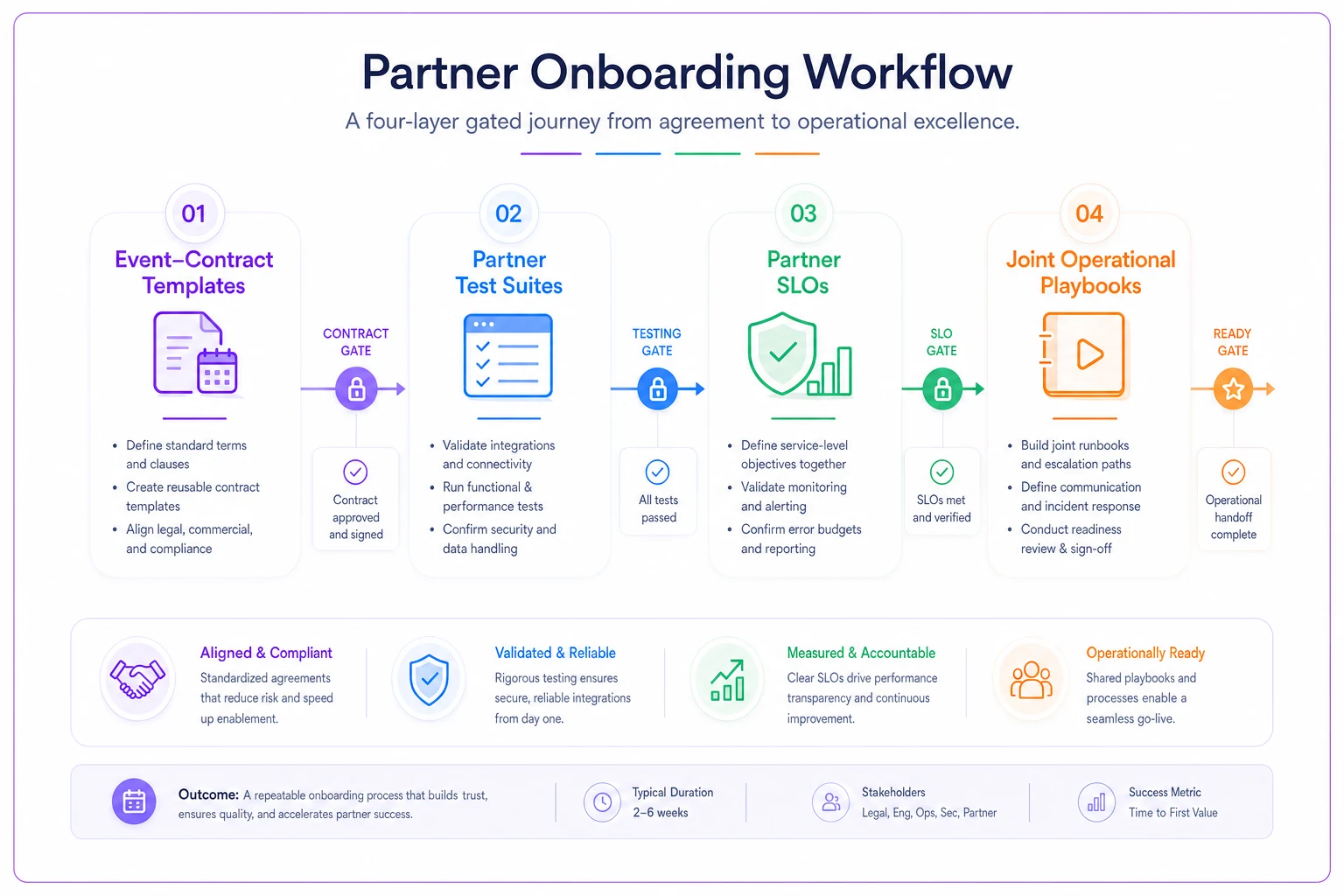
A quick visual of the four onboarding layers.
1. Event-contract templates
Before any code, you hand the partner a contract template that specifies the shape of every event you'll exchange. Not a vague API doc — a concrete, versioned spec that says exactly what fields exist, which are required, what happens on conflict, and how versioning works when either side changes something.
The non-negotiable pieces:
-
Idempotency keys on every write operation, with a defined dedup window.
-
Explicit state enumeration — no partner should ever send a status your system hasn't agreed to handle.
-
Version headers so a partner's minor release can't silently break your parser.
-
Reconciliation endpoints — a way for both sides to ask "what's the current truth?" when they disagree.
The mistake is treating the contract as documentation to be read once. It should be the thing both test suites validate against, so drift between the agreed contract and the actual behavior gets caught automatically.
2. Partner test suites
This is where most onboarding is dangerously thin. A partner passes a happy-path demo and gets waved through. The test suite that actually protects you covers the cases nobody wants to run manually.
-
Duplicate delivery — send the same event twice, confirm the partner dedupes correctly.
-
Out-of-order events — a cancellation arriving before the booking it cancels.
-
Rate-limit behavior — push past their documented limit and confirm they return clean, retryable errors instead of silent drops.
-
Partial failure — what happens when a multi-step booking succeeds on step one and fails on step two.
-
Clock skew — events timestamped slightly in the future or past.
-
Maintenance-window behavior — do they queue or reject during their own downtime?
-
Reconciliation accuracy — deliberately introduce drift, then confirm the reconciliation endpoint resolves it correctly.
Run these before production, and re-run a subset on a schedule, because partners change their systems without telling you. A test suite that only runs at onboarding tells you the partner was correct once, in the past.
3. Partner SLOs
A partner agreement without measurable objectives is a handshake. You need numbers you can actually check: availability, response latency at your real volume, error rates, and — critically — recovery time when they go down.
A practical SLO structure worth adapting:
| Dimension | What to specify | Why it matters |
|---|---|---|
| Availability | Target uptime % measured monthly | Sets the baseline you can plan around |
| Response latency | p95 and p99 at your expected peak volume | Averages hide the spikes that cause timeouts |
| Error rate | Max % of failed requests under normal load | Separates "blip" from "degraded" |
| Recovery time | Max minutes to restore after an incident | Determines how long your fallback must hold |
| Breaking-change notice | Minimum days of warning before contract changes | Prevents silent field changes from breaking parsing |
| Reconciliation SLA | Max time to resolve a flagged state mismatch | Keeps drift from becoming permanent |
The thing most teams miss: measure latency at your peak, not the partner's advertised average. A partner that's fast at 100 requests a minute can fall apart at 900, and their marketing numbers won't tell you that. Negotiate the SLO against your worst realistic hour.
4. Joint operational playbooks
The final layer is the one almost nobody writes until after their first bad incident. When something breaks across the boundary, who does what? If that's not written down, both teams improvise, and improvisation during an outage is how a 20-minute problem becomes a two-hour one.
-
Shared escalation contacts on both sides, with actual response expectations.
-
Who owns reconciliation after a split-brain event.
-
The fallback booking flow your side runs when the partner is down.
-
A shared definition of incident severity so you're not arguing about whether it's a P1 while customers are stuck.
Your internal side of this should connect directly to your scheduling incident response runbook with SLOs and fallback booking flows. The partner playbook is just the cross-boundary extension of that same discipline — the partner needs to know their role in your incident response, and vice versa.
A real scenario: multi-location clinic group
A regional clinic group running appointments across eleven locations had integrated three partners over roughly a year — a central scheduling platform, an SMS reminder service, and a dispatch tool for mobile home visits. Each was onboarded by a different person at a different time, with no shared standard.
Integration-related incidents were running somewhere around six to eight a month. Most weren't catastrophic, but each one meant a front-desk staffer manually fixing a booking, a missed reminder, or a double-booked provider. Staff started keeping a parallel paper log because they didn't trust the system during busy mornings — which quietly erased the efficiency the integrations were supposed to deliver.
When they rebuilt onboarding governance, nothing exotic happened. They wrote a single event-contract template, ran a proper test suite against all three existing partners (two of which failed the out-of-order and duplicate-delivery tests on the first run), set SLOs tied to their actual Monday-morning peak, and wrote one joint playbook per partner.
Over the following quarter, integration incidents dropped to about one or two a month, and the ones that happened resolved faster because everyone knew their role. The paper logs disappeared within about six weeks. No revenue miracle — just a system people could finally trust.
When this level of governance makes sense
This isn't free. Writing contract templates, test suites, SLOs, and playbooks is real work, and for a solo operator with one simple calendar sync, it's overkill.
This makes sense when:
-
You have three or more partner integrations touching the booking lifecycle.
-
A failed integration directly affects customer bookings or revenue.
-
You operate across multiple locations where drift compounds.
-
You've already had at least one cross-partner incident nobody could cleanly diagnose.
This is a bad idea when:
-
You have a single, stable integration and low volume.
-
You're still validating whether the partner relationship is even worth keeping.
-
Your volume is low enough that manual recovery is genuinely faster than building governance.
Who should probably wait: early-stage businesses still changing partners every few months. Building heavy governance around a partner you'll replace in a quarter is wasted effort. Get the relationship stable first, then formalize.
The ongoing part people forget
Onboarding governance isn't a one-time gate. Partners change. Your volume grows. The contract that fit last year's traffic cracks under this year's.
The teams that stay reliable re-run a subset of their partner test suite on a cadence, review SLO performance against actual incidents quarterly, and update playbooks after every cross-boundary incident. Drift is the real enemy — not just data drift between systems, but drift between the agreement you made and the behavior you're actually getting. The same discipline you apply to conflict-resolution rules and sync governance for calendar integrations applies here: without active governance, things slide quietly until they break loudly.
Partner integrations fail at the seams, not the center. The code usually works. What fails is the untested edge case, the unagreed behavior, the undocumented escalation path. Good onboarding governance isn't about distrust — it's about making the seams explicit before volume and time find them for you.
Ready to optimize your scheduling and operations?
Join thousands of businesses using Schedily to save time, improve coordination, and enhance operational efficiency.