

Most appointment businesses treat payments as a checkout step. Card goes in, money comes out, done. But the actual money doesn't move in a clean line — it moves through a lifecycle that runs parallel to your booking lifecycle, and those two timelines rarely stay in sync on their own. When they drift apart, you get chargebacks you can't win, captures that fire at the wrong moment, and disputes where you have no evidence to show the card network.
Payment governance is the discipline of keeping those two timelines locked together, with rules and evidence attached at every stage. It's less about "which payment processor" and more about when money is authorized, when it's captured, what gets recorded, and who is allowed to override any of it. Get that structure right and most chargebacks resolve in your favor or never happen. Get it wrong and you're bleeding disputes at 2–3% of revenue and blaming "bad customers."
Here's how the whole system actually connects — and where it usually falls apart as a business grows.
The two timelines nobody maps together
Every appointment has a booking lifecycle: requested, confirmed, reminder sent, arrived, serviced, completed (or no-show, or cancelled). Every payment has its own lifecycle: authorized, held, captured, settled, refunded, disputed.
The failure most operations make is running these on separate systems that never talk. The scheduler knows the appointment was a no-show. The payment processor captured the deposit three days earlier. Nobody connected the two, so when the customer disputes the charge — "I never received the service" — you're pulling logs from two systems with mismatched timestamps and no clean story.
Across a lot of appointment-driven businesses, the money almost always moves before the operational event that justifies it. That's the root problem. A deposit gets captured at booking, but the cancellation policy that makes it non-refundable only activates 48 hours before the appointment. If someone cancels five days out and you've already captured, you're technically holding money you agreed to refund — and that's an instant chargeback loss.
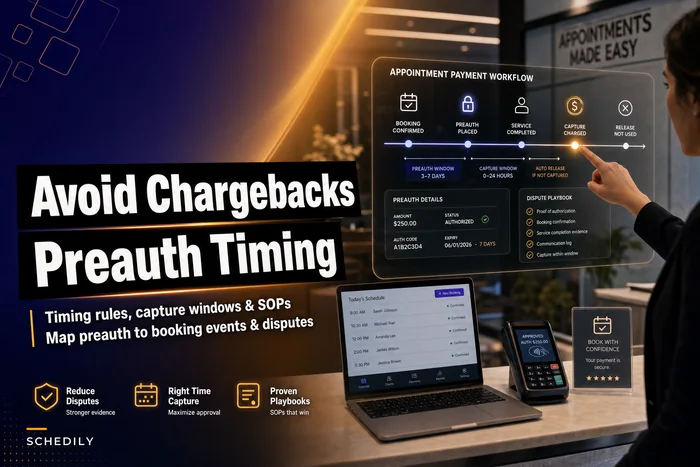
The fix isn't complicated in concept: capture timing has to be tied to a stage in the booking lifecycle, not to a calendar date or to the moment of booking. This is the whole reason appointment preauthorization and capture timing deserves to be designed deliberately rather than left on processor defaults.
Preauth vs capture: the timing table that decides your dispute rate
Here's how the timing decisions map to booking stages, and what each choice does to your risk exposure.
Eliminate scheduling conflicts and missed meetings.
Schedily helps you organize and manage all appointments and team availability effortlessly.
- Unified appointment and resource management
- Automated notifications & reminders
- Team calendar synchronization
No credit card required
| Booking stage | Payment action | What it protects | Risk if mistimed |
|---|---|---|---|
| Requested (unconfirmed) | Preauth only, no capture | Verifies card is real, holds nothing you'd have to refund | Auth expires (typically 5–7 days) before service |
| Confirmed | Preauth held or deposit captured | Locks commitment, funds the no-show fee | Capturing too early on refundable deposits |
| Reminder window (24–48h) | Convert preauth to capture for deposit | Aligns money with cancellation cutoff | Capturing before cutoff = refund exposure |
| Serviced / completed | Capture remaining balance | Money now maps to delivered service | Delayed capture past auth window = re-auth needed |
| No-show | Capture no-show fee per policy | Evidence-backed charge | Capturing full service price when policy says partial |
| Cancelled (within policy) | Release auth or refund | Prevents unnecessary disputes | Forgetting to release = customer disputes the hold |
The single most valuable thing to understand here: a preauthorization that never gets captured costs you almost nothing, but a capture that shouldn't have happened costs you the dispute plus the chargeback fee plus your win-rate reputation with the network. When in doubt, hold longer and capture later. Preauth is cheap. Bad captures are expensive.
One pattern worth flagging — auth windows expire. A preauth held at booking for a service two weeks out will often expire before the appointment. Teams that don't track auth expiry end up with dead holds, then scramble to re-auth the day of, and the card declines because the customer's balance changed. Your capture strategy has to account for the gap between booking date and service date.
Merchant-risk thresholds and why one policy doesn't fit every booking
Not every appointment carries the same risk. A returning client who's had twelve sessions is not the same risk as a first-time booking made at 2am with a mismatched billing zip. Treating them identically means you either annoy good customers with heavy preauth requirements or expose yourself to fraud on the riskier ones.
Risk-tiered payment governance means the timing and amount of what you preauth or capture flexes based on signals. In practice, the signals that actually matter tend to be:
-
First-time vs returning customer
-
Booking value relative to your average
-
Time between booking and appointment (very short or very long windows both skew risky)
-
Billing/shipping mismatch or repeated card failures
-
Booking channel (walk-in link vs verified account)
A returning client might get a soft preauth and pay on completion. A high-value first-time booking might require a captured deposit before the slot is confirmed at all. This kind of tiering connects directly to your broader operational fraud controls for fake bookings — because a fraudulent booking and a chargeback are usually the same event viewed from two angles.
The mistake is setting thresholds once and never revisiting them. Fraud patterns shift seasonally and by channel. If you launched a new promo link and suddenly your first-time booking volume tripled, your risk model needs to know that those aren't the same "first-time" customers you were used to.
When strict preauth actually makes sense
-
High no-show cost (long slots, specialist time, reserved equipment)
-
New customer with no history
-
Booking made far in advance where commitment tends to weaken
-
Promotional periods that attract low-intent bookings
When it's a bad idea
-
Loyal repeat clients — heavy holds erode trust and they will notice
-
Low-value quick appointments where the friction costs more than the risk
-
Situations where your cancellation policy is generous anyway (don't preauth aggressively if you refund freely)
The businesses that genuinely need the full structure are the ones with high no-show costs, meaningful first-time booking volume, multiple locations or channels, and a chargeback ratio creeping toward processor thresholds. If that's you, the coordination between booking events and payment events stops being optional.
The audit trail is your actual defense
When a chargeback lands, you don't get to explain your policy in a phone call. You submit evidence to the card network and wait. Whether you win comes down almost entirely to whether your records tell a coherent, timestamped story that matches what the customer agreed to.
-
Consent to the policy — the exact cancellation/deposit terms shown at booking, with a timestamp and version
-
Booking confirmation — when it was confirmed and by whom
-
Reminder delivery — proof the customer was notified, with delivery receipts
-
The service or no-show event — logged status change, ideally with a staff or device stamp
-
The capture event — amount, timing, and which policy rule triggered it
The part people miss: the policy text has to be versioned. If a customer booked in March under one cancellation policy and you updated it in May, your evidence needs to show the March version they actually agreed to — not whatever's live on your site today. Networks reject disputes where the merchant's submitted terms don't match the transaction date. This is exactly why policy-first governance for pricing, deposits, and cancellations has to sit upstream of your payment logic. The policy defines the evidence; the evidence wins the dispute.
What breaks at scale
At a single location with one person handling both the calendar and the card machine, this all stays coordinated by memory. That person knows the regular clients, knows which deposits were captured, knows why a charge exists. The system is essentially a human brain.
-
Second location or second bookings channel appears. Now two systems capture payments with slightly different rules. Reconciliation starts requiring manual spreadsheet work.
-
Staff turnover hits. The person who "just knew" the payment logic leaves. New staff capture deposits inconsistently — some at booking, some at arrival.
-
Volume crosses a threshold. Disputes go from "occasional annoyance" to a weekly task. Nobody owns the response process, so disputes get missed and auto-lost by default.
-
A processor flags your chargeback ratio. Once you cross roughly 1% chargeback-to-transaction ratio, you're on a monitoring program. Cross higher and you risk losing processing entirely.
The step that quietly does the most damage is #3. A missed dispute is an automatic loss. Businesses that don't have a named owner and a response deadline built into their workflow lose disputes they would have easily won — purely because the 7–14 day response window closed while the notification sat in an inbox.
The chargeback playbook: a repeatable response flow
Disputes need a process, not improvisation. Every chargeback should route through the same flow the moment it lands:
-
Categorize it. Is it fraud (card not authorized by holder), service dispute (didn't get what they paid for), or processing error (double charge, wrong amount)? The category decides everything downstream.
-
Pull the evidence bundle. Consent version, confirmation, reminders, service/no-show log, capture record. If you're assembling this by hand every time, you'll lose the ones that come in on a busy week.
-
Decide fight or fold. Not every chargeback is worth contesting. A $40 dispute that'll cost you an hour of work and you're 50/50 to win — sometimes you let it go. A $400 no-show fee with airtight evidence, you fight.
-
Submit within the window, tracked. Response deadlines are hard. Build the deadline into a task with an owner, not a hope.
-
Log the outcome and the pattern. Won or lost, record why. Patterns in your losses tell you where your governance is weak.
Step 5 is the one that turns disputes from pure cost into feedback. If you keep losing "service not received" disputes on no-shows, that's not a customer problem — it's a signal your reminder proof or your consent capture is thin.
Vendor control checklist
Your payment processor and scheduling system are both vendors in this chain, and gaps between them create most of the reconciliation pain. Before you trust the setup, walk this checklist:
-
[ ] Can you preauth and capture separately, with control over timing?
-
[ ] Does the auth window length match your typical booking-to-service gap?
-
[ ] Are policy versions stored and retrievable by transaction date?
-
[ ] Do booking status changes and payment events share consistent timestamps?
-
[ ] Is there a single reconciliation view across all locations/channels?
-
[ ] Are dispute notifications delivered fast enough to hit response windows?
-
[ ] Can you export a complete evidence bundle for any single transaction?
-
[ ] Are refund and auth-release actions logged with who triggered them?
-
[ ] Is there role-based control over who can override a capture or issue a refund?
Give a named owner a fast internal deadline for dispute responses so notifications don't sit unattended.
The last item catches a surprising number of internal problems. Unrestricted refund access is a quiet fraud vector — a staff member issuing refunds to a friend's card, or capturing and refunding to skim. Governance isn't only about the customer; it's about internal control too.
A realistic scenario
A mid-sized wellness studio running around 300–350 appointments a month was seeing chargebacks eat into revenue at roughly 2.5% of card volume. Most were "service not received" disputes on no-show fees. Their problem wasn't the fee — the policy was clear on their site. The problem was evidence: deposits were captured at booking, no reminder delivery was logged, and the cancellation policy had been updated twice without version history.
When disputes came in, staff had nothing coherent to submit. They were losing roughly 7 out of 10 contested cases.
The changes weren't dramatic. They moved deposit capture to the 48-hour cancellation cutoff instead of at booking, so the money always mapped to a point where the policy was actually enforceable. They started logging reminder delivery receipts. They froze and versioned the policy text so each booking recorded the exact terms agreed to. And they assigned one manager to own the dispute response flow with a hard 5-day internal deadline.
Over the following few months, their win rate on contested disputes moved to somewhere around 6 out of 10, and total chargebacks settled closer to 1% of volume. Not zero — you never get to zero — but out of the processor's danger zone and no longer a recurring drain. They didn't change their prices or their policy. They just aligned the money movement with the booking lifecycle and kept records that told the truth.
Who should not overbuild this
If you're running a low-volume, high-trust practice — mostly repeat clients, small deposits, few disputes — layering heavy preauth logic and risk tiering on top of everything is wasted effort and adds friction your best customers will resent. Match the governance to the actual risk. A dozen chargebacks a year doesn't justify a fraud-scoring engine.
The businesses that genuinely need the full structure are the ones with high no-show costs, meaningful first-time booking volume, multiple locations or channels, and a chargeback ratio creeping toward processor thresholds. If that's you, the coordination between booking events and payment events stops being optional.
Bringing the timelines back together
The core idea underneath all of this is simple even though the execution has moving parts: money should move at the moment the booking lifecycle justifies it, and every movement should leave evidence that matches the policy the customer agreed to. Preauth early and cheap, capture late and justified, log everything, version your policies, and give disputes a real owner with a real deadline.
Here's a visual overview of the workflow that ties booking stages to payment actions and evidence capture.
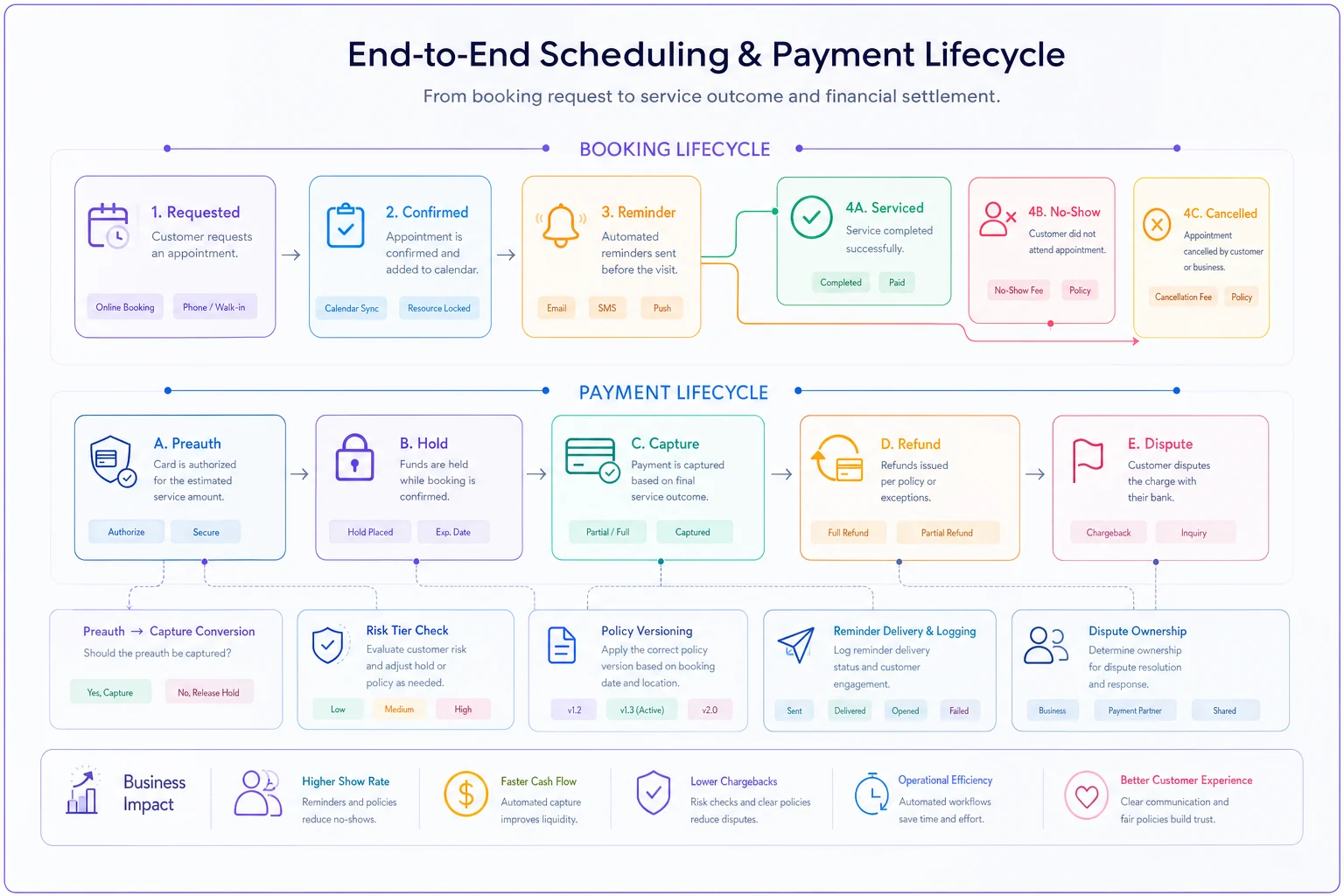
When those pieces are connected, chargebacks stop being random events you react to and become a manageable, mostly-winnable part of operations. When they're disconnected — money on one system, bookings on another, policy floating somewhere on a website — you're not really governing payments at all. You're just hoping the disputes stay quiet, and at scale, they never do.
When those pieces are connected, chargebacks stop being random events you react to and become a manageable, mostly-winnable part of operations. When they're disconnected — money on one system, bookings on another, policy floating somewhere on a website — you're not really governing payments at all. You're just hoping the disputes stay quiet, and at scale, they never do.
Ready to optimize your scheduling and operations?
Join thousands of businesses using Schedily to save time, improve coordination, and enhance operational efficiency.