

Most scheduling roadmaps fail for a boring reason: teams try to fix everything at once. A three-person clinic starts talking about event contracts and reconciliation windows before they've figured out who owns the calendar. Meanwhile a 40-location franchise is still running double-booking cleanup by hand because nobody ever staged the investment properly.
The whole point of a maturity model is to stop guessing about sequence. Not "what's broken" — you already know what's broken — but "what do we earn the right to build next." Scheduling systems don't fail randomly. They fail in a predictable order, and they mature in a predictable order too. Skip a level and whatever you build on top wobbles.
This is a scheduling operational maturity model built around actual artifacts you can point at: the contracts, the KPIs, the automation readiness signals, the roles you need to hire. Not vibes. Something you can walk into a planning meeting with and say "we're a Level 2, here's what Level 3 costs us and what it buys us."
Why scheduling maturity is different from general ops maturity
Generic maturity models talk about culture and process discipline. Fine. But scheduling has a specific failure signature that makes it worth its own model.
The core issue is that scheduling sits at the intersection of three things that rarely agree: customer expectations, staff availability, and resource constraints — rooms, chairs, trucks, equipment. Every appointment is a tiny negotiation between those three. When a business is small, a human holds all three in their head. As it grows, that human becomes a bottleneck, then a single point of failure, then a liability.
What you see across appointment-driven businesses is that maturity isn't about how fancy your software is. Plenty of businesses on expensive platforms operate at Level 1. Maturity is about how much of the scheduling logic lives outside someone's head and inside a system that survives that person leaving.
That's the real axis this model measures: how transferable and self-defending is your scheduling operation?
The five levels at a glance
Here's the full map before we dig into each stage. Read it top to bottom and you'll usually recognize your own business somewhere in the middle two rows.
Eliminate scheduling conflicts and missed meetings.
Schedily helps you organize and manage all appointments and team availability effortlessly.
- Unified appointment and resource management
- Automated notifications & reminders
- Team calendar synchronization
No credit card required
| Level | Name | What scheduling logic lives where | Signature artifact | Automation readiness | Typical breaking point |
|---|---|---|---|---|---|
| 1 | Manual | In one or two people's heads | A shared calendar (maybe) | None — automating chaos just speeds up chaos | The owner takes a vacation |
| 2 | Documented | Written rules, applied by humans | Booking policy doc + SOPs | Low — reminders, basic confirmations | Rules exist but aren't enforced consistently |
| 3 | Systematized | Enforced by the tool | Defined event lifecycle + KPI dashboard | Medium — routing, buffers, conflict blocks | Data is trusted but reactive; no forecasting |
| 4 | Instrumented | Measured and governed | Event contracts + SLA/KPI targets | High — dynamic routing, reconciliation, alerts | Coordination across teams/locations lags demand |
| 5 | Adaptive | Self-correcting within guardrails | Versioned contracts + closed-loop metrics | Full — automation acts, humans set policy | Diminishing returns; over-engineering risk |
The mistake most teams make is treating this like a ladder they should sprint up. It isn't. Most healthy businesses live comfortably at Level 3 or 4 for years. Level 5 only makes sense at real scale or real complexity.
Level 1: Manual — everything is in someone's head
At Level 1, scheduling works — which is exactly why it's dangerous. A two-chair salon or a solo consultant books appointments by memory, texts, and a paper book or a single Google Calendar. Nothing is written down because it doesn't need to be. The person doing the booking is the person doing the work.
The tell isn't disorganization. Some Level 1 operations are impressively tight. The tell is single-person dependency. Ask "what happens to the schedule if you're out sick for a week?" and watch the answer. If it's "everything stops" or "my partner sort of knows the regulars," you're at Level 1.
A typical example: a mobile detailing operator running 25–30 jobs a week entirely off text messages and a mental map of the city. Revenue is fine. But he can't take on a second van because there's no way to hand off the scheduling logic — the routing, the "don't book Mrs. Alvarez before 10am," the buffer for the drive across town. None of it exists outside his head.
What to build to leave Level 1: Not software. Just write things down. The booking rules, the buffers, the "never do this" list. That's the entire Level 2 investment.
Level 2: Documented — the rules exist, but humans have to remember them
Level 2 is where most small businesses plateau, and it's a surprisingly fragile place to sit.
You've written down your policies. There's a cancellation rule, a deposit policy, a note about how long each service takes. Maybe a front-desk SOP. The problem is that documentation isn't enforcement. The rules live in a doc but they're applied by whoever's on shift, at whatever level of attention they have that day.
This is where the classic Level 2 failure shows up: a policy that technically exists but gets followed maybe 60% of the time. The deposit rule is skipped for "nice" clients. The buffer between appointments gets eaten when the day runs long. Two staff members quote different cancellation windows to the same customer.
In real operations this usually surfaces as inconsistency that customers notice before you do. One client gets charged a no-show fee, another doesn't, and now you've got a fairness problem that's actually an enforcement problem.
The honest signal you're ready to leave Level 2 is when you catch yourself saying "we have a policy for that" more often than the policy actually gets followed. That gap is the cost. And it's the moment where structuring your underlying data starts to matter — because you can't enforce rules on data you haven't organized. Worth reading alongside the ideas in designing a scheduling data strategy for reliable bookings, because Level 3 is impossible without clean, consistent data underneath.
Hiring note: At this stage you don't need a scheduling specialist. You need a disciplined operations lead or office manager whose job explicitly includes owning the policy doc and pushing back when it's ignored. One person accountable for consistency beats three people vaguely aware of the rules.
Level 3: Systematized — the tool enforces the rules
Level 3 is the first level where the system holds the logic, not the person. The scheduling tool now blocks double-bookings, enforces buffers automatically, requires deposits before confirming, and won't let someone book a service the assigned staff isn't qualified for.
This is a genuine phase change, and it feels like it. The number of "how did that get booked?" conversations drops sharply. Front-desk staff stop being the enforcement mechanism and go back to being helpful humans.
The artifact that defines Level 3 is a defined event lifecycle: every appointment has clear states — requested, confirmed, in-progress, completed, cancelled, no-show — and the transitions between them are governed by rules the system applies. Once that lifecycle exists, you can finally measure things, which is why Level 3 is also where a KPI dashboard becomes real rather than aspirational.
Teams often think they're measuring performance at Level 2, but they're really just eyeballing a busy calendar. Real measurement requires the enforced lifecycle underneath it. If you're setting up that measurement layer, the framework in an operational KPI framework for appointment-driven businesses maps cleanly onto this stage — utilization, no-show rate, lead time, and revenue-per-available-hour become trackable because the state transitions are finally clean.
A concrete Level 3 example: a physiotherapy clinic with six practitioners moved from a shared calendar to a tool that enforced credentials, room assignment, and buffer times. No-shows didn't magically vanish, but the invisible losses did — the double-booked treatment room, the practitioner scheduled for a modality they weren't certified in. Effective daily capacity went up by roughly 8–10% just from eliminating the conflicts they'd been quietly absorbing.
The Level 3 trap: you now have data and enforcement, but everything is still reactive. You see the no-show after it happens. You react to the absence, you don't anticipate the demand. That's what Level 4 is for.
A 6-month roadmap from Level 2 to Level 3
This is the transition most people reading this are actually facing, so here's a runnable sequence:
-
Month 1 — Map your real event lifecycle. Write out every state an appointment can be in and every valid transition. You'll find edge cases you've never named (the "client showed up but we sent them home" state).
-
Month 2 — Clean your data. Standardize service definitions, durations, and resource types. Enforcement is impossible on messy inputs.
-
Month 3 — Configure enforcement in the tool
buffers, conflict blocks, deposit gates, qualification rules. Turn them on in one location or one team first.
-
Month 4 — Run in parallel. Keep the old process alive as a fallback while staff adjust. Track every override — overrides are your bug list.
-
Month 5 — Stand up the KPI dashboard. Pick 4–5 metrics, not 20. Utilization, no-show rate, lead time, cancellation rate.
-
Month 6 — Kill the fallback. Retire the manual process, make the system the source of truth, and review the override log to find remaining gaps.
The reason so many rollouts stall isn't technical — it's people. Staff quietly route around the new system when it's inconvenient. That behavioral side is genuinely the hard part, and it's worth pairing this roadmap with a real change-management playbook for rolling out scheduling policies and tools so the enforcement actually sticks.
Track every override — overrides are your bug list.
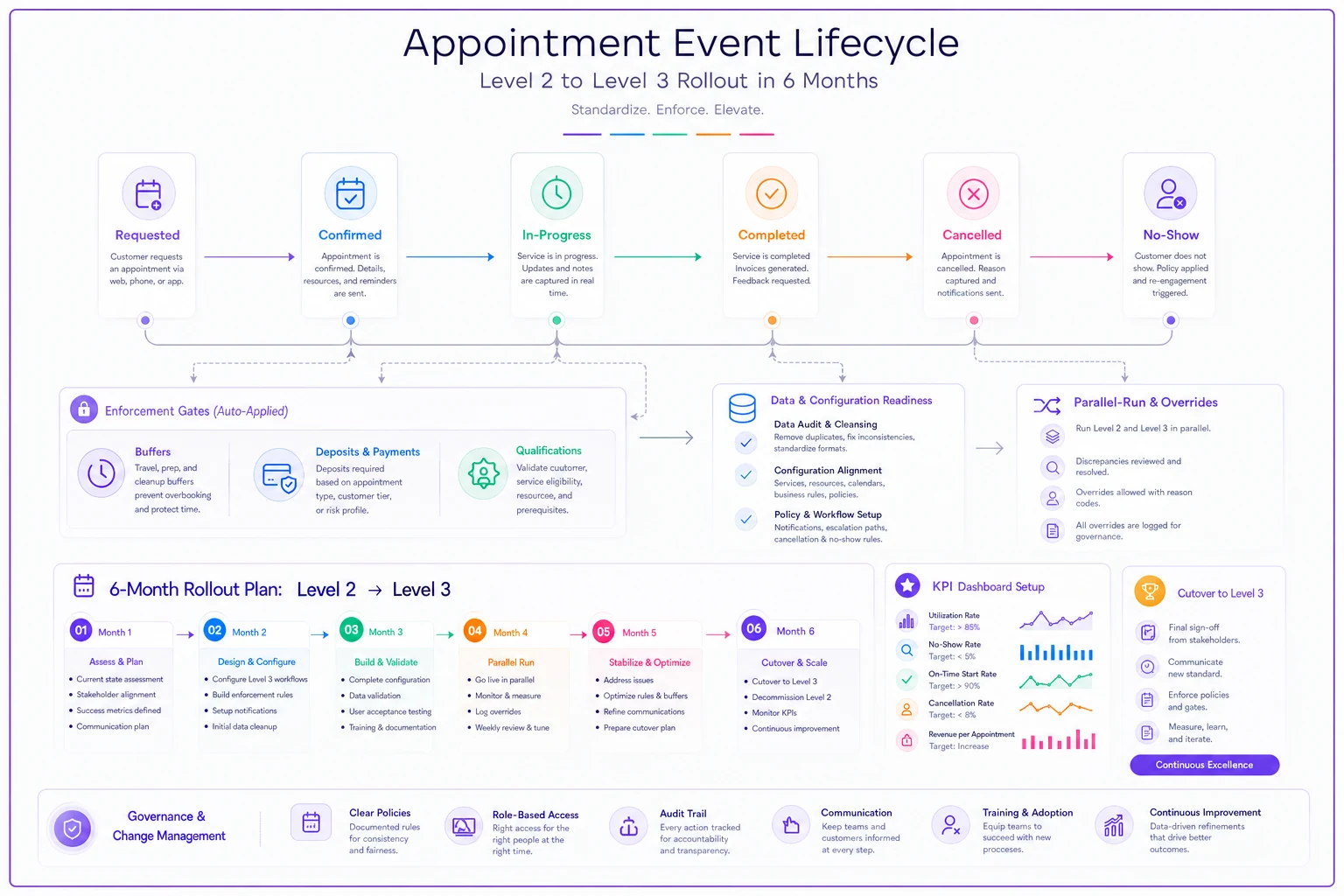
A simple workflow showing the event lifecycle and the 6-month rollout can help align the team during implementation.
Level 4: Instrumented — measured, governed, and coordinated
Level 4 is where scheduling stops being a single-team activity and becomes an operation that coordinates across roles, locations, and resource pools.
The defining artifacts here are event contracts and SLA-backed KPI targets. An event contract is the agreed-upon structure and guarantees around every scheduling event — what data it carries, what happens on failure, how systems downstream can trust it. This matters the moment your scheduling data feeds other systems: payroll, inventory, dispatch, customer notifications. At Level 3 the schedule is the schedule. At Level 4 the schedule is a data source other parts of the business depend on, so it needs guarantees.
The coordination shift is the big one. A single-location business at Level 3 is fine. But once you have five locations sharing a float pool of staff, or a services firm routing specialists across regions, the reactive model collapses. You need routing rules, escalation thresholds, and reconciliation — the schedule at HQ has to reconcile with what actually happened on the ground.
Here's what coordination looks like at Level 4 in plain terms: a client books a specialist appointment. The system checks specialist availability and certification validity and room or equipment availability and the buffer needed for travel between sites. If the primary specialist becomes unavailable, an automated rule surfaces the next-qualified person from the float pool, notifies the client, and updates the downstream payroll and dispatch records — all inside guardrails a human set. No one is manually chasing each of those threads.
That's the practical difference between Level 3 and Level 4: at Level 3 a human coordinates; at Level 4 the system coordinates and humans handle the exceptions.
Where this actually makes sense: multi-location, multi-resource, or multi-team operations where the coordination load has outgrown any single dispatcher. If one competent person can still hold your coordination in their head, you're probably not there yet.
Hiring guidance at Level 4: this is where a dedicated scheduling or ops analyst earns their salary. Someone who owns the KPI targets, watches the reconciliation reports, and tunes the routing rules. Most businesses hit this need somewhere between 8 and 15 locations, or when exceptions from a single team's booking volume are eating a full-time person's day.
Level 5: Adaptive — self-correcting within guardrails
Level 5 is where the system doesn't just enforce and coordinate — it adjusts. Demand forecasting feeds capacity decisions. Routing rules tune themselves against outcomes. The metrics form a closed loop where the schedule responds to its own performance data within limits humans set.
The defining artifact is versioned contracts with closed-loop metrics — meaning your event contracts are governed like code (versioned, tested, rolled back if they misbehave), and your KPIs don't just report, they trigger. A rising no-show rate for a service category automatically tightens deposit requirements for that category. A pattern of under-utilization in a time slot adjusts how aggressively it gets offered.
Two honest cautions about Level 5.
First, most businesses should never reach it, and that's not a criticism. The engineering and governance overhead of a self-adjusting scheduling system only pays back at genuine scale or genuine complexity. A 20-location chain, a large healthcare network, a high-volume field-service operation — these have the volume to make adaptive systems worth it. A 6-person clinic does not, and building it would be pure over-engineering.
Second, Level 5 done badly is worse than Level 3 done well. An automated system that adjusts pricing or routing incorrectly, at scale, without anyone noticing, can cause damage faster than any manual process ever could. The guardrails and rollback discipline aren't optional — they are the level. If you can't confidently version and roll back your scheduling logic, you're not ready, regardless of how large you are.
How to actually locate yourself on this model
Numbers and names are less reliable than behavior. Run through this checklist and count your honest yeses:
-
[ ] If the person who "owns" the schedule left tomorrow, the operation would keep running normally.
-
[ ] Your booking policies are written down and enforced by the tool, not by staff memory.
-
[ ] Every appointment moves through defined states, and you can query how many are in each state right now.
-
[ ] You track a small set of scheduling KPIs and actually look at them weekly.
-
[ ] Conflicts — double-bookings, unqualified assignments, resource clashes — are prevented, not cleaned up after.
-
[ ] Your scheduling data is trusted enough that other systems (payroll, dispatch, billing) depend on it.
-
[ ] When a resource falls through, the system helps surface alternatives instead of a human starting from scratch.
-
[ ] You can forecast demand well enough to staff ahead of it, not just react to it.
-
[ ] Your scheduling rules are governed — versioned, testable, reversible.
Roughly: 0–2 yeses puts you at Level 1–2. 3–5 is a solid Level 3. 6–8 means you're operating at Level 4. All nine, and you're genuinely at Level 5 — or you're overconfident, which is worth double-checking.
The most common maturity mistake: buying the level above you
The single most expensive error isn't moving too slowly. It's buying capability you haven't earned the operational foundation for.
A business at Level 2 — inconsistent enforcement, messy data — buys a Level 4 platform with routing, reconciliation, and event contracts. Six months later they're paying enterprise pricing to run a glorified calendar, because none of the advanced machinery has clean data or enforced rules to operate on. Automation applied to an inconsistent process just produces inconsistent results faster and more confidently.
The reverse mistake is quieter but just as real: a Level 4-sized business stubbornly running Level 2 processes, absorbing the coordination cost as "just how it is." The tell there is a small army of people whose entire job is manual scheduling cleanup — the human cost of not maturing the system.
The right move is almost always to build the artifact before you buy the tooling that depends on it. Define your event lifecycle before you buy lifecycle enforcement. Get your KPIs consistent before you automate decisions off them. Earn the level, then equip it.
A real scenario: a growing home-services firm
A regional HVAC and plumbing company running around 340–360 jobs a month across two crews had climbed to a shaky Level 2. Policies existed. A dispatcher held most of the routing logic in her head and a spreadsheet.
The breaking point was predictable: she went on maternity leave. Job throughput dropped noticeably, travel time between jobs crept up because nobody else routed as tightly, and they started missing the "we'll be there between 1 and 3" windows they'd promised. Customer complaints roughly doubled over two months.
Instead of panic-buying the biggest platform available, they did the boring Level 2-to-3 work first. Mapped the job lifecycle. Standardized service durations and job types. Moved enforcement — technician certifications, drive-time buffers, equipment requirements — into the tool. Stood up five KPIs and nothing more.
The payoff wasn't a dramatic revenue spike. It was resilience. The next time a key person was out, throughput held. Missed appointment windows fell back to where they'd been, and effective capacity ticked up by high single digits because the tool stopped allowing the small conflicts that had been quietly costing them jobs. About four months later, with clean data and enforced rules finally in place, they started their Level 4 work — cross-crew routing — on a foundation that could actually support it.
The lesson isn't the numbers. It's the sequence. They fixed the level they were on before reaching for the one above.
Using this model in your next planning cycle
Treat this as a prioritization tool, not a report card. Locate yourself honestly, look at the single next level up, and ask two questions: what does staying here cost us, and what artifact do we need to build before the tooling for the next level makes sense.
Most teams don't need to be at Level 5. Most teams need to fully occupy the level they're already halfway into — finishing the enforcement, trusting the data, retiring the manual fallback that's quietly still running.
The businesses that scale cleanly aren't the ones that jumped levels fastest. They're the ones that never built on a level they hadn't finished. Pick the one artifact that unlocks your next stage. Build that. Then reassess. Scheduling maturity is won in sequence, not in sprints.
The businesses that scale cleanly aren't the ones that jumped levels fastest. They're the ones that never built on a level they hadn't finished. Pick the one artifact that unlocks your next stage. Build that. Then reassess. Scheduling maturity is won in sequence, not in sprints.
Ready to optimize your scheduling and operations?
Join thousands of businesses using Schedily to save time, improve coordination, and enhance operational efficiency.