

Most compliance fines don't come from a business deciding to break the law. They come from a scheduler making a completely reasonable decision that happened to violate a rule nobody had translated into the system yet. Someone picks up a shift to cover a call-out. A part-timer gets scheduled 6 hours apart without the required rest window. An on-call tech gets paged three times overnight and nobody logs the compensation trigger. None of it looks like a violation on the calendar. It only becomes one on the payroll report, or worse, during an audit.
That gap—between the law as written and the schedule as built—is where the money leaks. And it gets wider as you add locations, shift types, and jurisdictions. This post is about closing that gap systematically: turning jurisdictional labor rules into concrete validations, escalation playbooks, and rule tables your scheduling operation can actually enforce.
Why labor compliance scheduling breaks in the first place
The core problem is that labor rules live in one language and schedulers work in another. A statute says "employees are entitled to a rest period of not less than 11 consecutive hours between shifts." A scheduler thinks in terms of "Maria closes Tuesday, opens Wednesday, looks fine." Nobody sat down and translated the 11-hour rule into a hard block that fires the moment those two shifts get created too close together.
When you only have one location and eight people, that translation happens in someone's head. The owner or a lead manager just knows the rules and catches problems by memory. It works fine—right up until it doesn't. What tends to happen in smaller operations is that the "person who knows the rules" becomes a single point of failure. They go on vacation, someone else builds the schedule, and three weeks later there's an overtime spike nobody can explain.
-
Federal/national baseline (overtime thresholds, minimum wage floors)
-
State or provincial layers (daily overtime, rest breaks, meal periods)
-
Local ordinances (predictive scheduling / "fair workweek" laws in certain cities)
-
Industry-specific rules (healthcare rest requirements, transport hours-of-service)
-
Contractual obligations (union agreements, on-call premiums in employment contracts)
Any given shift can be governed by four of those at once, and the strictest one wins. A manager building a roster at 6 PM on a Friday is not doing that math in their head. That's not a discipline problem—it's a system design problem.
What actually breaks as you scale
Single location, small team. Overtime creeps in through cover shifts. Someone calls out, a manager fills the hole with whoever answers the phone, and that person quietly crosses 40 hours. Nobody notices until payroll. Rest-break and meal-period rules get missed on long days because there's no prompt.
Eliminate scheduling conflicts and missed meetings.
Schedily helps you organize and manage all appointments and team availability effortlessly.
- Unified appointment and resource management
- Automated notifications & reminders
- Team calendar synchronization
No credit card required
Multi-location, same jurisdiction. Now you have managers who don't all interpret the rules the same way. Location A gives 30-minute unpaid meal breaks, Location B does 45 because that manager thinks that's the law. Employees working across both locations blow past overtime thresholds that neither manager can see—each one is only looking at their own roster.
Multi-jurisdiction. This is where it gets genuinely expensive. A tech in a predictive-scheduling city needs 14 days advance notice and gets "predictability pay" if you change their shift late. The same role in the next city over has none of that. If your scheduling process treats both identically, you're either overpaying everywhere or accruing penalties in the strict jurisdiction. On-call compensation rules diverge wildly here too—some places require pay for the on-call window itself, others only for actual call-outs.
The pattern underneath all of these: rules that were enforced by human memory don't survive coordination across people. The moment two schedulers, two locations, or two jurisdictions are involved, memory stops scaling and you need the rules encoded somewhere the schedule itself can check.
The three-layer system that actually holds
Instead of thinking about compliance as "make sure managers follow the rules," think of it as three connected layers: rule tables → scheduler validations → escalation playbooks. Each one does a job the others can't.
Rule tables are the source of truth. They translate each jurisdiction's requirements into structured parameters—the thing you version-control and update when a law changes, not a PDF buried in a shared drive.
Validations are the checks that run against those tables every time a shift is created or edited. They catch the problem before it becomes payroll. Hard blocks stop the save; soft warnings let a manager override with a logged reason.
Store a "rule type" code per location so a single update fixes all mapped sites instead of editing locations one-by-one.
Escalation playbooks handle the cases validations can't simply block—because sometimes you genuinely need to bend a soft rule to cover a critical shift, and someone with authority has to own that decision.
Sample rule tables by jurisdiction type
You don't need a separate table per city. You need jurisdiction types that most locations map onto. Here's a starting structure. Numbers are illustrative—verify against your actual jurisdictions before you deploy anything.
| Rule | Federal baseline | Daily-OT state | Predictive-scheduling city | Union/contract layer |
|---|---|---|---|---|
| Weekly OT threshold | 40 hrs | 40 hrs | 40 hrs | Per contract (often 37.5) |
| Daily OT threshold | none | 8 hrs (1.5x), 12 hrs (2x) | 8 hrs | Per contract |
| Min rest between shifts | none | none (some sectors 8h) | none federally | 11 hrs typical |
| Meal break | none | 30 min unpaid / 5 hrs | 30 min / 5 hrs | Per contract |
| Rest break | none | 10 min paid / 4 hrs | 10 min / 4 hrs | Per contract |
| Advance schedule notice | none | none | 14 days | Per contract |
| Late-change premium | none | none | 1–4 hrs pay depending on timing | Per contract |
| On-call compensation | none | reporting-time pay in some | on-call window may be payable | premium rate per contract |
The critical design principle: a shift inherits the strictest applicable value across every layer that applies to it. If a worker is in a daily-OT state, in a predictive-scheduling city, and under a union contract, the validation engine has to resolve all three and enforce the tightest one for each rule. Building the tables so each rule is independently comparable is what makes that resolution possible.
One mistake to avoid: don't hardcode "the rule for Location 12." Hardcode the rule type, then assign Location 12 to that type. When a law changes, you update one type and every location on it updates at once. Managing this location-by-location means updates get missed and you end up with a roster running last year's overtime threshold.
Validation templates: what to actually check, and how hard
Not every rule should block a save. If everything is a hard stop, managers learn to work around the system entirely—usually by scheduling in a spreadsheet and entering it later, which defeats the whole point. The art is in choosing block vs. warn.
-
Weekly overtime projection — When a shift is added, sum the employee's scheduled hours for the workweek. If it would cross the OT threshold: soft warning with projected cost. If it would push into double-time territory: harder warning, requires reason code.
-
Daily overtime check — If the shift itself exceeds the daily threshold in a daily-OT jurisdiction: soft warning, since sometimes a long shift is intentional and budgeted.
-
Rest-window check — Calculate the gap between this shift and the employee's adjacent shifts. Below the required minimum: hard block in contract/regulated sectors, soft warning elsewhere. This is the one people miss most because it spans two days.
-
Meal/rest break insertion — If shift length crosses the meal-period trigger and no break is scheduled: soft warning prompting break placement.
-
Advance-notice check — In predictive-scheduling jurisdictions, if the shift is being created or moved inside the notice window: warning that surfaces the estimated predictability-pay cost.
-
Cross-location aggregation — Before finalizing, sum hours across all locations the employee worked that week, not just the current roster. This is the check single-location schedulers never run, and it's where multi-site overtime hides.
That last one deserves emphasis. The most common surprise-overtime in multi-location businesses comes from an employee picking up shifts at two sites—each under 40 hours locally—combining to 46 total. Neither manager did anything wrong from where they were sitting. The validation has to see across the whole business, not just the roster in front of one person.
This is where automated validation earns its keep over manual review. A person checking rest windows across two days and two locations, for forty employees, at 6 PM on a Friday, will miss some. A validation that runs the moment a shift is saved doesn't get tired. The point isn't to replace manager judgment—it's to make sure the boring arithmetic always gets done so the manager's attention goes toward cases that actually need it.
Escalation playbooks: what happens when you have to break a soft rule
Validations catch problems. They don't decide what to do about the ones you can't avoid. That's the escalation layer, and skipping it is why a lot of businesses have validations that everyone just clicks past.
-
Soft warning, routine. Manager reviews, either fixes the schedule or overrides with a reason code (e.g., "employee requested extra shift"). Logged. No one else involved.
-
Soft warning, cost-significant. If the override triggers premium pay above a threshold—say, projected OT cost over a set dollar amount, or any predictability-pay event—it routes to a shift lead or ops manager for approval before the shift saves. Keeps expensive overrides from being a solo decision.
-
Hard block, operational necessity. When you genuinely need to violate a rest window to cover a critical shift, the override requires a named approver with the authority to accept the compliance exposure, plus documentation of why no compliant alternative existed. This is your audit trail.
-
Repeat pattern. If the same employee or location triggers the same warning repeatedly, it should escalate as a staffing problem, not a per-shift decision. Recurring overtime warnings usually mean you're understaffed, not that managers keep making bad calls.
That last point connects to a bigger operational reality. A lot of compliance fires are really absenteeism and coverage problems in disguise—the schedule was fine until three people called out and everything got rebuilt on the fly. Your real-time shift triage and float-pool playbooks for unexpected absenteeism should tie directly into these escalation rules. When a call-out forces a schedule change, the same validations need to run on the replacement shift—otherwise your emergency coverage is exactly where your worst violations happen.
A real scenario: multi-site home services
A home-services company running three service areas, roughly 40 field techs, had an overtime problem they couldn't pin down. Payroll ran $4k–$6k over budget on overtime some weeks, other weeks it was fine, with no obvious pattern. Managers swore they were watching hours.
The root cause turned out to be exactly the cross-location gap. Techs would get pulled across service areas to cover demand, and each dispatcher was scheduling against their own area's hours. A tech at 34 hours in Area 1 would pick up a Saturday job in Area 2 and land at 42—overtime that neither dispatcher saw coming. On top of that, one of the three areas was in a jurisdiction with daily overtime after 8 hours, and long install days were routinely crossing it without anyone flagging it.
They built out jurisdiction rule tables (two types—one standard, one daily-OT), added a validation that aggregated hours across all three areas before any shift saved, and set an escalation so any cross-area assignment projecting over 40 combined hours routed to a single ops lead for approval. Within a couple of months, the mystery overtime spikes mostly disappeared—not because they stopped covering shifts across areas, but because the cost was visible before the shift was committed. Someone could choose a cheaper option or knowingly accept the cost. Overtime dropped somewhere in the range of 30–40% on the unpredictable portion—not eliminated, but finally forecastable.
Nothing here required firing anyone or blaming dispatchers. They were making sensible local decisions. They just couldn't see the whole board.
Tying rosters to your appointment system
If your schedule is downstream of an appointment or booking system, the rule layer has to sit between demand and roster—not bolted on after. When bookings drive staffing, an overloaded appointment day can silently generate a roster that violates rest or overtime rules, because the demand came first and the schedule got stretched to meet it.
The connection that actually works: appointment volume forecasts feed your headcount plan, the headcount plan respects the rule tables as constraints, and only then does the roster get built. If you're doing this seriously, your seasonal headcount planning from appointment history should already carry the labor constraints as inputs, so you're not forecasting a demand peak you legally can't staff without triggering premium pay you didn't budget for. It's much cheaper to discover in planning that you're short-staffed for a busy week than to find out at 6 PM when three appointments need coverage and every compliant option is already exhausted.
A workflow end to end:
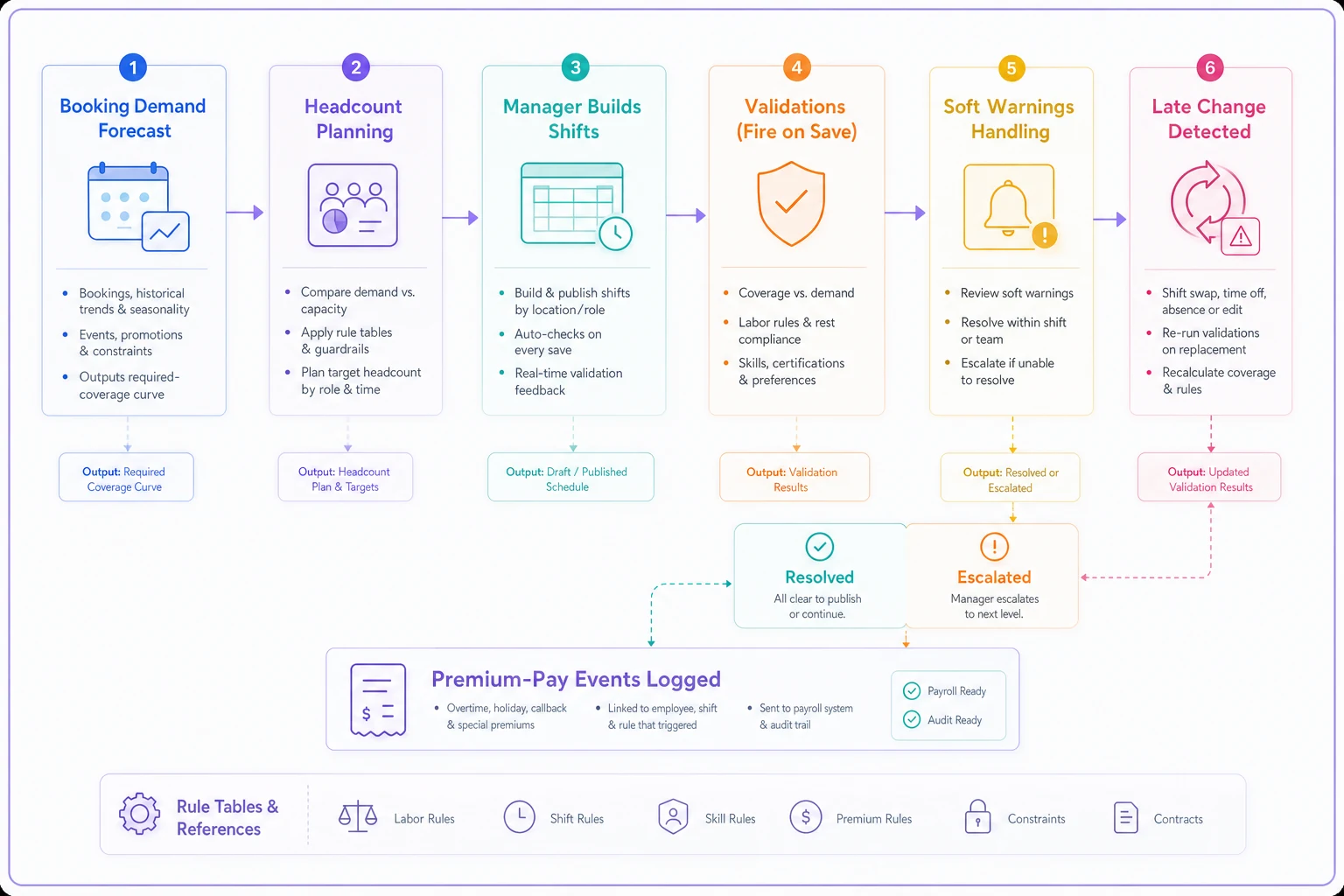
Every step in that chain is a place where a rule can get lost if something happens outside the system. The most common leak is that last one—the late change—because it happens under pressure and often in a side channel like a text message. That's not a workflow problem you can fix with a reminder; it's a system access problem.
A compliance-readiness checklist
Before you consider your labor compliance scheduling actually enforced rather than aspirational, run through this:
-
[ ] Every location is mapped to a jurisdiction rule type, not managed individually
-
[ ] Rule tables are versioned, with a named owner responsible for updates when laws change
-
[ ] Overtime validation aggregates across all locations an employee works, not per-roster
-
[ ] Rest-window checks span across days and across locations
-
[ ] Meal/break requirements prompt during scheduling, not just tracked after
-
[ ] Predictive-scheduling notice windows and late-change premiums are surfaced with cost estimates
-
[ ] On-call compensation triggers are defined and logged per jurisdiction
-
[ ] Every override produces a reason code and, above a cost threshold, an approver
-
[ ] Late changes and call-out replacements re-run the same validations as original shifts
-
[ ] Premium-pay events flow to payroll automatically, so the schedule and paycheck agree
If you can't check most of those, you're relying on memory somewhere—and memory is exactly what fails first as you grow.
When this level of rigor makes sense (and when it doesn't)
When it's worth building out fully: multiple locations, multiple jurisdictions, variable shifts, or any predictive-scheduling or union exposure. The complexity is real and the penalties compound. If you're running field crews across jurisdictions or any operation where employees float between sites, this isn't optional overhead—it's the difference between forecastable labor cost and random monthly surprises.
When lighter-weight is fine: a single location, single jurisdiction, stable schedule, mostly full-time staff. You still want overtime and rest-window validations, but you don't need the full multi-jurisdiction resolution engine. Encode the handful of rules that apply, run the basic checks, and don't over-engineer it.
Who should be careful before doing this: anyone treating it as a pure software project. The rule tables are the hard part, and they're a legal and operational question, not a technical one. Getting the parameters wrong—say, an incorrect overtime threshold—means confidently enforcing the wrong rule everywhere at once, which is worse than no automation. Have someone who actually understands your jurisdictions sign off on the tables before you enforce them.
Whatever you build, rolling it out is its own project. Managers who've enforced rules by memory for years will push back on a system that second-guesses their judgment, and if you drop it on them cold, they'll route around it. A well-run change-management rollout for scheduling policies and tools is what determines whether the validations actually get used or quietly get bypassed.
The real shift in thinking
The businesses that stay clean on labor compliance aren't the ones with the most careful managers. They're the ones who stopped depending on careful managers to catch everything. They moved the rules out of people's heads and into a place the schedule itself checks—rule tables that resolve the strictest requirement, validations that fire before payroll instead of after, and escalation paths that let humans make the hard calls while owning them on the record.
Fines and back-pay claims almost always trace back to the same thing: a rule that existed in the law but never got translated into something the scheduling process could actually see. Close that translation gap, connect it to how demand drives your roster, and most of the "how did this happen" overtime and compliance surprises simply stop happening—not because everyone got more disciplined, but because the system finally knew the rules as well as your best manager did, and never had an off day.
The businesses that stay clean on labor compliance aren't the ones with the most careful managers. They're the ones who stopped depending on careful managers to catch everything. They moved the rules out of people's heads and into a place the schedule itself checks—rule tables that resolve the strictest requirement, validations that fire before payroll instead of after, and escalation paths that let humans make the hard calls while owning them on the record.
Fines and back-pay claims almost always trace back to the same thing: a rule that existed in the law but never got translated into something the scheduling process could actually see. Close that translation gap, connect it to how demand drives your roster, and most of the "how did this happen" overtime and compliance surprises simply stop happening—not because everyone got more disciplined, but because the system finally knew the rules as well as your best manager did, and never had an off day.
Ready to optimize your scheduling and operations?
Join thousands of businesses using Schedily to save time, improve coordination, and enhance operational efficiency.