

Most staffing problems in appointment businesses aren't really staffing problems. They're translation problems. The booking data is sitting right there — the no-show patterns, the Tuesday-morning dead zones, the December spike that hits every year — and somewhere between that data and the actual schedule, the signal gets lost. Someone eyeballs last month, adds a body "just in case," and calls it a plan.
That gap is where money leaks. Overstaffed on slow days, scrambling on busy ones, and nobody can say why the numbers never feel right.
What makes staffing genuinely difficult isn't any single decision — it's that forecasting, skill mapping, float-pool design, shift templates, and hiring timelines are all connected. When you treat them as separate tasks owned by separate people, the seams fail. A solid appointment staffing strategy means wiring these five things together so a change in one actually updates the others.
Below is how the whole system connects, where it breaks as you grow, and how to turn raw booking signals into a staffing plan with real numbers behind it.
The five parts nobody connects properly
Most appointment businesses handle each piece in isolation — usually by a different person, often in a different tool.
-
Forecasting lives in the owner's head or a spreadsheet nobody trusts
-
Skill mapping exists informally ("don't book color with the new stylist")
-
Float-pool design is "call whoever answers"
-
Shift templates are copy-pasted from last quarter
-
Hiring timelines are reactive — you hire after you're already drowning
When these operate separately, predictable failures follow. The forecast says December needs 30% more capacity, but hiring didn't start until November and new staff aren't productive until January. The skill map says only two people can do the high-margin service, but the shift template has them both off on Saturdays. The float pool exists on paper but nobody defined who qualifies to cover what.
None of these failures are loud. They quietly misalign, and the symptom surfaces as "we're always short" or "payroll is too high" without a clear cause.
An integrated approach means a forecast doesn't just produce a number — it feeds the skill requirements, which shape the shift template, which exposes coverage gaps, which define the float-pool rules, which set the hiring timeline. One chain, not five islands.
Start with booking signals, not headcount
The mistake most owners make is starting with "how many people do I need?" That's the last question, not the first.
Eliminate scheduling conflicts and missed meetings.
Schedily helps you organize and manage all appointments and team availability effortlessly.
- Unified appointment and resource management
- Automated notifications & reminders
- Team calendar synchronization
No credit card required
Start with the booking signals — the raw operational truths your calendar already knows:
-
Demand shape — how bookings distribute across hours, days, weeks, and seasons
-
Service mix — what percentage of appointments require which skills
-
Lead time — how far ahead people book (tells you how much warning you actually get)
-
No-show and cancellation rates — by service type and time slot
-
Duration variance — how long appointments actually take vs. what's blocked
Here's a worked example. A mid-sized clinic pulls six months of history and finds:
-
Roughly 1,400 appointments per month
-
Peak demand Tuesday–Thursday, 9am–1pm
-
About 22% of bookings require a high-skill service only three staff can perform
-
No-show rate around 9%, climbing to ~14% for first-time patients
-
Average booking lead time of 11 days
That's not a staffing plan yet, but it's the raw material. The 9% no-show rate means effective demand is lower than booked demand — staffing to booked volume overstaffs you by nearly a tenth. The 22% high-skill share with only three qualified staff is a bottleneck in waiting. The 11-day lead time tells you how reactive you can realistically afford to be.
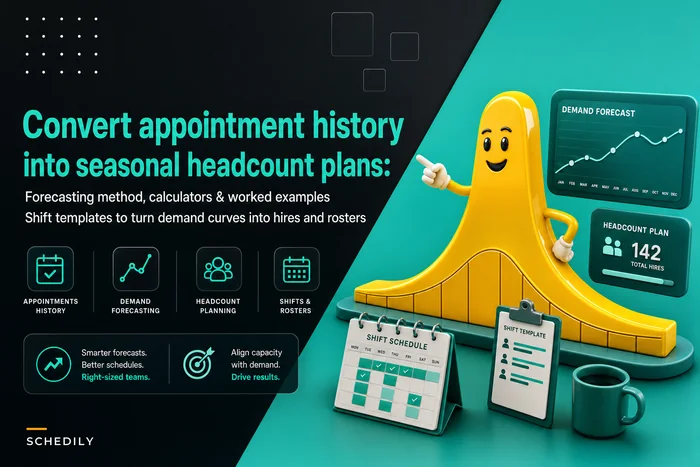
For the full method on turning raw history into forward-looking numbers, we covered that separately in turning appointment history into seasonal headcount plans. This article assumes you have a forecast and focuses on what you do with it.
Converting the forecast into required coverage
A forecast of "1,400 appointments next month" is useless until you convert it into coverage by skill and time slot. This is the step that gets skipped most often, and it's the one that matters most.
The conversion, in order:
-
Break demand into time blocks. Split the week into the smallest meaningful unit — usually 2-hour or half-day blocks — and assign forecasted appointment volume to each.
-
Apply the no-show discount. Multiply booked demand by (1 − no-show rate) per slot type. First-time-heavy slots get a steeper discount.
-
Split by skill requirement. Within each block, separate demand by the skill it needs. The high-skill 22% gets isolated here.
-
Convert to person-hours. Using real average durations — not blocked durations — calculate how many productive person-hours each block requires.
-
Add a utilization buffer. Nobody is productive 100% of the time. Most appointment operations run healthy at 75–85% utilization. Divide required productive hours by your target utilization to get scheduled hours.
A quick numeric pass on one block. Say Tuesday 9–11am forecasts 40 booked appointments, 25% of which are high-skill:
-
After a 10% no-show discount
~36 effective appointments
-
High-skill share
~9 appointments → at 45 min each, roughly 6.75 person-hours
-
Standard share
~27 appointments → at 30 min each, about 13.5 person-hours
-
At 80% target utilization
high-skill needs ~8.4 scheduled hours, standard needs ~17 scheduled hours
Now you know what that block actually requires — not just "about four people." You need coverage that includes at least one or two of your three high-skill staff, plus standard coverage. That precision is what lets you build a shift template that matches demand rather than smoothing everything into a flat headcount.
Skill mapping: the constraint that quietly caps your revenue
Most appointment businesses underestimate how much their skill distribution limits them. You can have plenty of people available and still turn away your highest-margin work because only two staff can do it and they're both booked out.
A skill map is simple to build and surprisingly revealing:
| Staff member | Standard service | High-margin service | Specialized/certified | Can train others |
|---|---|---|---|---|
| Staff A | ✓ | ✓ | ✓ | ✓ |
| Staff B | ✓ | ✓ | — | — |
| Staff C | ✓ | ✓ | ✓ | — |
| Staff D | ✓ | — | — | — |
| Staff E (new) | ✓ (ramping) | — | — | — |
The constraint jumps out immediately: the specialized service depends entirely on A and C. If A takes a week off, specialized capacity drops by half. If both are out, it's zero. No forecast fixes that — only cross-training does.
Skill concentration is a hidden single point of failure. Businesses forecast demand accurately and then get blindsided because the work they anticipated required a skill only one or two people have. The forecast was right. The capacity wasn't there.
Two rules worth building around:
-
No revenue-critical skill should sit with fewer than three people once you're past a handful of staff
-
Every shift template should guarantee minimum coverage per skill, not just per headcount
Skill mapping is also what makes a float pool actually functional — a pool of people who can't perform the work you're short on is just a list of names.
Float-pool design: rules, not vibes
The float pool is the part every business has in theory and almost nobody has actually designed. "We'll call someone" isn't a float pool. It's a hope.
A real float pool has defined rules:
-
Who qualifies. Which float staff can cover which skills, tied directly to your skill map
-
Activation triggers. At what point does a gap warrant a float call — one no-show, two, a same-day cancellation during peak?
-
Order of activation. Who gets called first and why — proximity, cost, skill match, fairness rotation
-
Response windows. How long you wait before moving to the next person
-
Cost rules. Float coverage often costs more. Define when it's worth it and when you absorb the gap
Booking signals make this concrete. If your data shows peak-hour no-shows cost around $140 in lost slot revenue, and float coverage runs about $45/hour at a premium rate, the rule practically writes itself: activate the float pool for any peak-block gap, because the lost revenue outweighs the coverage cost by a wide margin. For off-peak gaps where a walk-in might fill the slot anyway, you hold.
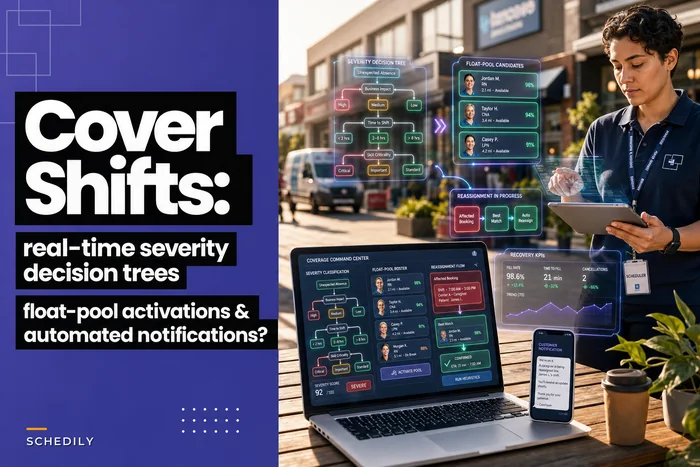
The connection between float-pool design and real-time execution is where a lot of plans fall apart — a well-designed pool is useless if activating it takes 40 minutes of phone tag. We covered the execution side in real-time shift triage for unexpected absenteeism, including how to structure activation sequences so coverage happens fast instead of chaotically.
When a float pool doesn't make sense
Not every business needs one. A two-person operation's float pool is the two of them. If demand is highly stable with near-zero no-shows, the overhead of maintaining a pool may cost more than the occasional gap ever would. Float pools earn their keep when there's genuine demand volatility, meaningful no-show rates, and enough volume that unfilled slots represent real lost revenue.
Activate the float pool for peak-block gaps when the expected lost slot revenue exceeds the marginal cost of float coverage.
Not every business needs one. A two-person operation's float pool is the two of them. If demand is highly stable with near-zero no-shows, the overhead of maintaining a pool may cost more than the occasional gap ever would. Float pools earn their keep when there's genuine demand volatility, meaningful no-show rates, and enough volume that unfilled slots represent real lost revenue.
Shift templates: where the plan meets reality
Shift templates are the physical expression of everything above. A good template isn't a static grid — it's the forecast, skill map, and float rules compressed into an actual weekly schedule.
Templates that work tend to share a few traits:
-
They guarantee minimum skill coverage per block, not just headcount
-
They stagger start times to match demand shape instead of everyone clocking in simultaneously
-
They build in overlap during peak transitions so handoffs don't create gaps
-
They designate who's "primary" and who's "flex" within each shift
A common failure: templates built around staff preferences rather than demand. Everyone wants Saturdays off, so Saturday ends up thinly covered — often your highest-demand day. The template should start from demand and negotiate preferences within those constraints, not the other way around.
Templates also go stale. A schedule built in spring doesn't fit fall demand patterns. The forecast changes seasonally and the template has to move with it. Treat them as living documents tied to your forecasting cycle, not permanent fixtures.
Hiring and ramp timelines: the part that's always late
This is the piece that quietly sinks the whole system. You can forecast demand accurately and design solid templates, but if you start hiring the week things get busy, you've already lost.
The math most owners skip: productive capacity lags hiring by weeks. A new hire isn't full-speed on day one. There's recruiting time, onboarding, and a ramp period before they're carrying a normal load — and even longer before they can handle high-skill work.
A realistic timeline looks something like:
-
Posting to offer
2–4 weeks
-
Offer to start date
1–2 weeks
-
Start to standard-service productivity
2–4 weeks
-
Standard to high-skill competency
1–3 months (if they get there at all)
Add that up. If December peak needs more high-skill capacity, and reaching that competency takes two months on top of six weeks of hiring and onboarding, the process needs to start in September. Not November. By November it's too late for anyone who needs to perform specialized work.
Hiring timelines have to be driven by the forecast, working backward. Take the date you need capacity, subtract the full ramp timeline, and that's your hire-by date. Working forward — "we're getting busy, let's hire" — guarantees you're perpetually behind.
One nuance worth separating out: you can hire for standard capacity later and usually be fine, because the ramp is short. High-skill capacity has to be planned a quarter ahead. Treating both the same is why businesses end up with plenty of hands and not enough qualified ones when it matters most.
A real scenario: the clinic that was always short
A multi-provider wellness clinic — about 1,200 monthly appointments across five providers — kept hitting the same wall every quarter. Overstaffed on Mondays, underwater Tuesday–Thursday mornings. Payroll ran high, yet they were still turning away their highest-margin service because only two providers could deliver it and both were routinely booked solid.
When they pulled their booking signals apart, the picture was straightforward:
-
Monday demand was running at roughly 60% of what they'd staffed for
-
The high-margin service made up about a fifth of demand but had zero coverage redundancy
-
No-shows were erasing close to 10% of booked slots, meaning they'd been staffing against inflated demand the whole time
The changes weren't dramatic. They rebuilt shift templates from the actual demand shape — thinner Mondays, heavier Tue–Thu mornings with staggered starts. They cross-trained a third provider on the high-margin service over about two months. They defined a simple float rule for peak-block no-shows.
Over the following couple of quarters, the overstaffed days tightened, payroll pressure eased noticeably, and the high-margin service stopped bottlenecking because a third person could finally cover it. Nothing exotic — just five pieces wired together instead of managed separately. The data had been telling them this the whole time.
Where tooling actually helps (and where it doesn't)
You can run this entire system in spreadsheets, and plenty of small operations do. The spreadsheet approach breaks at a predictable point: when the pieces stop fitting in one person's head.
Once your forecast needs to automatically update coverage requirements, which update templates, which trigger float rules and flag hiring gaps — manual coordination starts dropping signals. The forecast changes, nobody updates the template, and you're back to guessing.
Operational platforms that connect booking data to staffing decisions are useful precisely here — not because they're clever, but because they keep the chain intact. When booking signals flow directly into coverage math and gaps surface against your skill map without someone having to manually cross-reference everything, you stop losing the translation between "the data says" and "the schedule shows." The point isn't automation for its own sake. It's keeping five connected decisions actually connected as volume grows.
Where tooling doesn't help: it won't fix a skill concentration problem, and it won't make a hiring decision. It surfaces the gap earlier. You still have to act on it.
How this evolves as you grow
The system changes shape depending on where you are operationally:
-
Small (1–5 staff) Forecasting is informal, the float pool is each other, and the owner holds skill mapping in their head. This is fine for a while — the risk is invisibility. When someone leaves, the knowledge leaves with them.
-
Mid (6–20 staff) This is where the seams fail. The owner can no longer hold it all mentally, but no formal system has replaced the intuition. Skill concentration becomes a real risk, and hiring timelines start mattering because ramp lag is now expensive.
-
Larger (20+) All five pieces need to be formalized and connected, with clear ownership. Templates become living documents, float pools need actual rules, and hiring has to run a full quarter ahead of demand.
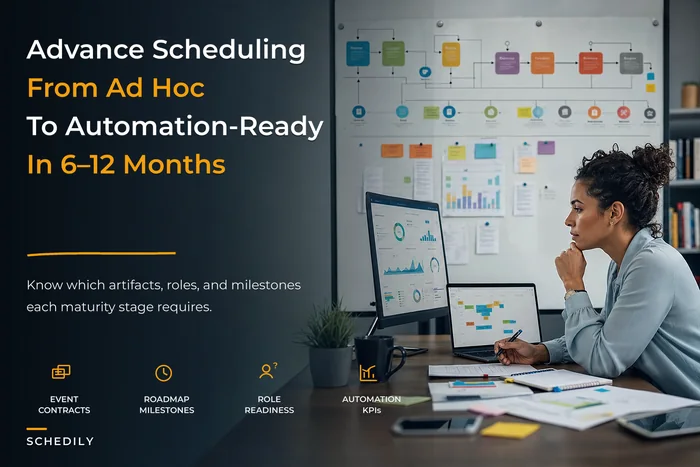
If you want a structured way to assess where you sit and what to build next, we laid out the stages in the scheduling operational maturity model. Most staffing pain comes from running a mid-stage operation on small-stage habits.
Pulling it together
The reason staffing feels like perpetual guesswork usually isn't a lack of data — it's that the data never gets translated into a connected plan. Forecasting produces a number that dies in a spreadsheet. The skill map lives in someone's memory. The float pool is a phone list. The templates are stale. And hiring starts after the pain, not before it.
A real appointment staffing strategy connects all five: booking signals feed the forecast, the forecast defines coverage by skill, coverage shapes the templates, the gaps define float rules, and the whole thing works backward into hiring timelines. Change one, and the rest should move with it.
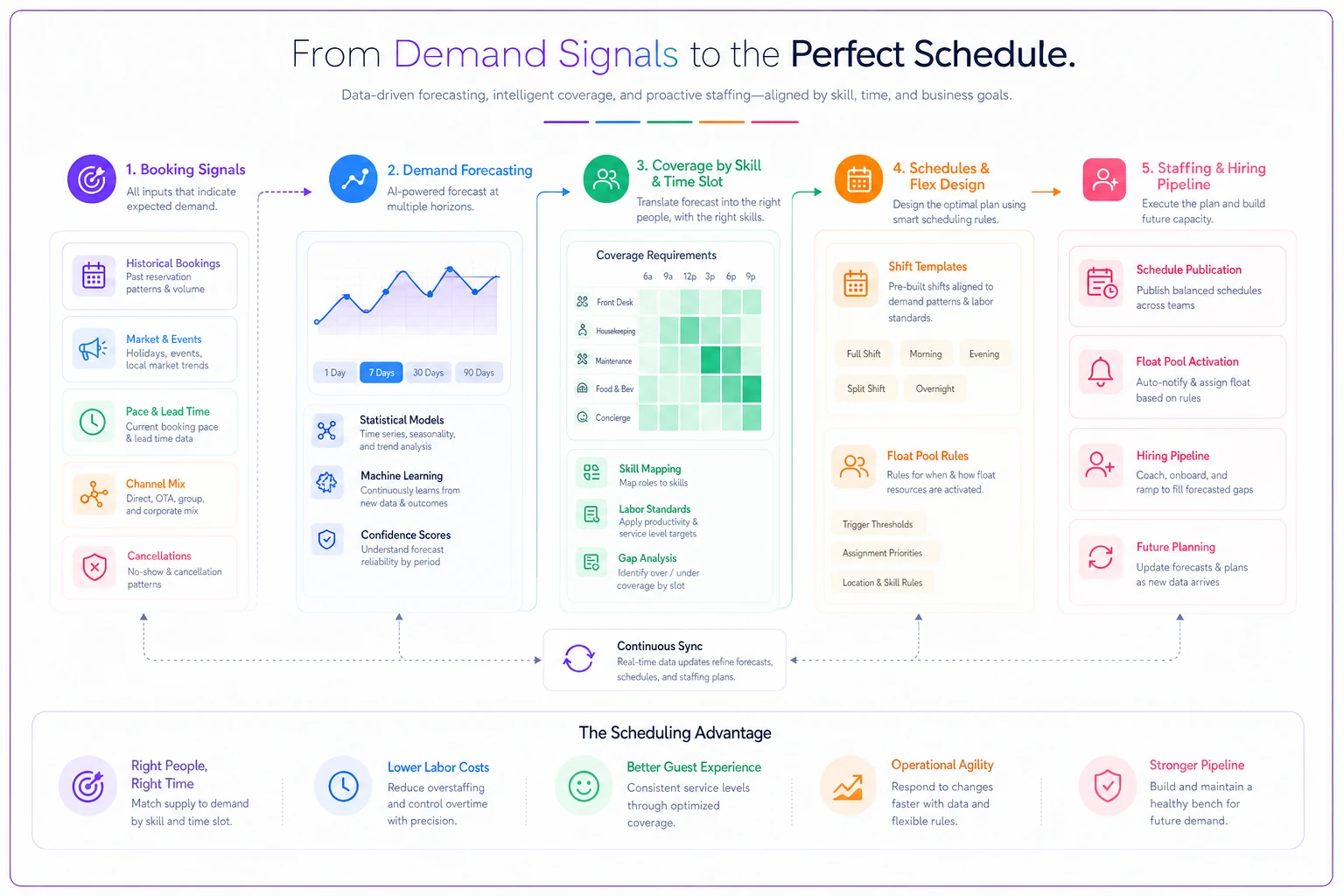
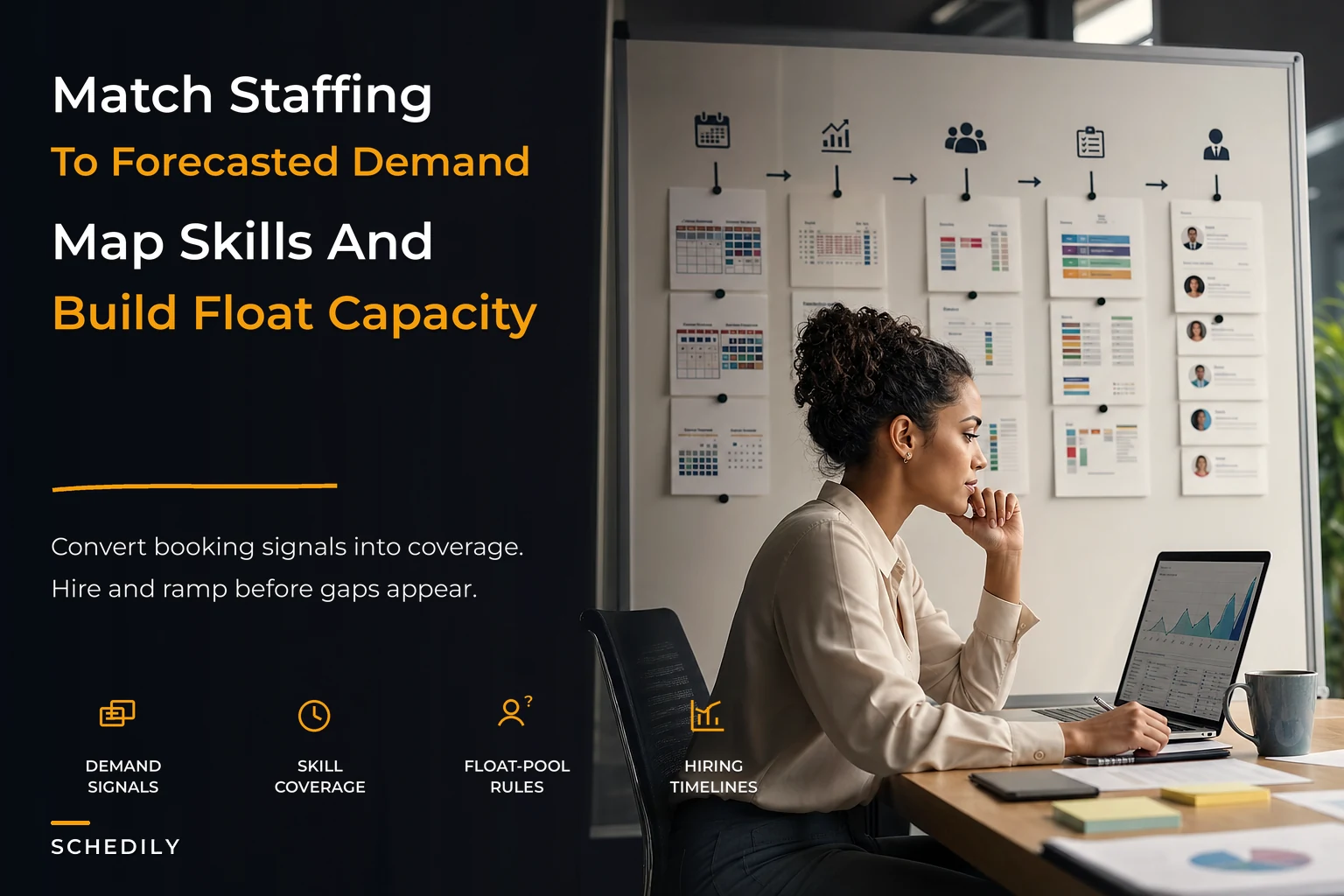
The diagram shows the process end-to-end so teams can see how a signal in bookings should ripple through to hiring timelines.
Start by pulling your actual booking signals apart — demand shape, no-show rates, skill mix, lead times. Convert them into coverage requirements before you think about headcount. Build your skill map and find your single points of failure. Then let the templates, float rules, and hiring dates fall out of that work. It's more deliberate than eyeballing last month, but it's the difference between always being short and actually matching your team to your demand.
Start by pulling your actual booking signals apart — demand shape, no-show rates, skill mix, lead times. Convert them into coverage requirements before you think about headcount. Build your skill map and find your single points of failure. Then let the templates, float rules, and hiring dates fall out of that work. It's more deliberate than eyeballing last month, but it's the difference between always being short and actually matching your team to your demand.
Ready to optimize your scheduling and operations?
Join thousands of businesses using Schedily to save time, improve coordination, and enhance operational efficiency.